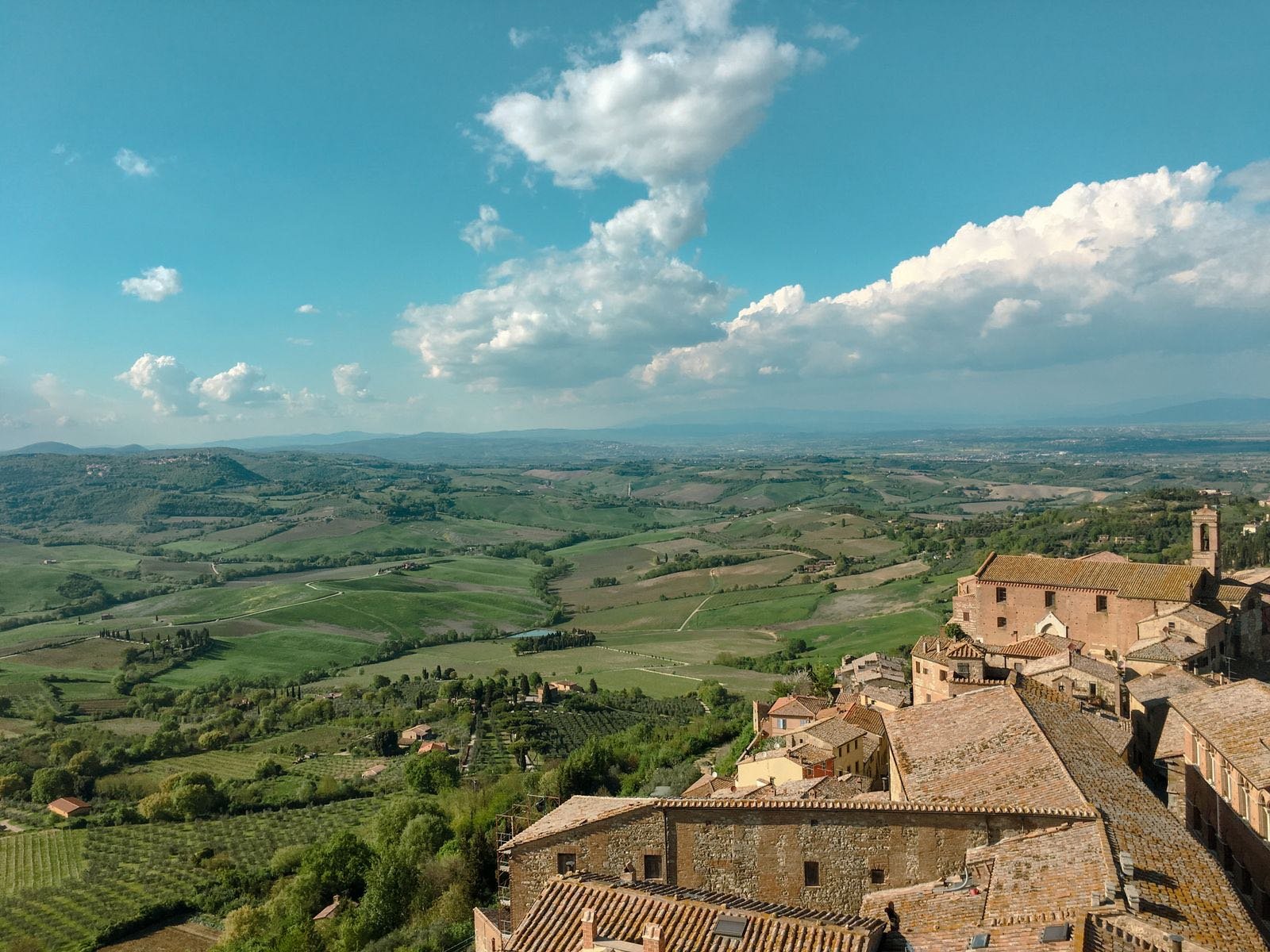
The best hill towns in Italy are Orvieto, Assisi, Perugia, Arezzo, Ostuni, Matera and Alberobello. All seven can be reached by train or regional bus from a major city. Each rewards a half day or more, and they cluster in Umbria, Tuscany and Puglia, so you can combine several in one trip.
Hill towns exist because medieval Italians built on high ground for defence and to escape malaria in the valleys. That is why most share the same pattern: a walled centre, a steep climb, a central square and views over farmland. Below we rank seven by atmosphere, accessibility and how much there is to do, with practical details for each.
1. Orvieto, Umbria
Orvieto sits on a flat tuff plateau with cliffs on every side, and it is the easiest hill town to reach from Rome. Trains take about an hour and a quarter, and a funicular runs from the station up to the old town. The Gothic cathedral, begun in 1290, has a mosaic-covered facade that glows in late afternoon light. Underground, the Orvieto Underground tours explore Etruscan-era cellars and quarries cut into the rock, and the Pozzo di San Patrizio is a 16th-century well with a double spiral staircase.
Local tip: book the underground tour for the first slot of the day to avoid the coach groups that arrive around late morning.
Read our Orvieto city guide, see things to do in Orvieto or browse Orvieto tours. If you want to stay overnight, compare Orvieto hotels.
2. Assisi, Umbria
Assisi is the pilgrimage town of Saint Francis, and the Basilica of San Francesco is the reason most people come. The basilica and other Franciscan sites were inscribed by UNESCO in 2000. Entry to the basilica is free, though dress rules apply (covered shoulders and knees). Above the town, the Rocca Maggiore fortress gives a wide view over the Umbrian plain, and the lanes are built from pink and white Subasio stone.
The main train station sits in Santa Maria degli Angeli in the valley, so allow time for the short bus ride up to the old town. Evenings are the best time, after the day groups leave.
Plan with our Assisi guide, the things to do in Assisi page and Assisi tours.
3. Perugia, Umbria
Perugia is the largest hill town on this list and the most lively, thanks to a big student population. The Fontana Maggiore in Piazza IV Novembre dates to the 13th century, the Etruscan Arch marks one of the old city gates, and the Rocca Paolina is a papal fortress whose underground streets now serve as escalators and walkways. The hilltop setting means plenty of stairs, but an urban mini-metro and escalators help.
Perugia works well as an Umbrian base because it has regional trains to Assisi and onward connections to Rome and Florence.
See Perugia city guide, the Perugia day trips page, or Perugia tours. Our 5 day Umbria itinerary links the towns in this section.
4. Arezzo, Tuscany
Arezzo gets far fewer visitors than Siena or San Gimignano, which is its appeal. The sloping Piazza Grande is lined with medieval and Renaissance buildings, and the Basilica of San Francesco holds Piero della Francesca’s fresco cycle, the Legend of the True Cross. Book a timed slot for the frescoes in advance, because only small groups enter at once.
Local tip: the Fiera Antiquaria, the antiques fair, runs on the first Sunday of each month and the Saturday before, and fills Piazza Grande and the surrounding streets.
Start with the Arezzo guide, our page on where to eat in Arezzo and Arezzo tours.
5. Ostuni, Puglia
Ostuni is the White City, a whitewashed old town stacked on three hills about 8 km from the Adriatic. Climb to the 15th-century cathedral, then wander the lanes where arches connect the houses. Ostuni has plenty of restaurants in converted cellars and rooftop terraces, and the beaches of the Costa Merlata are a short drive away.
The town is best at golden hour when the walls turn pink, and it is quieter outside July and August. A regional train runs along the coast, but a car makes the countryside around Ostuni easier.
Read the Ostuni guide, the Ostuni things to do page, where to stay in Ostuni and Ostuni tours.
6. Matera, Basilicata
Matera is built around the Sassi, two districts of cave dwellings cut into a ravine. The Sassi were inscribed by UNESCO in 1993 and Matera was European Capital of Culture in 2019. The city has no airport, and the usual route is by bus or train from Bari, which takes roughly an hour and a half. Many cave houses are now hotels and restaurants, and rock-hewn churches with Byzantine frescoes sit across the ravine.
Stay a night if you can, because the Sassi look best after dark when the day trippers leave.
Use our Matera guide, the Matera things to do page and Matera tours to plan a visit, and find Matera hotels.
7. Alberobello, Puglia
Alberobello is known for its trulli, conical dry-stone houses with grey roofs, and the Rione Monti and Aia Piccola districts were inscribed by UNESCO in 1996. Rione Monti has the busiest streets and the most shops; Aia Piccola is quieter and more residential. A day is enough, and many travellers sleep in a trullo for the experience.
Local tip: go early in the morning or after 5pm, when tour coaches have left and shop owners have more time to chat.
Our Alberobello guide covers what to do, the Alberobello things to do page lists specifics, and you can browse Alberobello tours or Alberobello stays.
How to combine the towns
Orvieto, Assisi and Perugia link naturally in Umbria. Arezzo fits a Tuscany itinerary alongside Siena and Florence. The Puglia trio of Ostuni, Alberobello and Matera takes about four days with a car. For a wider look at regions, see the Umbria region guide and the Puglia region guide. For national tourism information, the official Italian tourism site lists regional events.
Prices change, so check opening times and ticket fees on each site before you travel; entry fees quoted online vary by season.