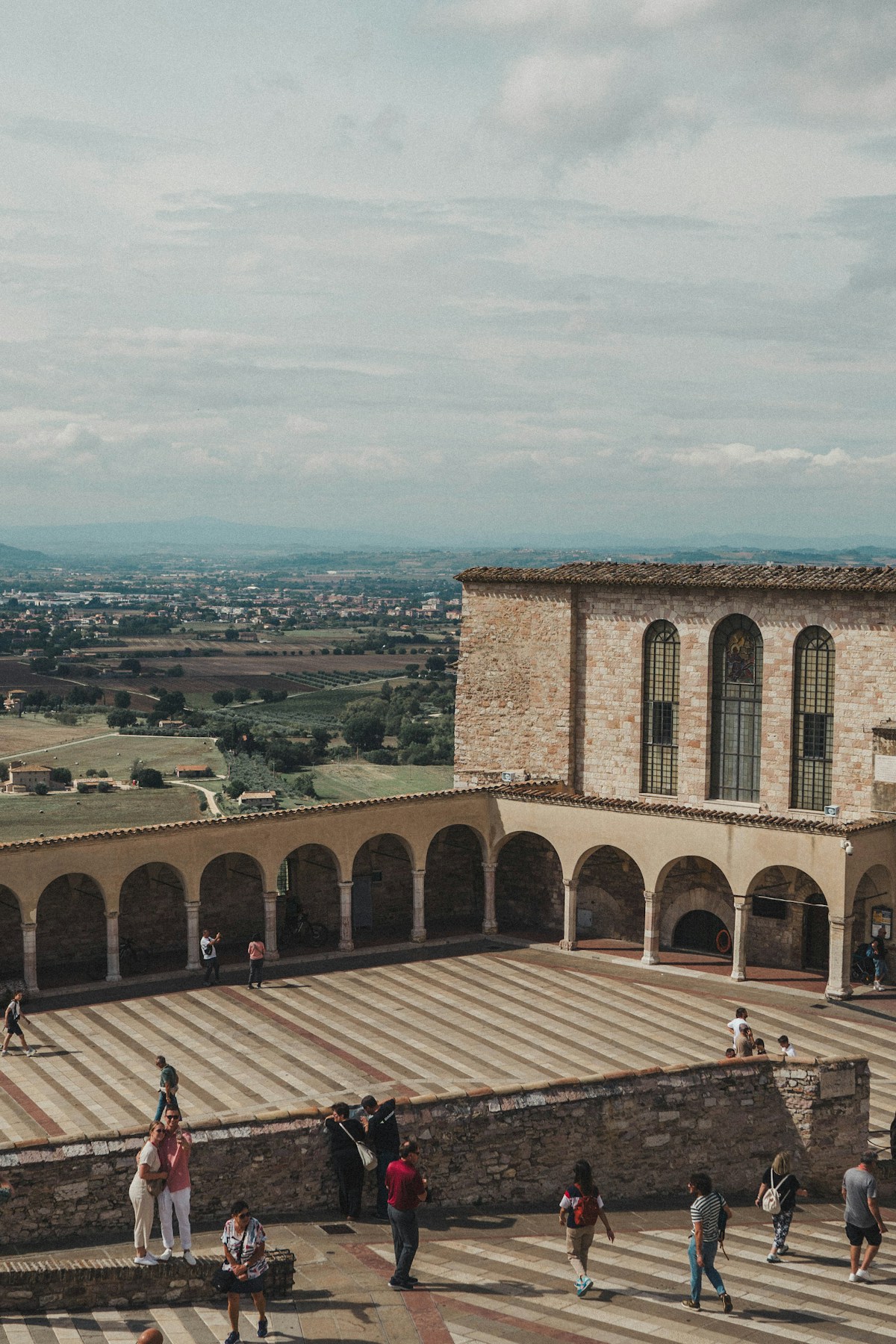
Assisi is one of the most important sites in Italian Christianity - the birthplace of St Francis (1181/2–1226) and the location of the Basilica built in his honour two years after his death, decorated with frescoes by the greatest painters of the 13th and 14th centuries. It is also a beautiful medieval hilltop town, compact enough to explore in a day and comfortable enough to stay overnight.
Basilica of St Francis (Basilica di San Francesco)
The reason to come to Assisi. The Basilica is actually two churches on top of each other:
Upper Church: Built 1230–1253 in the French Gothic style. The nave walls carry Giotto’s 28-scene fresco cycle of the Life of St Francis (c.1296–1300), the most important cycle in the history of Italian painting. Giotto’s humanisation of the figures - the weight, the emotion, the spatial coherence - marks the decisive transition from Byzantine to Renaissance painting. The scenes depicting the saint preaching to the birds, receiving the stigmata, and appearing to the friars in Arles are the most famous.
Lower Church: Darker, more intimate, earlier (begun 1228). Simone Martini’s frescoes in the Chapel of St Martin (1322–1326) and Cimabue’s Madonna Enthroned in the right transept. The crypt beneath holds the tomb of St Francis.
Entry to the Basilica is free. Dress code is strictly enforced - knees and shoulders covered. Photography without flash is permitted.
The town of Assisi
The medieval town on the slope of Monte Subasio is genuinely beautiful - pink and grey limestone buildings, steep lanes, and views across the Umbrian plain. The main sites beyond the Basilica:
Cathedral of San Rufino (Cattedrale di San Rufino) - the Romanesque cathedral where St Francis was baptised, with an exceptional rose window facade. The crypt dates to the 3rd century.
Basilica of Santa Chiara - the church dedicated to Clare of Assisi, Francis’s companion and founder of the Poor Clares. In the crypt: the body of St Clare, visible under glass.
Rocca Maggiore - the 14th-century fortress above the town. The views from the towers over Assisi and the Umbrian plain are exceptional.
Piazza del Comune - the central square, built over the Roman forum. The Temple of Minerva (1st century BC, now a church) has a complete Roman facade incorporated into the square.
Hermitage of the Prisons (Eremo delle Carceri)
A 5km walk or short drive up Monte Subasio above Assisi. A small 14th-century Franciscan hermitage in a natural cliff cave where Francis used to retreat for contemplation. The cave and the simple rooms of the early community are preserved. A forest walk continues to the summit of Monte Subasio (1,290m). Free entry.
Basilica of Santa Maria degli Angeli
2km below the hill town, in the plain. A large 16th-century basilica built around the Porziuncula - the tiny stone chapel where Francis first heard his vocation, where he died, and which is the founding church of the Franciscan Order. The chapel still stands intact inside the massive baroque basilica. Free entry.
St Francis and the Franciscan Order
Francis of Assisi (1181/2–1226) was the son of a wealthy cloth merchant who renounced his inheritance, embraced absolute poverty, and founded a religious order based on simplicity, love of creation, and care for the poor. He received the stigmata (the wounds of Christ) in 1224, the first person in Christian history for whom this was recorded. He was canonised in 1228, two years after his death.
The Franciscan Order he founded became one of the most significant institutions in medieval Europe, establishing universities, building churches, and transforming European intellectual life. Giotto, Dante, and virtually all 14th-century cultural life in Italy was shaped by the Franciscan movement.
Day trips from Assisi
Spello (12km) - a smaller Umbrian hill town with Roman walls and Pinturicchio frescoes in the Baglioni Chapel (1501).
Perugia (25km) - Umbria’s capital, with the National Gallery and Perugino paintings.
Bevagna (18km) - a remarkably well-preserved Roman and medieval town on the Via Flaminia with mosaics from Roman baths visible through gratings in the street.
For guided walking tours, day trips, and Franciscan heritage experiences in and around Assisi, browse tours of Assisi.
Book Assisi Tours on GetYourGuide
| Tour | Duration | From price | Highlights |
|---|---|---|---|
| Assisi guided walking tour — Basilica and medieval town | 2.5 hrs | From €25 | Basilica of St Francis, Giotto frescoes, Piazza del Comune |
| Assisi half-day tour from Perugia | 4 hrs | From €35 | Return transfer, Basilica, town walk with guide |
| Assisi and Perugia full-day tour from Rome | 11 hrs | From €90 | Both Umbrian cities, transport included, small group |
Browse all Assisi tours on GetYourGuide →
Back to the full Assisi travel guide for the Basilica di San Francesco, Giotto’s frescoes, and practical planning. For Assisi accommodation, see best hotels in Assisi. For day trips from Assisi to Perugia, Orvieto, and Spoleto, see day trips from Assisi. For the medieval Italian context - the Italian city-states, the Church, and the art tradition Giotto helped launch - our guide to medieval Italy provides the background. For the Umbrian circuit, Perugia and Orvieto each have dedicated guides.
Where to stay in Assisi: Find hotels in Assisi — search accommodation across all budgets.