Matera Travel Guide: The Ancient Cave City of Basilicata
Your guide to Matera: the sassi cave dwellings, one of the world's oldest inhabited cities, cave hotels, and the Basilicata plateau.
Guides for Matera
Matera is one of the oldest continuously inhabited settlements on earth - people have lived in the cave dwellings (sassi) carved into the ravines here for at least 9,000 years. In 1993 the sassi were declared a UNESCO World Heritage Site; by 2019, when Matera was European Capital of Culture, it had transformed from a byword for poverty (the Italian government forcibly relocated its cave-dwelling population in the 1950s, after Carlo Levi’s Christ Stopped at Eboli drew national attention to the conditions) into one of Italy’s most compelling destinations.
The sassi
The city’s two main cave districts - Sasso Caveoso (the southern quarter) and Sasso Barisano (the northern quarter) - are carved into the walls of a deep ravine (the Gravina) and built in tiers on the slopes above. Churches, homes, cisterns, and grain stores have been excavated from the tuff rock over millennia. Roughly 150 ancient rock churches (chiese rupestri) survive in and around the ravine, some with Byzantine frescoes dating to the 8th–13th centuries.
Casa Grotta di Vico Solitario - A restored cave dwelling showing how families lived in the sassi until the 1950s evacuation. A single room shared by a family, their animals, and a cistern for rainwater collection. Entry approximately €5 as of 2026. Open daily 9:30am–7pm (summer), 9:30am–5pm (winter). The most accessible way to understand sassi life.
MUSMA (Museo della Scultura Contemporanea Matera, Via San Giacomo) - A contemporary sculpture museum inside a cave complex. The combination of ancient rock spaces and modern art works surprisingly well. Entry approximately €7. Closed Monday.
Chiesa di Santa Maria de Idris - A rock church carved into the peak of the Monterrone limestone cone, with 12th–17th century frescoes. Entry approximately €5. The views from the church entrance are extraordinary.
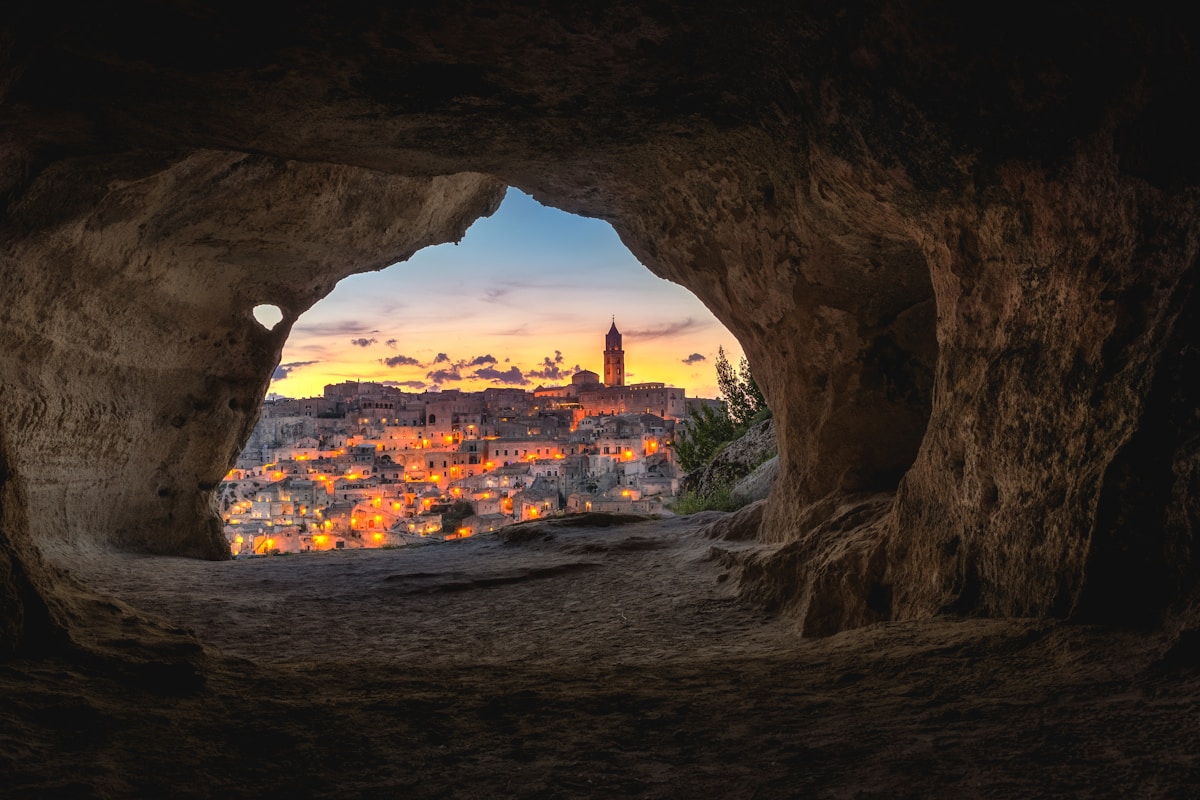
The best way to explore is on foot. The view from Via Bruno Buozzi at the edge of the ravine gives the full panorama of the Sasso Caveoso. For the opposite perspective, cross the ravine to the Murgia Timone plateau via the footbridge - the view back towards the city, particularly at sunset, is the most photographed scene in Basilicata. The walk takes approximately 30 minutes each way.
Staying in the sassi
Many of the cave dwellings have been converted into hotels and B&Bs - some of the most unusual accommodation in Italy. Staying in a cave hotel here (with electricity, plumbing, and usually excellent wifi) is genuinely worth doing. Budget cave rooms from approximately €50–80/night. Mid-range cave hotels approximately €80–150/night. Sextantio Le Grotte della Civita (Via Civita 28 - doubles from approximately €200/night) is the most distinctive, using 18 cave rooms restored with minimal intervention. Palazzo Gattini (Piazza Duomo - doubles from approximately €180/night) overlooks the Cathedral from a converted palazzo.
Food
Basilicata is one of Italy’s least-known food regions. Crapiata (pulse and grain soup - fava beans, chickpeas, lentils, wheat, and barley slow-cooked together) is the most traditional Matera dish. Pane di Matera (Matera bread, IGP-protected) is a large, dense loaf made from durum wheat semolina and baked in wood-fired ovens - it keeps for days and is served with everything. Peperoni cruschi (dried sweet peppers, fried until crispy) are the defining garnish of Basilicata cuisine.
Named restaurants: Oi Marì (Via Fiorentini 66 - traditional Basilicata, mains approximately €10–14), Baccanti (Via Sant’Angelo 58–61 - cave restaurant, mains approximately €14–18), Trattoria del Caveoso (Piazzetta San Pietro Caveoso 8 - panoramic terrace, mains approximately €12–16).
The local wines are Aglianico del Vulture (a powerful red from the volcanic slopes of Monte Vulture, north of Matera) and Primitivo (grown in the adjacent Puglia region). Both are excellent value.
Getting there
Matera has no station on the national rail network. From Bari: the Pugliairbus/Marozzi bus runs directly from Bari Centrale station to Matera (approximately 90 minutes, from approximately €5, multiple daily departures). The FAL regional railway from Bari to Matera via Altamura runs approximately hourly but is slower (approximately 2 hours). From Naples: direct Marozzi bus (approximately 4 hours). By car: Matera is approximately 65km south-west of Bari via the SS96/SS99 (approximately 1 hour).
Practical planning
How long to allow: One night minimum; two nights is better. The sassi look completely different at different times of day - early morning light (before 9am when tour groups arrive) and the hour before sunset are when the stone glows most distinctly. An evening in the sassi after the day visitors leave is the most rewarding experience the city offers.
What the sassi actually are: The word means “stones” in Italian, but the sassi are not just cave dwellings - they are a complete urban system, with neighbourhoods, churches, cisterns, and lanes that evolved over millennia. The 1952–1956 forced relocation emptied the population to public housing on the plateau above; the houses now serve as hotels, restaurants, and museums. Many Materani view the relocation as a cultural rupture; others see it as a necessary public health intervention. Both are true.
Getting around: The main belvedere viewpoints are on Via Bruno Buozzi (for the Sasso Caveoso) and Via D’Addozio (for the Sasso Barisano). The sassi lanes are steep and largely unpaved - comfortable footwear is essential. Most cave churches and museums charge approximately €3–8 individually; a combined ticket for several rupestrian churches costs approximately €14–16 and is available from the Matera tourist office.
Rock churches (chiese rupestri): The most accessible are Santa Lucia alle Malve (the oldest, with 8th-century Byzantine frescoes), Madonna delle Virtù and San Nicola dei Greci (adjacent caves, now used for exhibitions), and Santa Barbara (on the plateau edge). The Cripta del Peccato Originale (Cave of the Original Sin, approximately 15km north of Matera near Picciano) has the finest Byzantine frescoes in Basilicata - book guided visits at parcoscenicorupestre.it (approximately €10, guided only).
For the full things-to-do breakdown: things to do in Matera. Book a guided tour of Matera to explore the sassi, rock churches, and the Gravina ravine with a local expert. For accommodation - cave hotels, sasso conversions, and budget options: Matera hotels guide. For the local food - crapiata bean stew, peperoni cruschi, Aglianico wine: Matera food guide. Matera is most often combined with Lecce and Puglia - see our Puglia itinerary and southern Italy itinerary.
Upcoming Events in Matera
La Befana - Feast of the Epiphany 2027
La Befana 2027, January 6. Italy's Epiphany gift-giving day: children receive sweets or coal from the Befana witch, then decorations come down.
Book an experience
Top experiences in Matera
Explore the best tours and activities in Matera, with instant confirmation and free cancellation on most bookings.