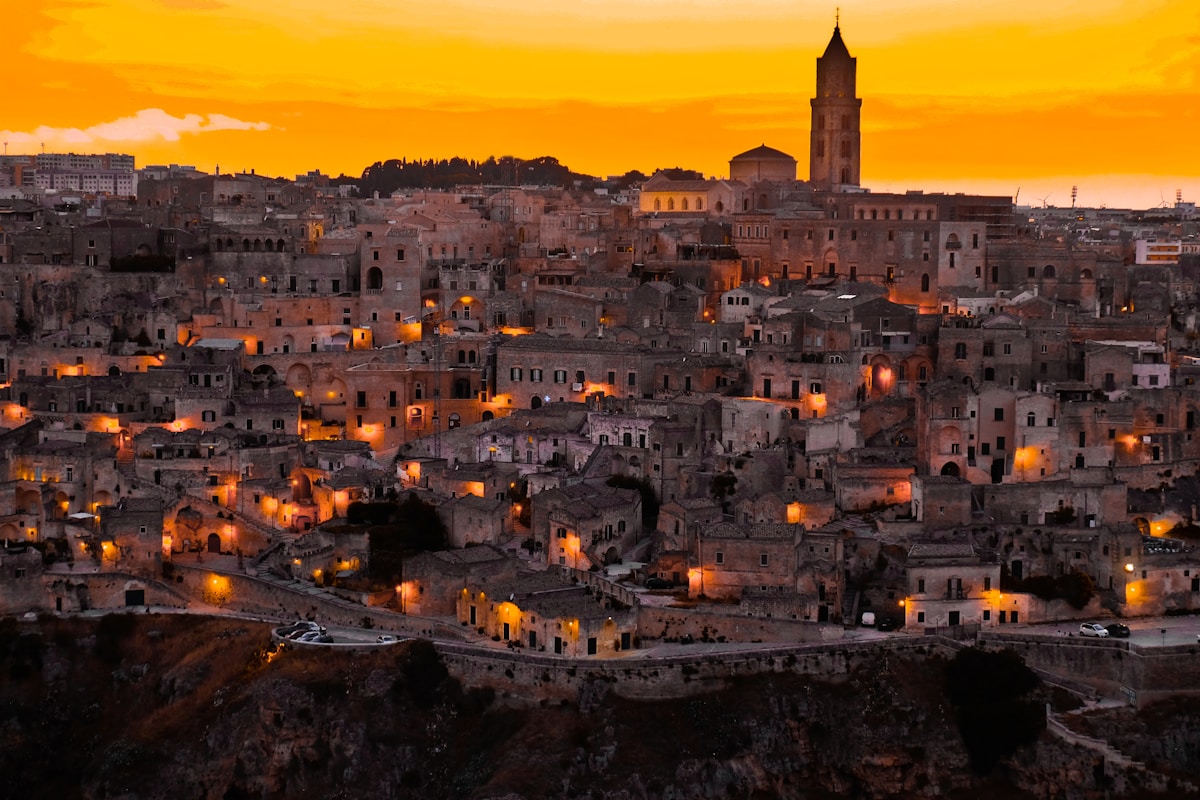
Matera is one of the strangest and most remarkable cities in Europe. Carved into the sides of a ravine in the Basilicata region of southern Italy, the Sassi di Matera - two cave districts covering a limestone plateau - have been continuously inhabited for at least 9,000 years, making this one of the oldest continuously occupied human settlements in the world. In the 1950s, the Italian government forcibly evacuated the cave dwellings as a national embarrassment (Carlo Levi called them “the shame of Italy”). Today they are a UNESCO World Heritage Site and one of the most visited destinations in southern Italy.
The Sassi
The Sassi are divided into two districts - Sasso Barisano (the more developed, western side) and Sasso Caveoso (the denser, less-modified eastern side, closer to the ravine).
Walking through the Sassi is the central experience of Matera. Guided tours of Matera - covering the cave churches, the Gravina ravine, and the Casa Grotta dwellings - are the most efficient way to understand what you’re seeing. The streets are carved into the limestone; many “buildings” are actually extensions of natural caves, with carved facades added to natural rock hollows. The cave dwellings were inhabited by multiple generations of families sharing space with their animals, harvesting rainwater from cisterns carved into the rock below.
The Sasso Caveoso is the better side for understanding the original character: lower down toward the ravine, denser, less restored, with rock-cut churches visible in the cliff faces on the other side of the canyon.
Rock-cut churches (chiese rupestri)
The area around Matera contains over 150 rock-cut churches carved into the tufa cliffs, most dating from the Byzantine period (6th–13th centuries). The best are:
Santa Maria de Idris - carved into the rock of Monte Errone at the heart of the Sasso Caveoso. Byzantine frescoes on the interior walls, partially preserved. A small dark space with extraordinary atmosphere.
Santa Lucia alle Malve - the first church established by Benedictine monks in the Sassi, with 12th-century frescoes. Now a museum.
Madonna delle Virtù and San Nicola dei Greci - two superimposed cave churches with a complex multi-level structure in the cliffs above the Sasso Barisano. Currently managed as an exhibition space.
Parco della Murgia Materana (on the opposite side of the Gravina ravine) - the 8,000-hectare protected area across the canyon contains the greatest concentration of rock churches, accessible by a 6km walk from the bridge or by hire car to the Murgia Timone parking area.
The Gravina ravine
The ravine (Gravina) running along the eastern edge of Matera is the defining landscape feature. The best views of the Sassi are from the opposite rim - the road above the canyon (Via Panoramica) and from across the ravine near the ancient bridge (Ponte della Gravina). The ancient bridge connects the town to the Murgia plateau.
Casa Grotta di Vico Solitario
A preserved and furnished example of a cave dwelling as it would have appeared in the early 20th century. A single room for a family of 6–8 people, sharing space with a donkey and chickens. The objects displayed - cooking utensils, sleeping arrangements, a Madonna niche - are authentic or period-appropriate. The guide’s explanation of how families lived here is the most direct way to understand what the forcible evacuation programme was addressing. Small but essential. €3.
The new town (Civita)
Above the Sassi, on the ridge plateau, is the Civita - the medieval and modern town built on solid ground. The Cathedral of Matera (13th century, Apulian Romanesque) sits at the highest point with views over both Sassi. The Piazza Vittorio Veneto is the main square.
Practical notes
Getting there: Matera is not on the main Italian rail network. The easiest approach is from Bari (65km, 1h40min by Ferrovie Appulo-Lucane regional train, or 1h by bus). From Naples, approximately 3.5 hours by train via Potenza.
When to go: April–June and September–October. July–August are very hot (the stone amplifies heat) and increasingly crowded. The Sassi are good even in winter - the limestone holds warmth.
Getting around the Sassi: On foot only - most of the Sassi streets are too narrow or steep for vehicles. Allow half a day minimum; a full day to include the rock churches and the Murgia plateau.
Book Matera Tours on GetYourGuide
| Tour | Duration | From price | Highlights |
|---|---|---|---|
| Matera Sassi guided walking tour — cave dwellings and rupestrian churches | 2.5 hrs | From €20 | Sasso Barisano and Caveoso, Casa Grotta, Byzantine cave churches |
| Matera by night — illuminated Sassi evening tour | 2 hrs | From €18 | Sassi lit after dark, Gravina ravine viewpoints, panoramic walk |
| Matera full-day tour from Naples | 12 hrs | From €95 | Return transport, guided Sassi walk, southern Italy context |
Browse all Matera tours on GetYourGuide →
Back to the full Matera travel guide for the Sassi overview, cave hotels, and getting there from Rome or Bari. For Matera food - ancient grain breads, spit-roasted meats - see the Matera food guide. For day trips from Matera to Alberobello and the Puglia coast, see day trips from Matera. Matera is a key stop on a southern Italy circuit - our southern Italy itinerary connects it with Naples, the Amalfi Coast, and Sicily. For Bari as the main transport hub connecting to Matera, see the Bari travel guide. For accommodation, see best hotels in Matera.
Where to stay in Matera: Find hotels in Matera — search accommodation across all budgets.