Orvieto sits on a flat-topped volcanic tufa plateau rising 195m above the Paglia valley - one of the most dramatic natural settings of any Italian city. From the motorway or the train, the cathedral’s gold mosaic facade is visible from kilometres away, high on the plateau. Getting to the top requires an escalator carved through the rock or a funicolare up the cliff face. Once up, the city is compact, beautifully preserved, and contains two of the most significant attractions in central Italy: the cathedral and the Etruscan underground.
The Cathedral (Duomo di Orvieto)
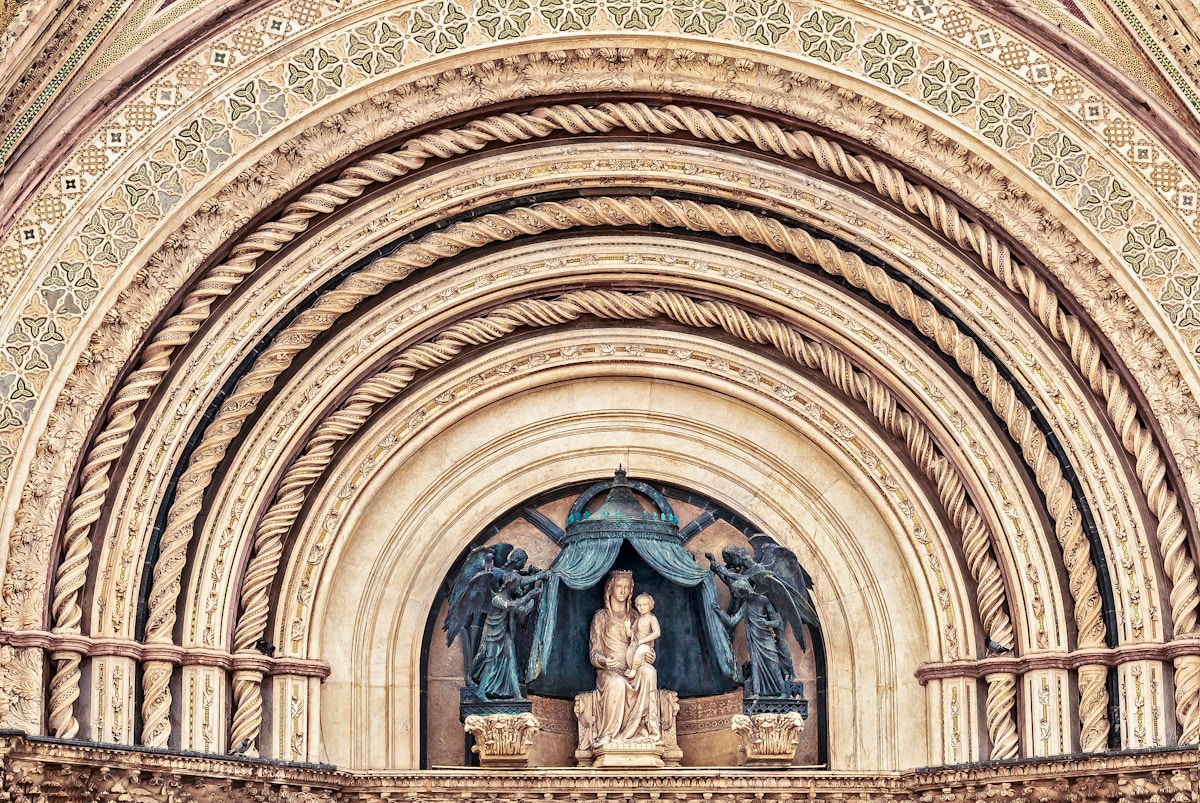
One of the greatest Gothic facades in the world. The Duomo was begun in 1290, allegedly to house a relic from a 13th-century Eucharistic miracle, and the facade - completed over three centuries - is a programme of Gothic architecture, gold mosaic, sculpture, and relief. Lorenzo Maitani’s marble relief panels on the lower facade (1320–1330) depict Old Testament scenes, the Last Judgement, and The Blessed and The Damned in an extraordinary sequence of early Trecento carving.
The interior is the setting for the San Brizio Chapel - Luca Signorelli’s fresco cycle of the Last Judgement, the Resurrection of the Dead, The Damned Cast into Hell, and The Antichrist (1499–1504). This is one of the supreme works of the Italian Renaissance and the direct influence on Michelangelo’s Sistine Chapel ceiling. Michelangelo visited Orvieto to study these frescoes before beginning the Sistine vault. The muscular figures in violent motion, the complex foreshortening, and the spatial organisation all anticipate what Michelangelo would achieve. Book a timed entry ticket - the chapel has visitor limits.
Orvieto Underground
The tufa plateau on which Orvieto stands has been excavated from below since Etruscan times. Beneath the city is a labyrinth of over 1,200 caves, tunnels, cisterns, Etruscan tombs, medieval wells, wine cellars, and olive press chambers. The official Orvieto Underground tour (2 hours, departing from Piazza del Duomo) covers a section of the tunnels with guides who explain the different eras of excavation. €7 with guide; book at the tourist office. Guided tours of Orvieto covering the underground city and cathedral are also available and worthwhile for historical context.
The Pozzo di San Patrizio (St Patrick’s Well, 1537) is a separate attraction - a 53-metre-deep cylindrical well designed by Antonio da Sangallo the Younger for Pope Clement VII during his period of refuge in Orvieto after the Sack of Rome. The well has two interlocking spiral staircases (one for going down with empty donkeys, one for ascending with full water jars) so they never meet.
Etruscan Museum (Museo Nazionale Etrusco “Claudio Faina”)
The most important Etruscan collection in Umbria, housed in the Palazzo Faina on the Piazza del Duomo. Orvieto was a major Etruscan city (Velzna/Volsinii); the surrounding area has been extensively excavated. The collection includes Etruscan red-figure pottery, bronzes, gold jewellery, and the famous “Warrior’s sarcophagus.” €5 entry.
The old streets
The historic centre west of the Duomo - Via del Duomo, Via Maitani, and the surrounding streets - has the best concentration of medieval buildings, enotecas selling Orvieto Classico, and ceramic workshops. Orvieto has a significant ceramic tradition; the glazed earthenware is good quality and sold from workshops throughout the centre.
Orvieto Classico wine
Orvieto Classico DOC - a dry white wine from Grechetto, Trebbiano, and other local grapes - has been produced in the area since Etruscan times. The wine’s quality ranges from decent to very good depending on the producer. The enotecas along Via del Duomo offer tastings; the Cantina Foresi on Piazza del Duomo is the oldest in the city (established 1878) and has the best selection.
Practical notes
Getting there: Orvieto is on the main Rome–Florence railway line (1h 15min from Roma Termini, 1h 45min from Firenze Santa Maria Novella). The funicolare connects the station to the city plateau (€1.30, included in some transport passes). A frequent bus from the funicular top serves the rest of the city.
Half day or full day? The Cathedral and the Underground together take a full half-day. A full day allows the Etruscan museum, the Pozzo di San Patrizio, and a relaxed lunch. Orvieto is good for an overnight if combining with other Umbrian sites.
Book Orvieto Tours on GetYourGuide
| Tour | Duration | From price | Highlights |
|---|---|---|---|
| Orvieto Cathedral and underground city guided tour | 3 hrs | From €30 | Duomo facade, Signorelli frescoes, Etruscan tunnels and caves |
| Orvieto wine tasting and Classico DOC cellars | 2 hrs | From €35 | Orvieto Classico tastings, historic enoteca, food pairings |
| Orvieto day trip from Rome | 8 hrs | From €55 | Return transport from Rome, Cathedral, Pozzo di San Patrizio |
Browse all Orvieto tours on GetYourGuide →
Back to the full Orvieto travel guide for the Cathedral, underground city, and day trip logistics. For Orvieto food - pici, cinghiale, Orvieto Classico wine - see our Orvieto things to do guide and our Italian wine guide for the DOC context. For accommodation, see best hotels in Orvieto. Orvieto is most commonly visited as a day trip from Rome - our day trips from Rome guide covers the train logistics. For the broader Umbrian circuit, Perugia and Assisi are each 1–1.5 hours away by bus - both have dedicated city guides on this site.
Where to stay in Orvieto: Find hotels in Orvieto — search accommodation across all budgets.