Perugia Travel Guide: Umbria's Hilltop Capital
Guide to Perugia: hilltop capital of Umbria, with medieval streets, the Galleria Nazionale, Perugina chocolate, and the Umbria Jazz festival.
Guides for Perugia
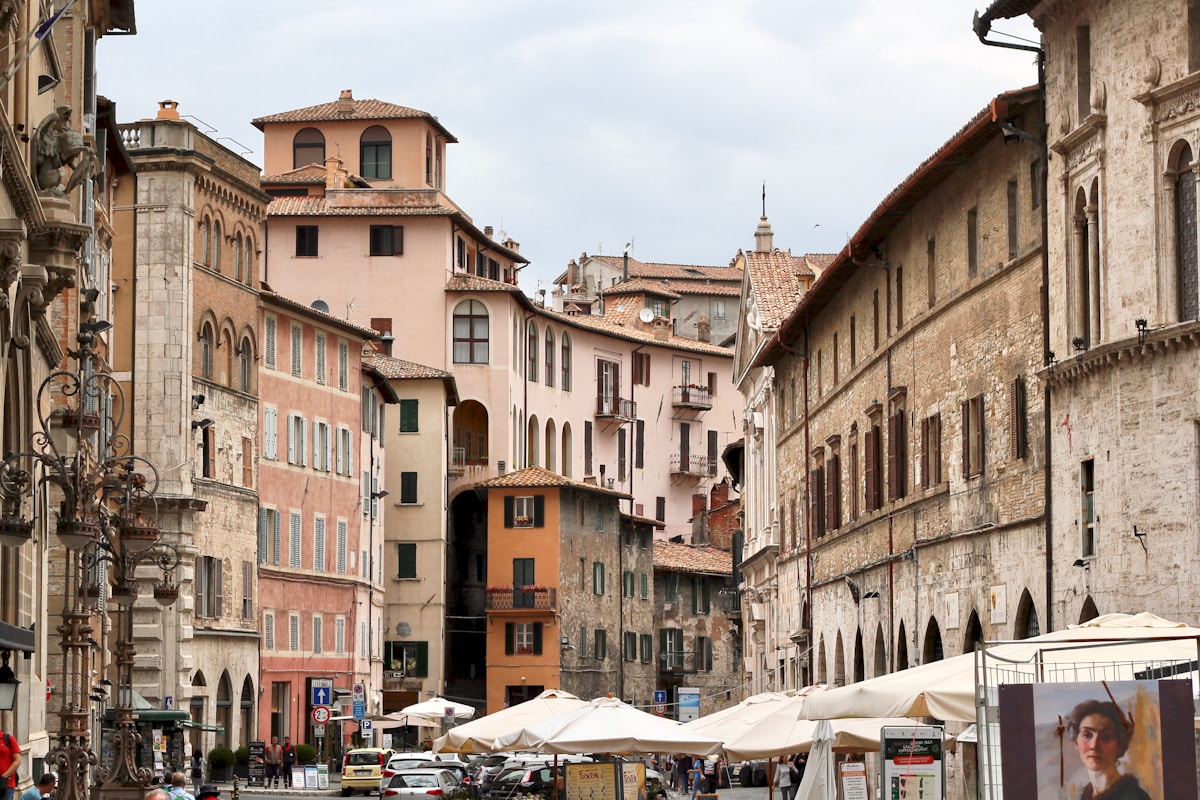
Perugia is the capital of Umbria - the landlocked region between Tuscany and Lazio - and one of Italy’s most dramatically situated cities. Built across several hills, its medieval centre is almost entirely car-free and connected by escalators and lifts from the lower town. The University for Foreigners (Università per Stranieri) has made it an international city by Umbrian standards; in summer it hosts Umbria Jazz, one of Europe’s best jazz festivals, and in October, Eurochocolate, the world’s largest chocolate festival.
The city
Corso Vannucci - The main pedestrian street, lined with palaces and cafes, named after Pietro Vannucci (better known as Perugino, Raphael’s teacher). It opens onto Piazza IV Novembre, the heart of medieval Perugia.
Fontana Maggiore - One of the finest medieval fountains in Italy (Nicola and Giovanni Pisano, 1278). Two concentric marble basins with 50 carved relief panels depicting the months, the liberal arts, biblical scenes, and Aesop’s fables. A masterpiece of Gothic sculpture in a public space.
Cattedrale di San Lorenzo - The Gothic cathedral on Piazza IV Novembre. The interior contains the wedding ring of the Virgin Mary (the Santo Anello), kept in a locked tabernacle and displayed only on July 30. Free entry.
Galleria Nazionale dell’Umbria (Palazzo dei Priori, Corso Vannucci 19) - The best collection of Umbrian painting in existence. Major works by Perugino (including the Adoration of the Magi), Pinturicchio, Piero della Francesca (the Sant’Antonio Polyptych), and Gentile da Fabriano. Entry approximately €8 as of 2026. Closed Monday. Allow 1.5–2 hours.
Palazzo dei Priori - One of the finest Gothic civic buildings in Italy, housing the Galleria Nazionale and the Collegio del Cambio (the bankers’ guild hall, with frescoes by Perugino, entry approximately €5). The building’s facade spans an entire side of Corso Vannucci.
Rocca Paolina - A 16th-century papal fortress built by Paul III over an entire medieval quarter (the Baglioni family’s houses were deliberately buried beneath it). Partially demolished after the unification of Italy; the subterranean medieval streets preserved beneath are accessible via escalator and form a free, extraordinary underground walk through Perugia’s earlier medieval fabric. Open daily.
Arco Etrusco (Etruscan Arch, also known as Arco di Augusto) - A 3rd-century BC Etruscan city gate, one of the best-preserved in Italy. The massive travertine blocks are the original construction; the upper section is Roman.
Festivals
Umbria Jazz (usually mid-July) - One of the world’s great jazz festivals, running since 1973. Main concerts in the Arena Santa Giuliana and Piazza IV Novembre; free and ticketed events throughout the city. Headliners from approximately €25–80. The city fills up; book accommodation 2–3 months ahead.
Eurochocolate (usually mid-October) - The world’s largest chocolate festival. Corso Vannucci is lined with stands from Italian and international chocolatiers. Free entry; tastings and workshops available. Perugina (makers of Baci chocolate) is headquartered in Perugia - the Casa del Cioccolato factory (San Sisto, bus from centre) offers tours (approximately €10, book at perugina.com).
Umbrian food
Umbria produces excellent truffles - black truffles from Norcia (available year-round) and white truffles from around Gubbio (autumn only). Norcineria - the Umbrian tradition of cured pork products - is equally important: prosciutto, salami, and the preserved meats of Norcia are sold across the region. Strangozzi (thick hand-rolled pasta) with truffle sauce or tomato is the standard first course. Umbrian olive oil is among Italy’s finest - green, peppery, and used generously.
Named restaurants: Osteria a Priori (Via dei Priori 39 - Umbrian cuisine, mains approximately €12–16), Dal mi’ Cocco (Corso Garibaldi 12 - traditional trattoria, mains approximately €8–12, cash only), La Taverna (Via delle Streghe 8 - refined Umbrian, mains approximately €14–20).
Where to stay
Budget: approximately €40–65/night. Mid-range: approximately €70–120/night. The centro storico (within the walls) is the best position. Sina Brufani (Piazza Italia 12 - doubles from approximately €150/night) is the grand hotel with views over the Umbrian valley. B&Bs and small hotels along Corso Vannucci and in the university quarter offer better value.
Day trips
Assisi (approximately 25 minutes by bus or train) - The Basilica of St. Francis. Assisi is 25 minutes by bus - the Basilica of St Francis (a UNESCO World Heritage site) and the complete medieval hilltop setting make it the strongest day trip from Perugia. Norcia (approximately 90 minutes by car, limited bus service) - Truffles, cured meats, and the earthquake-damaged town (the 2016 earthquake caused significant destruction; rebuilding is ongoing). Lake Trasimeno (approximately 30 minutes by train) - Umbria’s lake, with beaches, boat trips to Isola Maggiore, and the site of Hannibal’s victory over the Romans in 217 BC. Gubbio (approximately 40 minutes by bus) - A dramatic medieval hill town with the Palazzo dei Consoli.
Getting there
Perugia station (Fontivegge): regional trains from Florence approximately 2–2.5 hours (from approximately €12, usually with a change at Terontola). From Rome approximately 2.5–3 hours (from approximately €12). The Minimetrò connects the station area to the upper city centre in approximately 12 minutes. Perugia San Francesco Airport (PEG) has limited Ryanair connections to London Stansted.
For accommodation in the centro storico and on the Umbrian valley: Perugia hotels. For the full list of sights, day trips, and the Minimetrò connection: things to do in Perugia. Book a guided Perugia tour to explore the Etruscan underground, the Galleria Nazionale, and the medieval centre with a local expert. Perugia is a practical base for Assisi (25 minutes) and Orvieto - our southern Italy itinerary covers the Umbrian leg.
Upcoming Events in Perugia
La Befana - Feast of the Epiphany 2027
La Befana 2027, January 6. Italy's Epiphany gift-giving day: children receive sweets or coal from the Befana witch, then decorations come down.
Book an experience
Top experiences in Perugia
Explore the best tours and activities in Perugia, with instant confirmation and free cancellation on most bookings.