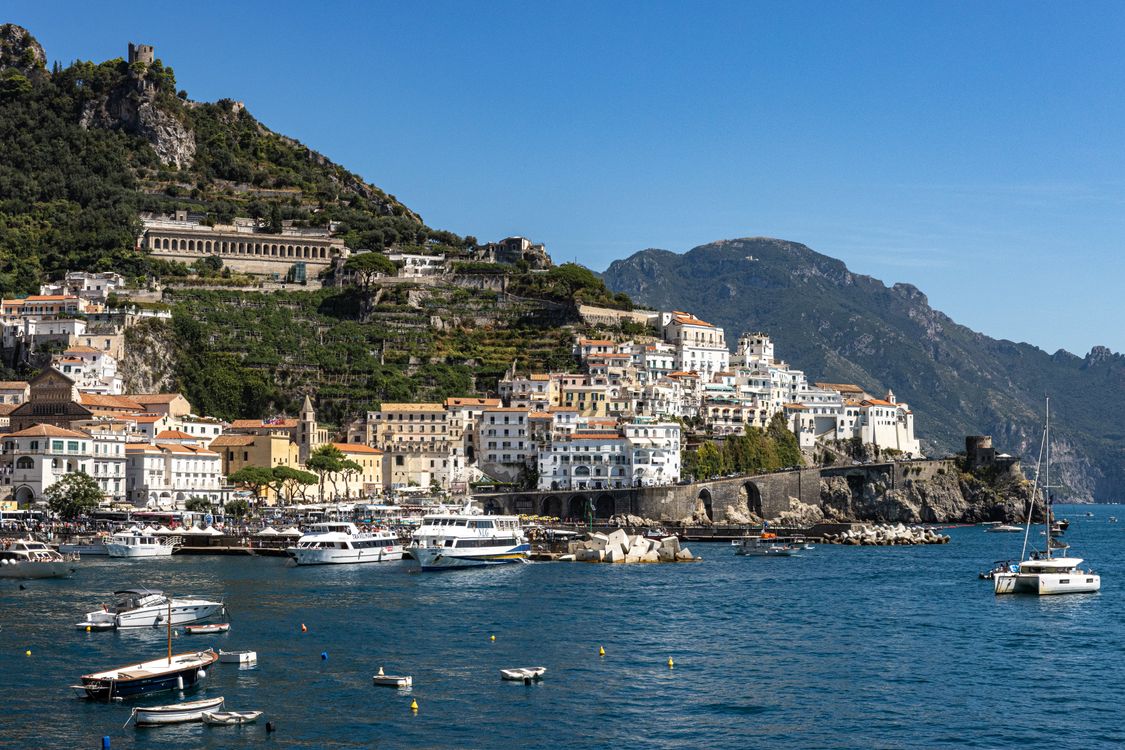
Amalfi and Positano are the Amalfi Coast’s two flagship towns — and they attract very different types of visitor. Positano is the coast’s most photographed village, built for aesthetics and romance, with prices to match. Amalfi is the former maritime republic that gave the coast its name: a proper working town with a cathedral, medieval history, a ferry terminal, and a commercial life that exists beyond tourism. Choosing between them comes down to what you want from the Amalfi experience.
Quick Verdict
| Category | Amalfi | Positano |
|---|---|---|
| Scenery | - | Winner |
| History and culture | Winner | - |
| Value for money | Winner | - |
| Transport links | Winner | - |
| Romance | - | Winner |
| Beach access | Winner | - |
| Photography | - | Winner |
| Nightlife | Winner | - |
Choose Amalfi if you want history, authenticity, a working ferry terminal, and better value without sacrificing the Amalfi Coast drama. Choose Positano if the clifftop village aesthetic is your priority and you are prepared to pay a significant premium.
Scenery and Atmosphere
Positano’s scenery is more dramatic in the conventional sense: a near-vertical cliffside stacked with terracotta and ochre buildings above a small curved bay, best photographed from the ferry or from the Via Positanesi d’America coastal path. The village has a concentrated beauty that earns its reputation. It is also extremely busy in summer — the narrow paths between boutiques and restaurants fill up quickly, and the intimate atmosphere photographs better than it sometimes feels.
Amalfi’s position is slightly different: the town sits at the mouth of the Valle dei Mulini (Valley of the Mills) where a ravine meets the sea, giving it more depth and shade than Positano’s sun-blasted terraces. The Piazza del Duomo, with the Cathedral of Sant’Andrea (free entry to the piazza, €3 for the cathedral crypt) rising above the staircase, is one of southern Italy’s finest town squares. The historic paper mills in the ravine above town (the Museo della Carta, entry €5) add a cultural layer that Positano simply doesn’t have.
Winner: Positano for visual drama. Amalfi for depth, history, and the feeling of a real town.
History and Culture
Amalfi dominated Mediterranean trade from the 9th to 12th centuries as one of the original Italian Maritime Republics. The Duomo di Amalfi (Cathedral of Sant’Andrea) dates from 1203, with a 9th-century crypt containing the relics of the apostle Andrew — the same Andrew venerated at St. Andrews Cathedral in Scotland. The cloisters (Chiostro del Paradiso, entry €3) contain ancient sarcophagi and Arab-Norman stonework that reflects the republic’s reach into the eastern Mediterranean. The Arsenale della Repubblica (the medieval shipyard) is partially accessible and tells the story of Amalfi’s naval power.
Positano’s history is largely that of a fishing village — notable mainly for a 13th-century Byzantine painting of the Virgin in the church of Santa Maria Assunta, visible behind the altar. The Saracen watchtower above the town (Torre di Fornillo) was built in the 16th century to spot pirate raids. The village became fashionable in the 1950s when it was discovered by American writers — John Steinbeck wrote about it for Harper’s Bazaar in 1953 — and the celebrity association has defined its identity since.
Winner: Amalfi, convincingly, for historical depth and cultural interest.
Cost and Accommodation
Positano is among the most expensive small towns on the Italian coast. Hotels with sea views run €250–450/night in July and August; the landmark Le Sirenuse (from €800) and Il San Pietro (from €700) represent the top tier. Budget accommodation is effectively unavailable. Even apartments without a sea view run €150–250/night in peak season.
Amalfi has a wider range. A well-located 3-star hotel near the cathedral costs €120–220/night in summer. The five-star Santa Caterina (from €500) and NH Collection Grand Hotel Convento di Amalfi (a converted 13th-century convent, from €400) are the premium options. Small B&Bs and guesthouses in the ravine above town run €80–130/night. Restaurants along the seafront charge €15–22 for pasta; the trattorias on side streets offer the same for €12–15.
Winner: Amalfi for value across all budget levels.
Beaches
Amalfi’s beach (La Battigia) is a long stretch of grey pebbles directly below the seafront road, with public access free but sunbed hire available from €15–25 for a set. The water is clean and the beach faces south, getting full sun most of the day. Marina Grande to the west of the harbour is smaller but often less crowded.
Positano has the SPIAGGIA GRANDE as its main beach — compact, pebbly, and hemmed in by the cliff walls. Sunbed hire costs €20–35 for two sunbeds and an umbrella. Fornillo Beach, a 10-minute walk west along the coastal path, is smaller and slightly quieter. The beach setting in Positano is spectacular but the beach itself is not the draw — the scenery surrounding it is.
Winner: Amalfi for beach size and access. Positano for dramatic beach setting.
Transport and Access
Amalfi is the transport hub of the central coast. Ferries run to Salerno (35 minutes, €8), Naples (60 minutes, from €25), Positano (20 minutes, €10), and the Amalfi Coast ports throughout the season. The SITA bus connects Amalfi to Salerno (1.5 hours, €3.20) and Sorrento (1.5 hours, €2.50). Coming from the east (Salerno direction), Amalfi is significantly easier to reach than Positano.
Positano has no ferry to Salerno, fewer bus connections, and — because it sits at the western end of the coast — is a slightly awkward journey from both Salerno and Naples. The ferry from Sorrento (45 minutes, from €15) is the most pleasant way to arrive in summer. A private transfer from Naples airport costs approximately €150.
Winner: Amalfi for transport connections, particularly year-round ferry access from Salerno.
Day Trips and Region
Both towns work as bases for exploring the rest of the Amalfi Coast, but their positions give them different strengths.
From Amalfi: Ravello (30 minutes by bus up the mountain, €2.50) for the Villa Cimbrone and Villa Rufolo gardens — among Italy’s most beautiful viewpoints. Atrani (10-minute walk) is Amalfi’s quieter neighbour, effectively a continuation of the town with fewer tourists. Positano (20 minutes by ferry).
From Positano: Sorrento (45 minutes by ferry in summer), Capri (seasonal ferry, 50 minutes), Amalfi (20 minutes by ferry). Positano sits closer to Sorrento and the western part of the coast.
Winner: Amalfi for access to Ravello and the eastern coast. Positano for Sorrento and Capri connections.
Final Verdict
Amalfi wins for people who want more than the view: history, practicality, better value, and a real town with a life beyond tourism. Positano wins for those whose priority is the coast’s most photogenic village and who have the budget to stay in it properly.
Many visitors do both — the 20-minute ferry ride makes it easy to spend a morning in Positano and an afternoon in Amalfi, or vice versa. If you must choose one base, Amalfi’s ferry connections and cultural depth make it the stronger practical choice; Positano’s scenery makes it the more romantic one.
Ready to Plan Your Trip?
See our guides for the wider region:
- Sorrento vs Positano - which Amalfi Coast western anchor to choose
- Amalfi Coast vs Cinque Terre - Italy’s two great coastal rivals compared
- Amalfi Coast Itinerary - five days along the Amalfi Coast
Plan Your Trip
✈️ Book your flights to Italy 🛡️ Get travel insurance 📱 Stay connected with an eSIM 🚗 Rent a car
🎟️ Browse Amalfi Coast tours — Browse tours in Positano 🏨 Search hotels in Amalfi — Search hotels in Positano