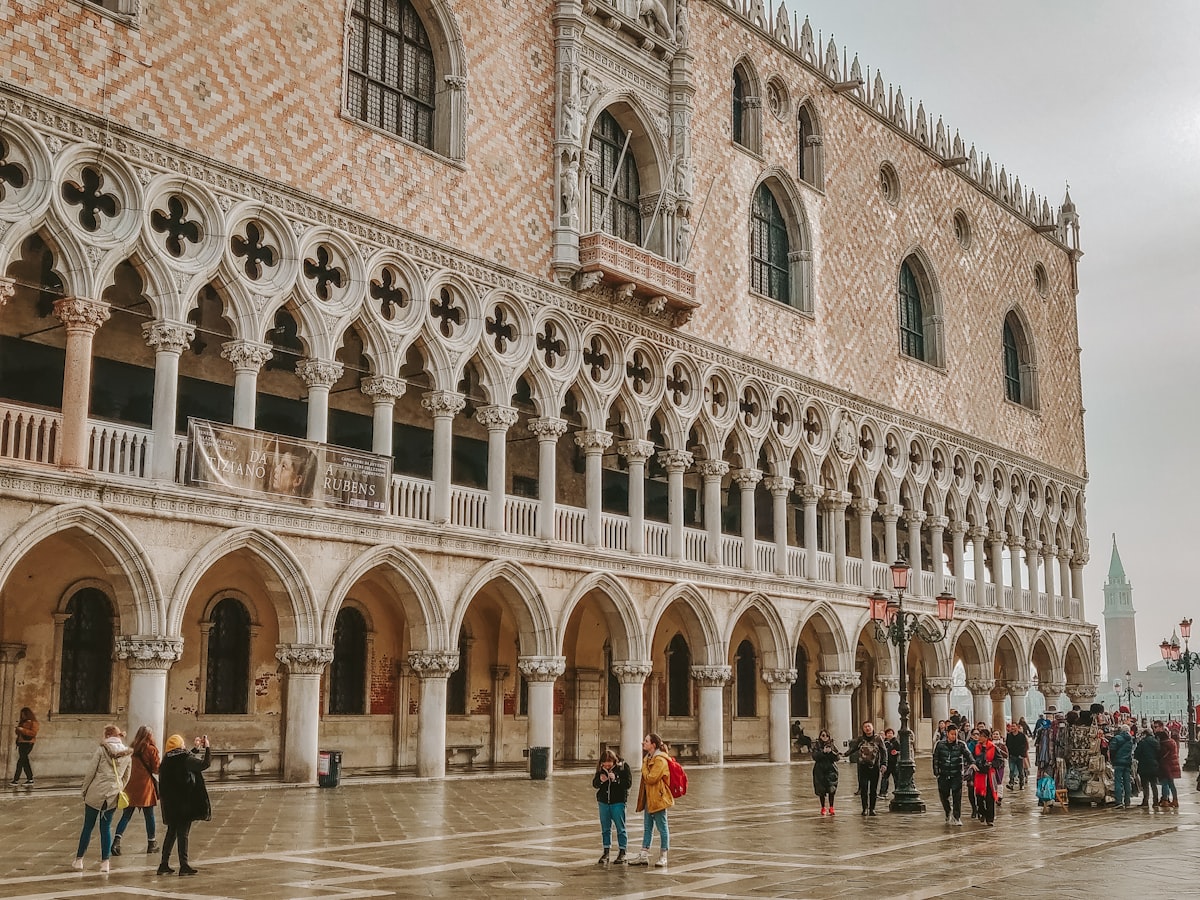
Italy rewards a car in the places trains skip: the lake shores, the Chianti ridge roads, the Val d’Orcia and the Umbrian hill towns. It punishes a car in the places trains handle best: Venice, Florence’s centre, Rome. This two-week route is built around that split. You spend the big cities on foot, collect the car for the countryside, and drop it before the final city stay.
The line runs Venice, Verona, Lake Garda, Lake Como, Florence, Siena, the Val d’Orcia, Orvieto, Assisi and Rome. It totals roughly 1,100 km and about 20 hours behind the wheel across 14 days. If you only want Tuscany, our Tuscany road trip goes deeper there; if you would rather go by rail, see the 2 weeks in Italy itinerary.
Route at a glance
| Days | Base | Drive that day | Car? |
|---|---|---|---|
| 1-2 | Venice | None | No |
| 3 | Verona | Venice airport to Verona, about 120 km (1h 20) | Collect car |
| 4 | Sirmione to Bellagio | About 190 km (2h 45) | Yes |
| 5 | Lake Como | Ferry day, short drives | Park |
| 6 | Florence | Bellagio to Florence, about 340 km (4h) | Yes |
| 7 | Florence | None | Garage |
| 8 | Chianti to Siena | About 70 km via the SR222 (1h 30 with stops) | Yes |
| 9 | Val d’Orcia | Siena to Pienza and Montalcino, about 100 km | Yes |
| 10 | Orvieto | Pienza to Orvieto, about 95 km (1h 30) | Yes |
| 11 | Assisi and Perugia | Orvieto to Assisi, about 130 km (1h 40) | Yes |
| 12 | Rome | Assisi to Rome, about 195 km (2h) | Drop car |
| 13-14 | Rome | None | No |
Distances are approximate road distances; allow extra for traffic around Milan, Bologna and the Rome ring road (GRA).
Before you go: pick-up, drop-off and paperwork
Venice or Milan pick-up. Start in Venice and you see the one city that cannot be driven. Collect the car on day 3 at Marco Polo airport or Mestre station, never in Venice itself (cars stop at Piazzale Roma). If you would rather skip Venice, pick up at Milan Malpensa and begin at Lake Como, then add two nights in Tuscany or Umbria.
One-way fee. A Venice-to-Rome rental carries a one-way fee, typically in the range of €50-120 as of 2026, shown before you pay. It is nearly always cheaper than backtracking. Compare one-way prices across providers and book an automatic early if you need one, since manual cars dominate the Italian fleet. Our guide to renting a car in Italy covers insurance, deposits, age limits and fuel. For a regional fallback, the Tuscany car rental guide lists the best pick-up points around Florence and Pisa.
Licence. Non-EU drivers are advised to carry an International Driving Permit with their national licence. Check your rental company’s current rules.
ZTL warnings: where cameras will catch you
A ZTL is a limited-traffic zone in a historic centre, enforced by cameras that photograph your plate. There is no warning beyond a round white-and-red sign, and the fine (typically €80-150, plus a rental admin fee) arrives months after you return home. Our full ZTL driving zones guide explains the rules and signs. On this route, treat these as no-go for a car unless your hotel confirms access:
- Verona: the centre around Piazza Bra and Piazza delle Erbe.
- Bellagio and Como: the lakeside lanes; use the municipal car parks above the waterfront.
- Florence: the whole historic centre, one of Italy’s strictest. Park in a hotel garage or a car park on the ring road.
- Siena, Pienza, Montepulciano, Montalcino, Orvieto, Assisi, Perugia: all have ZTLs within the walls. Park outside, or in the escalator-linked car parks (Orvieto’s funicular car park, Perugia’s Pincetto and Mini-Metro car parks).
- Rome: the Centro Storico and Trastevere ZTLs. This is why the car goes back on day 12.
Rule of thumb: if your hotel is inside a ZTL, email them your plate number before arrival and ask them to register it with the municipality. Do the same for any agriturismo with a restricted-access road.
Tolls and motorway rules
Most of the long legs use autostrade, which are toll roads. Take a ticket at the entry gate and pay at exit with a card or cash, avoiding the yellow Telepass-only lanes unless your rental includes the device. Budget approximately €70-110 in tolls across the trip as of 2026; the official calculator on autostrade.it prices any leg. The Tuscan and Umbrian hill-town roads are free. Remember that:
- Blue-and-white signs mark card lanes, and the sign with a hand means cash.
- Speed limits are 130 km/h on motorways (110 in rain), 90 km/h on main roads and 50 km/h in towns, and Tutor/Autovelox speed cameras are common.
- Fuel is dearer on autostrade; fill up in a town, and note that many stations are self-service (“fai da te”) and cheaper than staffed pumps.
- Headlights must be on outside built-up areas, even in daylight.
Days 1-2: Venice (no car)
Spend two full days on foot and by vaporetto. See St Mark’s Basilica and the Doge’s Palace, walk Cannaregio and Dorsoduro, and take the boat to Burano. Book a Venice tour for the first morning to beat the queues. Venice now charges a day-tripper entry fee on peak dates, which does not apply to overnight guests; see the Venice tourist entry fee guide. Search hotels in Venice on Booking.com; staying in Cannaregio or Dorsoduro is quieter and cheaper than San Marco.
Full city detail is on our Venice guide.
Day 3: Venice to Verona
Collect the car at Marco Polo and take the A4 west for about 120 km. Leave the car at a garage outside the ZTL, then walk to the Roman Arena (tickets from approximately €10-12 as of 2026), Juliet’s courtyard and the Ponte Pietra. Dinner is risotto all’Amarone or pastissada de caval in the Veronetta backstreets. Our Verona guide has opening times, and a guided Verona tour fills in the Roman layers. Search hotels in Verona.
Day 4: Sirmione to Bellagio
Drive 35 km to Sirmione on Lake Garda, a peninsula town with a car-free centre (park at Lugana or Parcheggio Sirmione Centro and walk). Visit the Scaliger Castle and the Grotte di Catullo ruins, then lunch on the lake. Our Lake Garda guide covers the other shores. Then drive west on the A4 and up the lake to Bellagio (about 190 km, 2h 45). Arrive mid-evening and park in the car park above the town. Hotels in Bellagio book out in summer, so reserve months ahead.
Day 5: Lake Como by ferry
Leave the car parked. Take the public ferry (or a faster hydrofoil) from Bellagio to Varenna, Menaggio and Villa del Balbianello’s landing at Lenno. Day tickets for the central lake zones cost approximately €15-25 as of 2026. Walk Varenna’s lakeside path, eat fish from the lake in Bellagio’s old town, and consider a boat tour. Browse Lake Como tours and our Lake Como guide for the villas.
Day 6: Bellagio to Florence
The longest drive of the trip: about 340 km, 4 hours without stops. Take the A9/A1 via Milan, Parma and Bologna, crossing the Apennines on the Appennino section of the A1. Start by 8 am to miss Milan traffic, and stop at a service area (“autogrill”) at Parma for lunch, or detour 30 minutes to Parma itself for prosciutto and parmigiano. Arrive in Florence, drop the bags and walk. Do not drive into the centre: choose a hotel with its own garage or use a garage outside the ZTL such as Parcheggio Oltrarno or Santa Maria Novella. Search hotels in Florence.
Day 7: Florence on foot
This is a rest day for the car. See the Duomo and the Uffizi (book timed tickets ahead), cross the Ponte Vecchio and climb to Piazzale Michelangelo for sunset. A Florence tour is the quickest route through the Uffizi queues. Our Florence guide has the details.
Day 8: Chianti and Siena
Leave via the SR222 Chiantigiana through Greve and Castellina in Chianti, stopping at a winery for a tasting (approximately €15-40 per person as of 2026, book ahead for estates). Arrive in Siena by mid-afternoon and park at the Fortezza or Il Campo car park outside the ZTL, then walk to the shell-shaped Piazza del Campo and the Duomo. Hotels in Siena are cheaper than Florence. See our Siena guide and book Siena tours if you prefer a guide.
Day 9: Val d’Orcia
This is the Tuscany of postcards. Drive south to Montalcino (Brunello wine, hilltop fortress), then Pienza (Renaissance town built by Pope Pius II) and San Quirico d’Orcia for the cypress avenues. Park outside each walled centre. Add a stop at Bagno Vignoni’s thermal square. If you have extra time, the free thermal cascades at Saturnia are about 1.5 hours away; our Saturnia hot springs guide covers access. Our Tuscany region guide lists more hill towns.
Day 10: Orvieto
Cross into Umbria for about 95 km (1h 30). Orvieto sits on a tufa plateau; leave the car at the funicular car park at the base and ride up. See the striped Duomo, take the Orvieto Underground tour and taste Orvieto Classico. Book tours in Orvieto, then compare hotels in Orvieto. Our Orvieto guide covers the sights.
Day 11: Assisi and Perugia
Drive about 130 km (1h 40) via the E45 to Assisi. Visit the Basilica of St Francis, free to enter but with dress rules, and walk the upper town. Continue for 25 km to Perugia, a ZTL-heavy hill city, and park at the Pincetto car park and take the Minimetro up. Both are in our Umbria region guide; see also Assisi tours and Assisi hotels.
Day 12: Assisi to Rome and the drop-off
Take the A1 south for about 195 km (2 hours). Drop the car at Fiumicino airport or Roma Termini, depending on your rental company, before entering the city. The car is no use in Rome: parking is scarce and the ZTL is strict. Take the Leonardo Express or a metro to your hotel. Hotels in Rome near Termini or the Centro Storico suit a car-free stay.
Days 13-14: Rome
Spend two full days on the Colosseum and Forum (book timed tickets in advance), the Vatican Museums, Trastevere and the Pantheon. Tours in Rome save time at the big sites, and our Rome guide has the area breakdown. Leave on day 14 from Fiumicino.
Practical notes
- Best months: April to June and September to October. July and August are hot and the lakes and hill-town car parks fill up. Drive times grow near Ferragosto.
- Parking: blue lines mean paid parking, white lines are free, yellow lines are reserved for residents or disabled drivers.
- Fuel: petrol typically costs approximately €1.70-1.90 per litre as of 2026.
- Budget: a mid-range trip typically costs €220-320 per person per day including car, fuel and tolls. Use the trip cost calculator to price your own plan.
Trip-planning links
- Flights: Flights to Italy guide · Find the best fares
- Insurance: Italy travel insurance guide · cover with EKTA
- eSIM: Italy eSIM guide · buy with Airalo
- Car rental: Compare prices across providers
- Tours: Italy tours on GetYourGuide