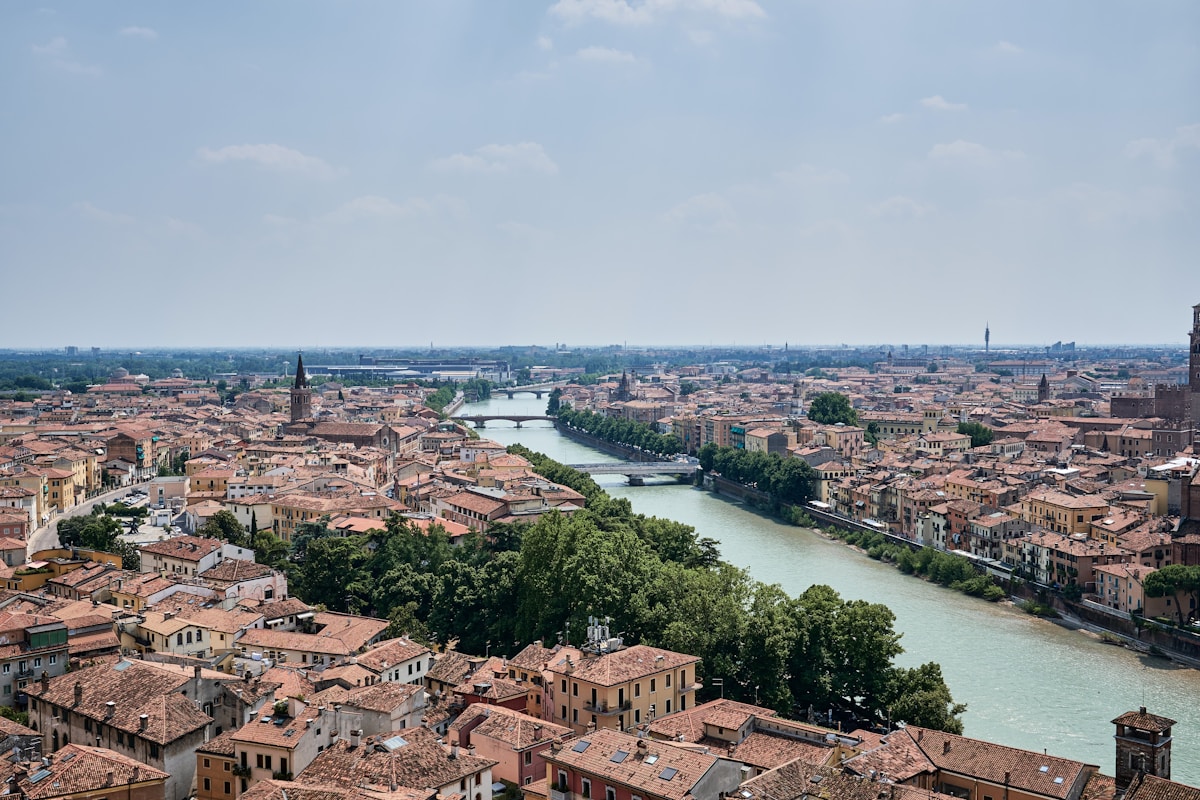
Verona Travel Guide: Romeo & Juliet, the Arena & the Veneto
Visiting Verona: the Roman amphitheatre, Shakespeare's city, Venetian architecture, Valpolicella wine, and Lake Garda day trips.
Guides for Verona
Verona is one of northern Italy’s most beautiful cities - a compact medieval and Roman city on the Adige River with an exceptional concentration of well-preserved architecture spanning two millennia. It’s internationally known as the setting for Romeo and Juliet (Shakespeare’s invention, not a true story, but the city has embraced it commercially) and as a gateway to Lake Garda and the Veneto wine region. UNESCO World Heritage since 2000.
The Arena
The Arena di Verona is a Roman amphitheatre completed in approximately 30 AD, one of the best-preserved in the world, and the third-largest Roman amphitheatre that survives. It seats 15,000 and has hosted the Verona Opera Festival every summer since 1913. The opera experience - with an audience of thousands, the old stone, candlelight, and open air - is one of the most atmospheric in the world.
Opera season: Performances run late June through early September. Tickets range from approximately €30 for the unreserved stone steps (the gradinate, where you sit on the original Roman seats - bring a cushion) to approximately €250 for the prime stalls seats. Book at arena.it well in advance for popular operas (Aida, Carmen, La Traviata). Stone step seats are often available closer to the date.
Outside opera season: The Arena is open for visits daily. Entry approximately €10 as of 2026. Open Tuesday–Sunday 8:30am–7:30pm (Monday from 1:30pm).
The historic centre
Piazza delle Erbe - The market square built over the old Roman forum. Frescoed facades on the surrounding palaces (the Casa dei Mercanti, the Mazzanti houses), a column with the Lion of St. Mark (Venice ruled Verona from 1405 to 1797), and a daily produce market. Lively but tourist-oriented by day; better for an evening aperitivo. Adjacent Piazza dei Signori has the Scaligeri tombs - elaborate Gothic canopied tombs of Verona’s medieval ruling family (the della Scala), visible from the street.
Castel Vecchio (Corso Castelvecchio 2) - A 14th-century Scaligeri fortress on the Adige River, now a museum of Venetian and Veronese art. Carlo Scarpa’s 1960s renovation is architecturally significant - a masterclass in integrating modern and medieval architecture. Entry approximately €6. Closed Monday.
Ponte Pietra - The Roman stone bridge across the Adige, partially destroyed in WWII and rebuilt using the original stones recovered from the river. The view from the bridge, with the Roman Theatre and the hillside above, is one of the best in the city.
Roman Theatre and Archaeological Museum (Regaste Redentore 2) - On the hillside across the Adige. The 1st-century BC theatre hosts summer performances. The museum above has Roman artifacts. Entry approximately €4.50. A lift ascends the hillside.
Juliet’s Balcony
Casa di Giulietta - Via Cappello 23. The medieval house has no connection to Shakespeare’s play; the balcony was added in the 1930s. The courtyard is perpetually crowded and the bronze statue’s right breast is polished by tourists for luck. Entry to the house approximately €6. It is a tourist trap, but an enthusiastic one. If you skip it, you’ll miss nothing of Verona’s genuine heritage.
Where to eat
Veronese cuisine includes pastissada de caval (horse-meat stew - a local tradition), risotto all’Amarone (risotto cooked with Amarone wine), and bigoli (thick whole-wheat spaghetti with anchovy or duck ragù). Osteria al Duca (Via Arche Scaligere 2 - mains approximately €12–16) serves traditional Veronese dishes near the Scaligeri tombs. Trattoria al Pompiere (Vicolo Regina d’Ungheria 5 - mains approximately €14–20) has been serving the city since 1920.
Wine country
Verona is surrounded by the wine appellations of the Veneto - Valpolicella and Amarone (north-west, 20 minutes by car), Soave (east, 25 minutes), and Bardolino (west, toward Lake Garda). Wine tours are well-organised from the city - expect approximately €80–150 per person for a half-day guided tour with tastings. Self-driving is also straightforward; the Valpolicella wine road is well-signed.
Where to stay
Budget: approximately €60–100/night near the station or in side streets off the centre. Mid-range: approximately €100–180/night in the historic centre. Hotel Colomba d’Oro (Via Carlo Cattaneo 10 - doubles from approximately €120/night) is a reliable four-star near the Arena. During opera season (late June–early September), prices increase by 30–50% and availability is tight - book 2–3 months ahead.
Day trips
Lake Garda is the obvious choice - Sirmione (35 km west, 30–45 minutes by bus or train to Peschiera) has a Scaligeri castle and Roman ruins, while Malcesine on the northern shore has a cable car ascending to Monte Baldo for panoramic views. Mantua (45 minutes east by train, approximately €5) is a Renaissance masterpiece: the Palazzo Ducale with Mantegna’s Camera degli Sposi is one of the finest rooms in Italian art. Valpolicella wine country is 15 km northwest - Amarone and Ripasso tastings available at Allegrini, Bertani, and Zenato with advance booking. Vicenza (45 minutes by train) is Palladio’s city, with the Teatro Olimpico and Villa La Rotonda. For a full guide: Day Trips from Verona.
Trento, 1 hour north by train, is the capital of Trentino - a city of Alpine character, Christmas markets, and strong wine culture that makes an excellent extension of a Verona visit.
Getting there
Verona Porta Nuova station: Frecciarossa to Milan approximately 1 hour (from approximately €15), to Venice approximately 1 hour (from approximately €10), to Rome approximately 3.5 hours (from approximately €35). Verona Villafranca Airport (VRN) has direct European flights. Bus 199 connects the airport to Porta Nuova (approximately 15 minutes, approximately €6). Lake Garda’s southern shore (Peschiera, Sirmione) is approximately 25 minutes by regional train.
For where to stay: Verona hotels. For the Arena opera, Roman theatre, and Castelvecchio in detail: things to do in Verona. Book a guided Verona tour to cover the Arena, the Scaligeri palaces, and the wine country context with a local guide. For horse-meat ragù, Soave, Amarone, and the best restaurants: Verona food guide. For a broader look at accommodation across the Veneto - Verona, Venice, Padua, and wine-country agriturismo: our Veneto hotels guide.
Upcoming Events in Verona
La Befana - Feast of the Epiphany 2027
La Befana 2027, January 6. Italy's Epiphany gift-giving day: children receive sweets or coal from the Befana witch, then decorations come down.
Book an experience
Top experiences in Verona
Explore the best tours and activities in Verona, with instant confirmation and free cancellation on most bookings.