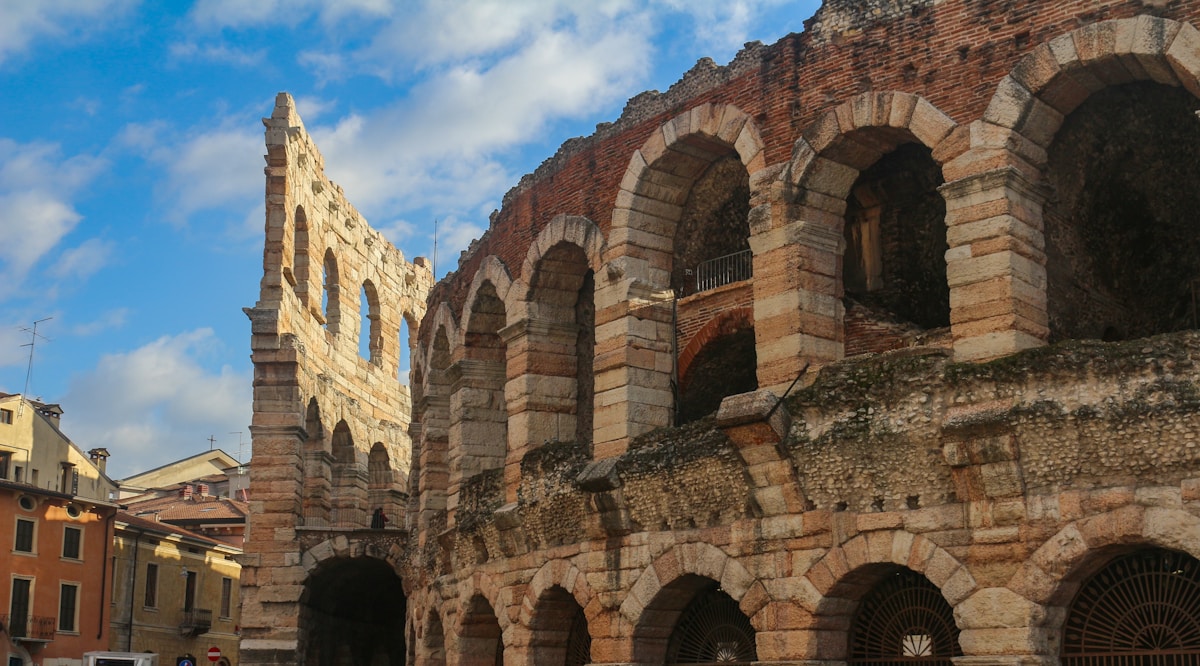
Verona is an exceptionally well-preserved Roman and medieval city in the Veneto region, an hour west of Venice by train. Most visitors arrive expecting Romeo and Juliet and leave genuinely surprised by the city’s depth - a complete Roman amphitheatre, a series of Romanesque and Gothic churches, one of the finest medieval piazzas in Italy, and easy access to Lake Garda.
The Roman Arena
Verona’s Arena is one of the best-preserved Roman amphitheatres in the world, built in 30 AD and still used for its original purpose - open-air performances. The annual summer opera festival (July–August) fills it with 14,000 people for full-scale productions of Aida, Carmen, and Tosca. The experience of watching opera in a Roman amphitheatre at night, with candle stubs distributed to the audience, is one of Italy’s most memorable events.
Outside the opera season, the Arena is a museum (€10 entry) with excellent views from the upper tiers across the city. Guided tours of Verona covering the Arena, Piazza delle Erbe, and the Scaligeri tombs provide strong historical context for the Roman and medieval layers of the city.
Top Tours at a Glance
| Tour | Duration | Price (from) | Group Size | Highlights |
|---|---|---|---|---|
| Verona walking tour with Arena | 2 hrs | from €25 | Up to 20 | Roman Arena, Piazza delle Erbe, Scaligeri tombs |
| Verona Arena opera evening with tickets | 4 hrs | from €85 | Up to 30 | Guided pre-show tour + reserved Arena opera seat |
| Verona + Lake Garda day tour | 8 hrs | from €65 | Up to 20 | Sirmione castle, Garda town, Verona old town |
| Valpolicella wine tour from Verona | 4 hrs | from €75 | Up to 12 | Amarone tasting, cellar visit, vineyard views |
Browse all Verona tours → GetYourGuide
Piazza delle Erbe and Piazza dei Signori
The Piazza delle Erbe sits on the site of the old Roman forum and has been a market since Roman times - still functioning as a daily market with fruit and vegetable stalls under the medieval tower fringe. The Colonna del Mercato (14th century), the Berlina (a small canopy where humiliated criminals were exhibited), and the baroque Maffei Palace at the north end surround it.
The adjacent Piazza dei Signori is the more austere civic square - the Scaligeri family’s Palazzo della Ragione (now a gallery), the Loggia del Consiglio, and the Arche Scaligere (Gothic tombs of the Scaligeri lords) just off to the east.
Castel San Pietro and the river views
A 10-minute walk up from the Roman theatre brings you to the terrace of Castel San Pietro, a 19th-century Austrian military structure on the hill above the city. The views across the river bend and the city’s Roman and medieval roofscape are the best in Verona. Go at sunset.
Juliet’s House (Casa di Giulietta)
The tourism industry has created this. The real Romeo and Juliet were a literary invention; the “Juliet’s house” is a medieval building that was given a balcony in the 1930s. Worth a look at the exterior (it’s free) but skip the museum inside. The courtyard has a Juliet statue, the right breast of which has been rubbed smooth by tourists for luck.
Basilica of San Zeno
One of the finest Romanesque churches in northern Italy (11th–12th centuries), 15 minutes walk west of the Arena. The bronze doors (1100s) with 48 panels of Biblical scenes are extraordinary. The crypt holds the sarcophagus of San Zeno, patron of Verona. Mantegna’s altarpiece in the north transept (the original in the nave is a copy; the panels were taken to Paris by Napoleon). The adjacent cloister is peaceful.
The Giusti Garden
A 16th-century formal garden on the hill above the city (east side). Grotesque sculptures, cypress rows, a maze, and views over the Adige river. One of the best-preserved Renaissance gardens in northern Italy. €10 entry.
Lake Garda day trip
Lake Garda is 30 minutes west of Verona by car or bus. The southern end - Lazise, Bardolino, Garda town, Sirmione - is accessible and worth a half day. Sirmione in particular: a castle on a spit of land projecting into the lake (the Scaligeri castle, 13th century), and at the tip of the peninsula, the Roman ruins of the Grotte di Catullo - a large 1st-century AD villa associated (loosely) with the poet Catullus, with views across the lake. Our Lake Garda guide covers the full lake with boat trips, the best towns to stay in, and the things to do on Lake Garda.
Soave and Valpolicella wine tasting
Verona sits in the middle of three of Italy’s most important wine zones. Soave (Soave DOC - dry white from Garganega grapes) is 25km east; the castle and the original medieval wine zone are worth the drive. Valpolicella (north of Verona) produces the DOC, Ripasso, and the top-tier Amarone. The Allegrini, Bertani, and Zenato estates all do visits. The Valpolicella Classico zone (Fumane, Negrar, San Pietro in Cariano) has concentrated stone villages and dramatic terraced vineyards.
Back to the full Verona travel guide for an overview of the city. For food and wine - Amarone, risotto, pastissada - see the Verona food guide. For day trips to Lake Garda, Mantua, and Venice, see day trips from Verona. For the Italian wine context, including Amarone, Soave, and Valpolicella, our Italian wine guide covers the Veneto’s classification system. For a northern Italy circuit connecting Venice, Verona, and Lake Garda, see our northern Italy itinerary.
Where to stay in Verona: Find hotels in Verona — search accommodation across all budgets.