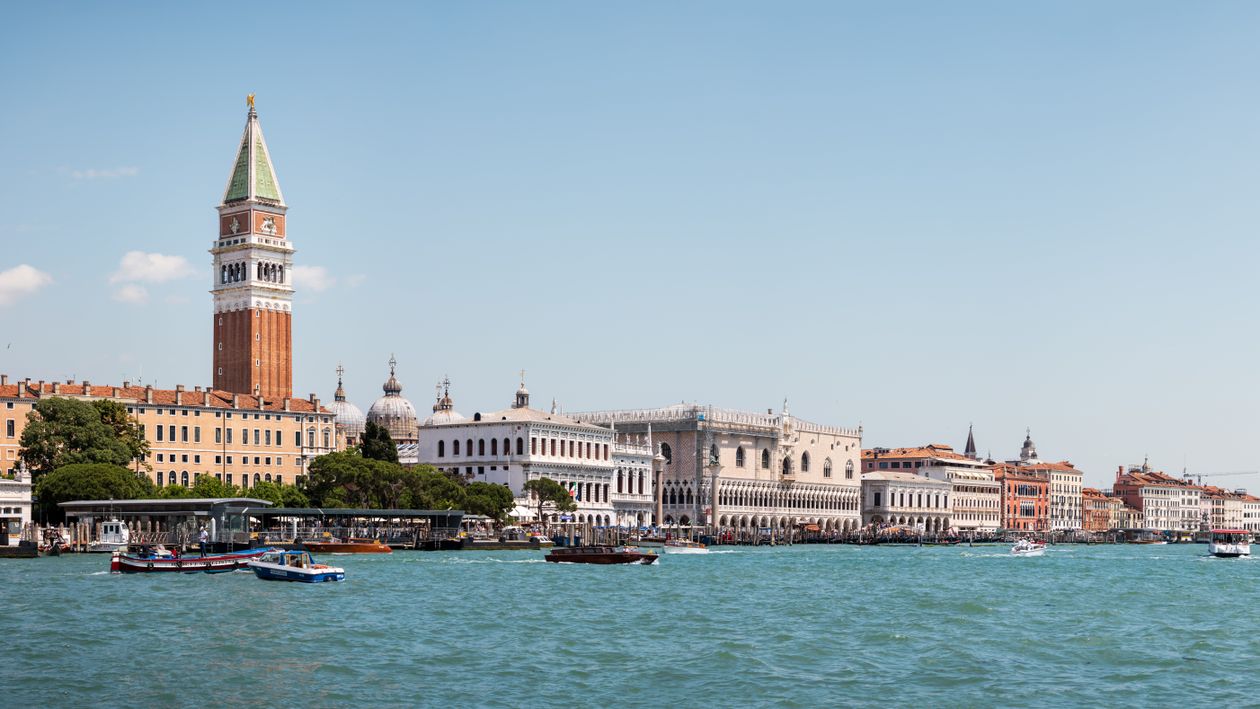
Rome and Venice are Italy’s two most distinct cities — and choosing between them is one of travel’s genuinely interesting problems. Rome is a living city of four million people built on top of 2,800 years of accumulated civilisation: ancient, medieval, Renaissance, Baroque, and contemporary, all existing simultaneously. Venice is something else entirely — a city of 250,000 people (many of whom live on the mainland) on 118 islands connected by 400 bridges, with no cars, no roads, and a built environment that has been extraordinary for six centuries. The comparison is between the world’s greatest accumulation of historical layers and the world’s most improbable city.
Quick Verdict
| Category | Rome | Venice |
|---|---|---|
| Ancient history | Winner | - |
| Uniqueness | - | Winner |
| Food variety | Winner | - |
| Value for money | Winner | - |
| Romance | - | Winner |
| Art and museums | Tied | Tied |
| Walkability | - | Winner |
| First-time visitors | Winner | - |
Choose Rome if you want scale, ancient history, Italian street life, and a city that operates as a city rather than a tourist attraction. Choose Venice if you want an experience that exists nowhere else on earth and are prepared to pay for it.
The Unique Factor
Venice’s most important quality is that there is nowhere else like it. Walking out of Venezia Santa Lucia station and confronting the Grand Canal for the first time is one of travel’s genuinely arresting moments. The city works by water: groceries arrive by boat, the postman has a boat, ambulances are boats, funeral gondolas carry coffins along the canals. The absence of traffic noise and the reflections of 15th-century palaces on still water create a sensory experience that has no equivalent in Europe.
Rome is extraordinary in a different register. The Pantheon (nearly 2,000 years old, free entry, still intact) sits between a pizzeria and a newsstand. Emperors and popes have walked the same basalt stones currently underfoot. The accumulated density of history is unmatched — but it is experienced within a functioning modern city rather than the preserved-in-amber quality of Venice.
Winner: Venice for pure uniqueness. Rome for historical depth across a broader timeline.
Ancient History and Sightseeing
Rome is unmatched for ancient history. The Colosseum (€24 combined ticket with the Roman Forum and Palatine Hill — book weeks ahead in peak season) is the defining structure of ancient power. The Roman Forum, the Circus Maximus, the Baths of Caracalla, and Trajan’s Column create an archaeological landscape that no other city in the world can replicate. Walking from the Colosseum to the Pantheon to Trajan’s Forum covers 1,000 years of Roman history in under two hours.
Venice’s history begins in the 9th century with the emergence of the Republic of Venice. The Doge’s Palace (€30 combined ticket, book ahead) is the political heart of what was once Europe’s most powerful trading state. The Basilica di San Marco (free entry to the church, €7 for the treasury, book the facade mosaic entry for €3 to avoid queues) was begun in 832 and rebuilt repeatedly into its current gold-encrusted Byzantine form. The Accademia gallery (€15) contains the definitive collection of Venetian painting from Bellini to Titian to Tintoretto.
Winner: Rome for ancient history. Venice for medieval and Renaissance maritime power.
Art and Museums
Rome’s art is encyclopaedic. The Vatican Museums (from €20, mandatory advance booking to avoid 3-hour entrance queues) contain the Sistine Chapel, Raphael’s Stanze, and dozens of galleries spanning Egyptian antiquities to 20th-century religious art. The Borghese Gallery (€13, timed entry required — book 2+ weeks ahead) holds Bernini sculptures that are among the finest achievements of Western art. The Capitoline Museums (€16) are the world’s oldest public museums, dating from 1471.
Venice’s museums are more focused but outstanding in their field. The Gallerie dell’Accademia houses the canonical collection of Venetian painting. The Peggy Guggenheim Collection (€18) is one of Europe’s best surveys of 20th-century modernism — housed in the American heiress’s Grand Canal palazzo. The Ca’ Rezzonico (€10) reconstructs 18th-century Venetian aristocratic life. The Punta della Dogana contemporary art space (€20) occupies the former customs house at the tip of Dorsoduro.
Winner: A draw. Rome for breadth and volume. Venice for specialist depth in Venetian and medieval art.
Food and Dining
Rome’s food scene is one of Italy’s finest. The four canonical pasta dishes — carbonara, cacio e pepe, amatriciana, and gricia — are rigorously executed and widely available. A plate of carbonara at a proper trattoria in Trastevere costs €12–15. Pizza al taglio (by the slice) from Bonci Pizzarium near the Vatican costs €3–5 and represents some of Italy’s best pizza. Supplì (fried rice balls, €2–3) are the standard street snack. A full dinner with wine at a mid-range restaurant runs €30–40 per person. The range from street food to fine dining is exceptional.
Venice’s food is more expensive and more limited in variety. The two signature dishes are risotto al nero di seppia (cuttlefish ink risotto) and sarde in saor (sweet-and-sour sardines with onions and raisins) — genuinely good and distinctive, but the repertoire is narrower. Cicchetti (small bar snacks, €2–5 each) served at traditional bacari (wine bars) along Fondamenta della Misericordia in Cannaregio are the best-value eating in the city. Avoid the tourist restaurants near Piazza San Marco — the quality and prices are both extreme. A decent restaurant meal in Venice costs €35–55 per person.
Winner: Rome for variety, value, and street food. Venice for distinctive lagoon cuisine.
Accommodation
Rome has far more hotel stock, which keeps prices competitive across all tiers. A well-located 3-star hotel near the historic centre costs €90–150/night in high season. Boutique hotels in Trastevere or near Piazza Navona run €160–280. Budget travellers can find clean hostels from €30–40/night per bed.
Venice has less accommodation than demand requires, which drives prices up year-round. A 3-star hotel in Cannaregio or Dorsoduro (the less touristic sestieri) costs €130–250/night in peak season. The iconic luxury properties on the Grand Canal — the Gritti Palace, Hotel Danieli, Cipriani — start from €700–1,200/night. Hostels run €50–80/night. The nearby mainland town of Mestre offers cheaper hotels (€60–100) with a 10-minute train or bus connection to Venice — a legitimate cost-saving strategy.
Winner: Rome for value and range. Venice if you want to sleep inside the island city.
Getting Around
Venice has no cars, which makes navigation simple: you walk, or you take a vaporetto (water bus). A 24-hour unlimited vaporetto pass costs €25; a single ticket costs €9.50. Walking across the entire island takes about 45 minutes without stops. The absence of traffic is Venice’s great freedom — wandering off the main routes into the quieter Cannaregio or Santa Croce sestieri, you can lose the crowds within minutes of leaving Piazza San Marco.
Rome requires more planning. The historic centre is walkable, but distances between major sights are significant — the Vatican to the Colosseum is a 45-minute walk. The metro (Line A and Line B are the useful lines) costs €1.50 per journey. Taxis are reasonable (€10–20 for most journeys within the centre). Walking is the best way to explore neighbourhoods like Trastevere, Testaccio, and Pigneto, but the city’s size means you’ll need public transport for longer journeys.
Winner: Venice for sheer ease of navigation within the island. Rome requires more strategic planning.
Crowds
Venice has a genuine overtourism problem. In peak summer (July–August) and during events like Carnival (February) and Regatta Storica (September), the Ponte di Rialto, Piazza San Marco, and the area around the train station become genuinely unpleasant. Approximately 20 million tourists visit per year — a city of 250,000 permanent residents. The city has introduced a day-visitor booking fee (€5 on peak dates) to manage flow, but the core tourist routes remain very busy.
Rome’s crowds are significant but the city is large enough to absorb them. The Colosseum, Trevi Fountain, and Vatican Museums are genuinely congested without advance booking. But five minutes off any major route and you are in a neighbourhood that feels like a real city. The dispersed geography of Rome’s major sights means the crowds are diluted.
Winner: Rome for managing crowds. Venice in the off-season (November–February, excluding Carnival) is genuinely calm.
Final Verdict
Rome wins for a first-time visit to Italy — it offers more variety, better value, more historical depth, and a city that functions as a city rather than primarily as a tourist experience. Venice wins for uniqueness: it is the one place in Europe that genuinely has no equivalent, and experiencing it properly — staying for two or three nights, walking the quiet routes after 8pm when day-trippers have left, drinking prosecco at a canal-side bacaro — is one of travel’s great pleasures.
If you can, visit both. The 4-hour high-speed train connection makes it easy to combine them in a single Italy itinerary.
Ready to Plan Your Trip?
See our guides for planning across both cities:
- Rome vs Florence - how Italy’s two greatest cities compare
- Venice vs Florence - two Renaissance powerhouses compared
- One Week in Italy - seven days through Rome, Florence, and Venice
Plan Your Trip
✈️ Book your flights to Italy 🛡️ Get travel insurance 📱 Stay connected with an eSIM 🚗 Rent a car
🎟️ Browse tours in Rome — Browse tours in Venice 🏨 Search hotels in Rome — Search hotels in Venice