Ravenna Travel Guide: Byzantine Mosaics & UNESCO
Guide to Ravenna: eight UNESCO World Heritage Sites, 5th-century Byzantine mosaics, Dante's tomb, Basilica San Vitale, and day trips from Bologna.
Guides for Ravenna
Ravenna was three times at the centre of European history: as capital of the Western Roman Empire in its final decades (402–476 AD), as the seat of Theodoric the Great’s Ostrogothic kingdom, and as a Byzantine stronghold after Justinian’s reconquest of Italy in 540 AD. Each period left behind mosaics that remain, 1,500 years later, unmatched anywhere in the Western world. The city has eight UNESCO World Heritage Sites — all within walking distance of each other in a mid-sized Emilia-Romagna town — and almost no international tourist crowds compared to what that designation implies.
The mosaics: what to see and in what order
A combined ticket (approximately €12) covers five of the six main sites. The sensible route starts at the two earliest and most important:
Mausoleo di Galla Placidia — The oldest intact monument in Ravenna (c. 430 AD), a small cruciform building containing what many art historians consider the finest early Christian mosaics anywhere. The deep blue vault of the main cupola, set with gold stars, and the lunette mosaics showing the Good Shepherd and figures of saints, are extraordinary for their condition and colour intensity. Note: this site sometimes requires timed entry during peak season due to its small size. Entry included in combined ticket.
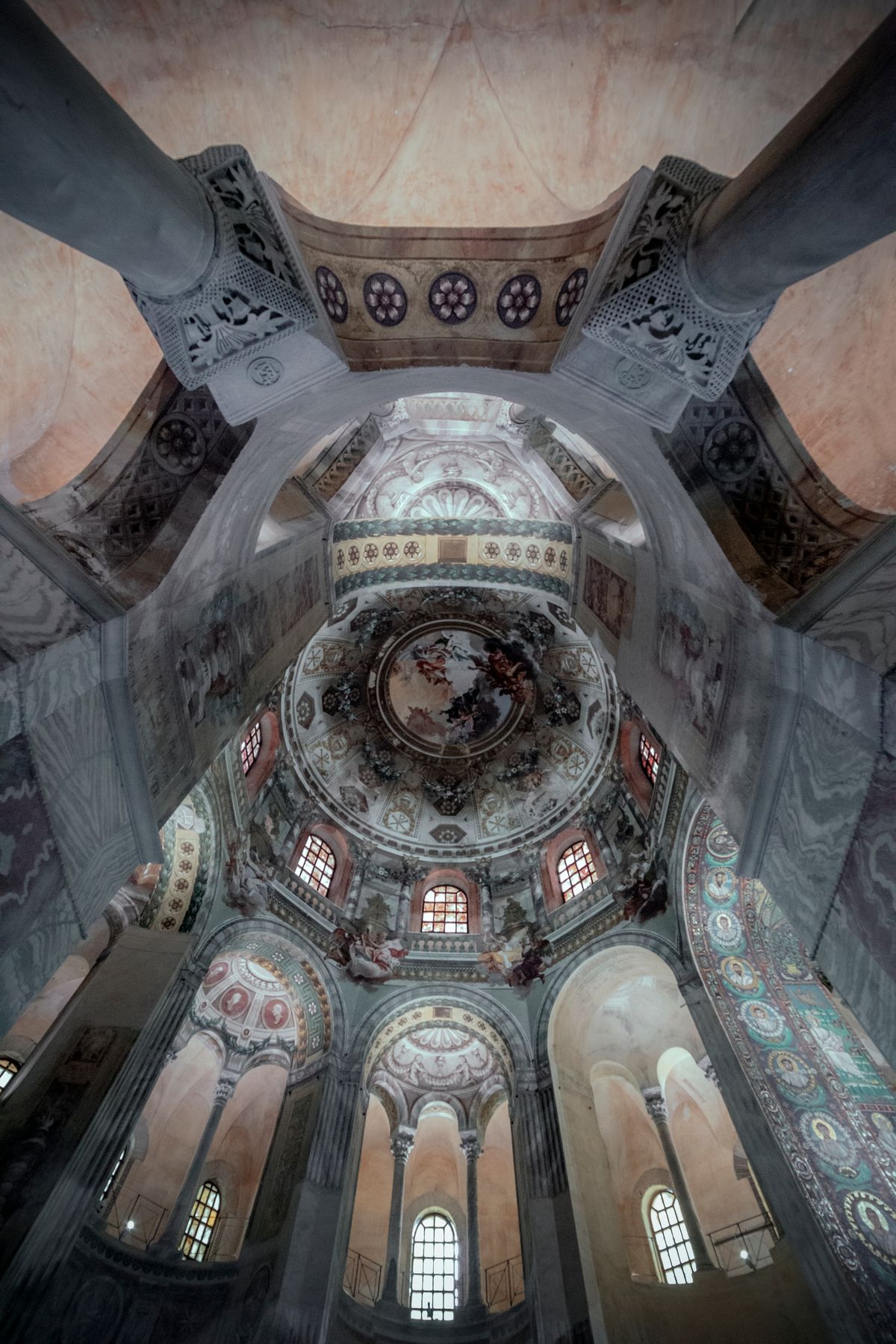
Basilica di San Vitale (Via Fiandrini) — Built under Justinian I and consecrated in 548 AD, this octagonal basilica contains the two most famous Byzantine mosaic panels in the world: the imperial portraits of Justinian and his court (north apse) and Empress Theodora and her attendants (south apse). These are not decorative — they are political statements in coloured glass. The domed ceiling, covered entirely in mosaic, requires looking upward for extended periods. Entry included in combined ticket.
Battistero Neoniano (Bishop’s Baptistery, Via Battistero) — A late 4th-century octagonal baptistery with a mosaic ceiling showing the Baptism of Christ surrounded by the twelve apostles. The oldest functioning baptistery in the Western world and one of the best examples of early Christian art in Italy. Entry included in combined ticket.
Basilica di Sant’Apollinare Nuovo (Via di Roma) — Built by Theodoric around 500 AD, with two long mosaic processions along the nave walls: 26 martyrs on one side, 22 virgins on the other, forming a formal cortège towards Christ and the Virgin. The processions are easier to read than the dense iconographic programmes at San Vitale. Entry included in combined ticket.
Battistero degli Ariani (Piazza degli Ariani) — A smaller baptistery built by Theodoric for the Arian Christian community. The mosaic ceiling, again showing the Baptism of Christ, is simpler than the Orthodox baptistery but notable for the stylistic differences that reveal different theological interpretations of the same scene. Entry included in combined ticket.
Cappella Arcivescovile (Archbishop’s Chapel, Piazza Arcivescovado) — Inside the Archbishop’s Palace, this oratory contains a mosaic programme from around 494 AD including an unusual image of Christ as a warrior. The building also houses the Archiepiscopal Museum. Entry approximately €4 (not always included in combined ticket).
Sant’Apollinare in Classe (Via Romea Sud, 4km from centre) — The most impressive of the basilicas in terms of scale, built over the site of the ancient port of Classe. The apse mosaic — showing Christ as the Transfiguration, represented symbolically rather than literally — is among the finest Byzantine images outside Istanbul. Buses from Ravenna centre run to Classe approximately every 30 minutes. Entry approximately €5.
Tomba di Dante (Via Dante Alighieri) — Dante Alighieri died in Ravenna in 1321, while in exile from Florence. His tomb is a small neoclassical structure beside the larger Church of San Francesco. Florence has repeatedly requested the return of Dante’s remains; Ravenna has consistently refused. Entry free.
Where to stay
Hotel Centrale Byron (Via 4 Novembre 14 — doubles from approximately €90/night) sits in the quiet pedestrian zone of the historic centre, six minutes’ walk from the Basilica San Vitale. Named after Lord Byron, who lived in Ravenna between 1819 and 1821 while conducting an affair with the Countess Guiccioli and writing much of Don Juan. Clean rooms, free breakfast, and the best location in town.
Mid-range alternatives are clustered near the train station (Piazzale Farini), approximately 10–15 minutes’ walk from the main sites. Hotel Sant’Andrea (Via Cat. Sforza 6 — doubles from approximately €80/night) is 100 metres from Basilica San Vitale and is consistently well-reviewed for location.
Food
Ravenna sits in Emilia-Romagna, and the food reflects it. Piadina (unleavened flatbread, cooked on a terracotta griddle and filled with squacquerone cheese, prosciutto, or salami) is the regional staple — eaten standing at a piadineria for approximately €4–6. Cappelletti in brodo (small filled pasta in capon or beef broth) is the traditional first course for winter meals. Ravenna’s position on the Adriatic coast also means excellent fish — grilled or battered seafood at the restaurants near the covered market.
Named restaurants: Ca’ de Ven (Via C. Ricci 24 — a historic osteria in a 15th-century building with excellent regional food; mains approximately €14–18) is the most atmospheric spot in the centre. Osteria del Tempo Perso (Via Gamba 12 — mains approximately €12–16) focuses on local seafood and regional classics.
Sangiovese di Romagna is the local wine — lighter and more acidic than the Sangiovese-based wines of Tuscany, and typically very good value at €5–7 a glass.
Getting there and around
Train: Direct regional trains from Bologna Centrale (approximately 1 hour, €7–10). From Florence, change at Bologna (approximately 2 hours total). From Venice, change at Ferrara or Bologna (approximately 2 hours). Ravenna is not on the high-speed rail network.
Car: Ravenna is approximately 74km from Bologna via the A14 and SP610 (approximately 1 hour). Parking is available outside the walls.
On foot: All six town-centre sites are within a 15-minute walk of each other. The pedestrian zone makes walking the obvious way to get around.
Day trip from Bologna: Ravenna is well-placed as a full-day trip from Bologna or Ferrara. See the northern Italy itinerary for routing. Bologna is the closest major city (1 hour by train); Ferrara is 1h15 away and combines well as a two-city day. For the food context, see the Emilia-Romagna food guide. To book a guided mosaic tour of Ravenna’s UNESCO sites, see tours in Ravenna.
Upcoming Events in Ravenna
La Befana - Feast of the Epiphany 2027
La Befana 2027, January 6. Italy's Epiphany gift-giving day: children receive sweets or coal from the Befana witch, then decorations come down.
Book an experience
Top experiences in Ravenna
Explore the best tours and activities in Ravenna, with instant confirmation and free cancellation on most bookings.