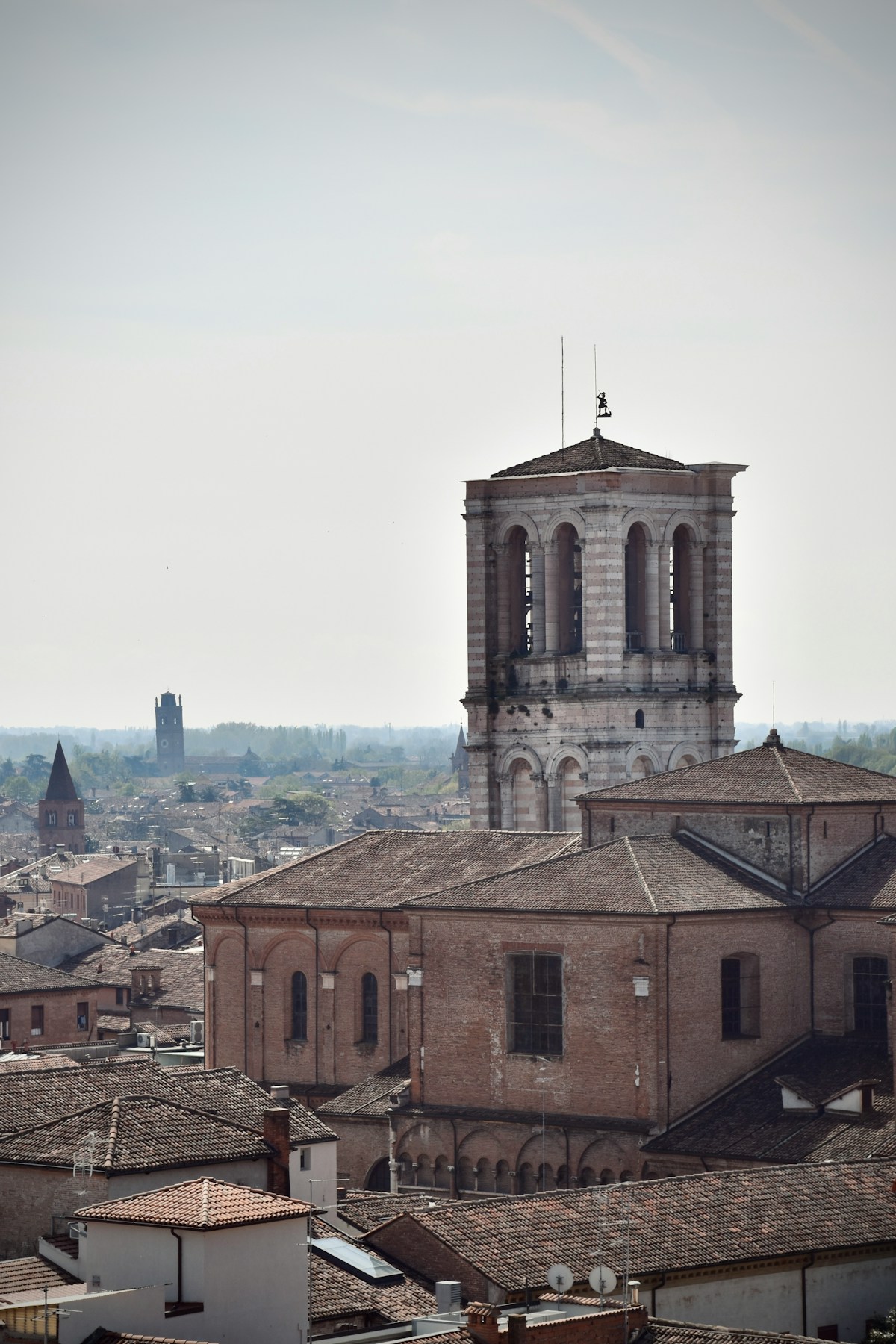
Ravenna sits at a useful point in Emilia-Romagna: close enough to the major cities to make day trips practical, and well connected by regional rail. The flat Po Plain means travel is fast and straightforward. Whether you want another UNESCO city, a food capital, an Adriatic beach, or something quieter, the options within 90 minutes are genuinely strong.
Ferrara (50–70 minutes by train)
Ferrara is the most underrated city in Emilia-Romagna and, in our view, the best day trip from Ravenna. It is a UNESCO World Heritage City — designated partly for its Renaissance urban plan, one of the first deliberately designed Renaissance cities in Italy — and it has a character quite different from the busier cities of the region.
The city was the seat of the Este dynasty from the 13th century until 1598, when the papacy annexed it. The Este court was one of the most significant in Renaissance Italy, patronising Ariosto, Tasso, and a series of important painters including Cosmè Tura, Francesco del Cossa, and Dosso Dossi. The art and architecture they left behind are substantial.
Castello Estense occupies the centre of the city — a large moated 14th-century castle with towers at each corner and a drawbridge still in working order. The interior has frescoed rooms, a hanging garden, and dungeons where members of the Este family were imprisoned and executed. Entry is approximately €10. Open daily except Monday.
Palazzo dei Diamanti is one of the most distinctive Renaissance buildings in Italy: the facade is covered with 8,500 pointed stone blocks cut to resemble diamonds, creating a shimmering optical effect in raking light. The palazzo now houses temporary exhibitions — check what is on before you visit, as the quality varies.
The medieval quarter around Via delle Volte is the best-preserved medieval street in the city: a long arcaded lane of brick arches, dark even at midday, with the feel of a 14th-century city intact. The Jewish Ghetto established in 1627 is also intact, with the old synagogue complex and several Jewish museums (the community was one of the oldest in Italy).
Ferrara is notable for cycling: it is often cited as Italy’s most bicycle-friendly city by per capita use. Bikes can be rented at the main station for approximately €10 per day. The city’s 6km circuit of intact medieval walls is excellent on a bicycle, and the flat terrain makes it entirely practical.
By train: Ferrara Centrale is the destination. Services from Ravenna sometimes require a change; check Trenitalia for your specific journey. Fare approximately €5–8 each way.
Bologna (1 hour 20 minutes by train)
Bologna is the regional capital and one of the best food cities in Italy, but it is also consistently rewarding for art, architecture, and university-town atmosphere. The city has one of the best-preserved historic centres in northern Italy, and the 42 kilometres of arcaded porticoes that line its streets — now a UNESCO World Heritage Site in their own right — give it a distinctly walkable character in all weathers.
The Two Towers (Due Torri) at the edge of the historic centre are the city’s symbol: the Asinelli tower (97m) can be climbed for views over the city and the Apennine foothills to the south. Entry approximately €5, approximately 498 steps.
The Quadrilatero market district (Via Drapperie and surrounding streets) is the best food market in Emilia-Romagna: butchers, cheese shops, pasta-makers, fishmongers, and salumerie arranged in lanes that have served the same function since the medieval period. Come here for mortadella, fresh tortellini, Parmigiano-Reggiano, and local charcuterie. Open Monday to Saturday.
Santuario di San Luca stands on a hill south of the city and is connected to Bologna by a continuous covered arcade of 666 arches stretching 3.8km — built from 1674 to 1793 to allow the icon of the Madonna di San Luca to be carried into the city in bad weather. Walking the full arcade takes about an hour each way and ends at the sanctuary, which has exceptional views over Bologna and the Po Plain. Bus 20 also runs to the base of the hill.
The Pinacoteca Nazionale di Bologna (Via Belle Arti 56) holds an important collection of Emilian painting from the 13th to 18th century, including Raphael’s Ecstasy of St Cecilia and major works by the Carracci, Guido Reni, and Guercino. Entry approximately €6.
By train: Bologna Centrale from Ravenna takes approximately 1h20, usually requiring a change at Castel Bolognese. Fare approximately €8–10 each way.
Rimini (1 hour by train)
Rimini is known primarily as a mass-market beach resort, and in July and August the coast is extremely crowded. But the old town contains two monuments that most visitors to the beach never see, and together they make a half-day visit worthwhile.
The Arco d’Augusto (27 BC) stands at the edge of the old city where the Via Flaminia entered Rimini — now called Ariminum. It is one of the best-preserved Roman arches in northern Italy, still standing to full height, with the original Latin inscription intact. Free to view.
The Tempio Malatestiano (Via IV Novembre) is one of the most unusual churches in Italy. It was a Gothic Franciscan church (San Francesco) until Sigismondo Pandolfo Malatesta, ruler of Rimini, commissioned Leon Battista Alberti in 1450 to encase it in a classical marble shell intended as a humanist pantheon and dynastic mausoleum. The result is a Gothic interior wrapped in a Roman exterior — the project was never fully completed, so the intended dome was never built. Inside, the tombs of Sigismondo and his court humanists remain. Alberti’s facade is considered one of the founding documents of Renaissance architecture. Free entry; open mornings.
If you are visiting in summer, Rimini’s beach is a classic Italian Adriatic experience: rows of striped umbrellas and sunloungers stretching for kilometres, with bars, music, and the social ritual of the Italian seaside fully intact. Sunlounger and umbrella hire from approximately €15–25 per day.
By train: direct services from Ravenna to Rimini take approximately 1 hour. Fare approximately €8–10 each way.
Cervia and the Adriatic Salt Pans (30 minutes by train)
For a quieter day trip, Cervia is a smaller resort town 30 minutes south of Ravenna by train. The town itself is pleasant but not remarkable; the reason to come is the Salina di Cervia, a working salt flat and natural park immediately behind the resort strip.
Cervia’s salt — Sale Dolce di Cervia — has been produced continuously here since at least the 8th century and is considered one of the finest table salts in Italy (low in magnesium, higher in natural minerals than most industrial salts). The salt flats have been returned to a more natural state in recent decades, and the shallow ponds now attract wading birds including, in spring and autumn, pink flamingos. The salt pans can be visited on foot or by bicycle along paths at the edge of the lagoon.
Salt produced at Cervia is sold in local shops throughout Emilia-Romagna — bags of Sale Dolce di Cervia make a useful and genuinely local gift.
By train: Ravenna to Cervia-Milano Marittima, approximately 30 minutes. Fare approximately €3–4 each way.
Practical Notes
All day trips described here are accessible by regional train from Ravenna Centrale station. Trenitalia tickets can be bought at the station, at ticket machines, or via the Trenitalia website and app. For journeys requiring a change (particularly to Ferrara and Bologna), build in extra connection time on regional services — delays of 10–15 minutes are not uncommon. None of these destinations requires advance booking to visit, though checking opening times for specific museums before you go is advisable.
Where to stay in Ravenna: Find hotels in Ravenna — search accommodation across all budgets.