Ferrara Travel Guide: The Renaissance Bicycle City
Ferrara travel guide: the Este dynasty's Renaissance capital, with the Castello Estense, Palazzo dei Diamanti, and cycling the old walls.
Guides for Ferrara
Ferrara is one of Italy’s most liveable cities - a planned Renaissance city built by the Este dynasty in the 15th and 16th centuries, with wide straight streets, a magnificent moated castle at its centre, and a flat terrain that makes it the cycling capital of Italy (one of the highest bike-to-car ratios in the country). It has been a UNESCO World Heritage Site since 1995 and receives far fewer tourists than its quality warrants.
The Este Castle
The Castello Estense sits at the physical and historical centre of Ferrara - a moated medieval-Renaissance castle begun in 1385 that served as the court of the Este lords for over 200 years. The interior (open for visits) includes the ducal apartments with frescoed ceilings, the Salone dei Giochi, the chapel, the kitchens, and the underground prisons where Parisina d’Este and her lover Ugo were executed in 1425. Entry approximately €8 as of 2026. Open Tuesday–Sunday 10am–6pm. The moat, with its drawbridges and corner towers, is the defining feature of the city - a castle surrounded by water in the middle of an Italian city is genuinely unusual.
The Renaissance city
The Addizione Erculea - the northern expansion of Ferrara planned by Duke Ercole I and his architect Biagio Rossetti in 1492 - is the most ambitious Renaissance urban planning project that survives substantially intact. Wide straight streets (Corso Ercole I d’Este is the most impressive), palaces with gardens behind high walls, and a logic of urban design 300 years ahead of most European cities.
Palazzo dei Diamanti (Corso Ercole I d’Este 21) - Named for its facade of 8,500 diamond-shaped marble blocks, each cut at a slightly different angle to catch light throughout the day. Now the Pinacoteca Nazionale (permanent collection of Ferrara school painting, entry approximately €6) and one of Italy’s most important temporary exhibition spaces. Check ferraraarte.it for current shows.
Palazzo Schifanoia (Via Scandiana 23) - A 15th-century Este pleasure palace with the extraordinary Salone dei Mesi - a cycle of frescoes depicting the months of the year with astrological themes, painted by Francesco del Cossa and his workshop. Entry approximately €6. Closed Monday. One of the most underrated fresco cycles in Italy.
The medieval city
The Cathedral (Piazza della Cattedrale) - A Romanesque-Gothic cathedral with a remarkable triple-arched facade depicting the Last Judgment. The south wall, facing Piazza Trento e Trieste, has a loggia of shops that have been trading since the medieval period. The Museo della Cattedrale (entry approximately €6) has works by Cosmè Tura, the founder of the Ferrara school of painting.
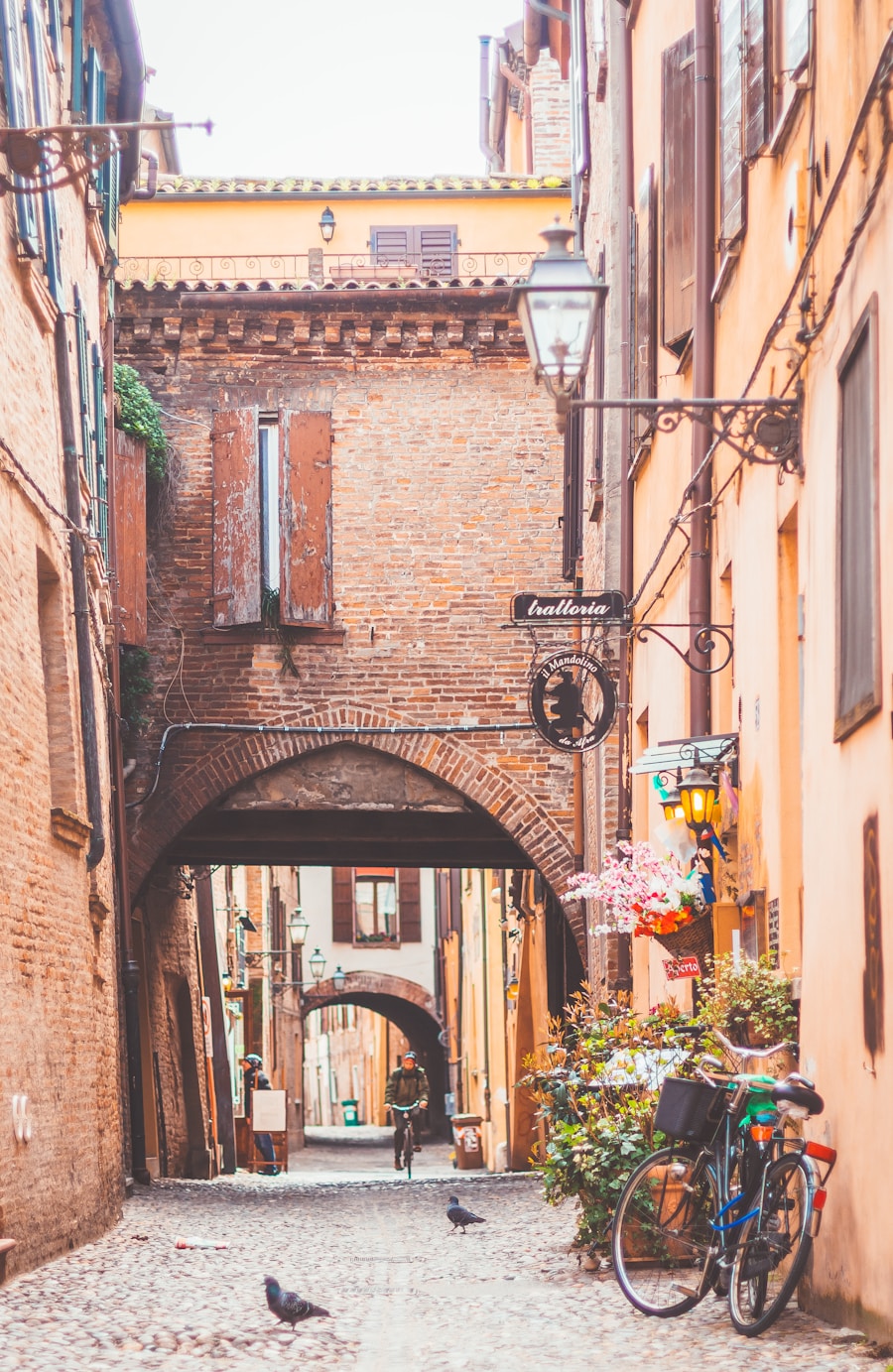
Via delle Volte - A medieval street running parallel to the former Po riverbank, with covered brick passageways (volte) spanning the street overhead. Atmospheric and largely empty of tourists.
The city walls - Ferrara’s 9km Renaissance walls are almost completely intact and form a continuous elevated path around the city - one of the best urban walks in Italy. Accessible on foot or by bicycle. Allow 2–3 hours for the full circuit.
Cycling
Ferrara is flat, compact, and built for bicycles. Most locals cycle everywhere; the city has extensive cycle lanes and dedicated paths. Rent a bicycle at the station (several rental shops near Piazzale Stazione, approximately €10/day) and use it to explore the old city, the walls, and the Addizione Erculea. This is the best way to experience Ferrara.
Food
Ferrara’s cuisine is Emilian but has unique local specialities. Cappellacci di zucca (pumpkin-filled pasta in butter and sage - the Ferrara equivalent of tortellini) is the signature dish. Pasticcio di maccheroni (a sweet-savoury pasta pie with pastry crust, ragù, béchamel, and truffles - uniquely Ferrarese) is extraordinary. Salama da sugo (a fermented pork sausage served with mashed potato) is the most distinctive local meat dish. Coppia ferrarese (the city’s twisted bread, IGP-protected) is served at every meal.
Named restaurants: Trattoria da Noemi (Via Ragno 31 - traditional Ferrara, cappellacci approximately €10, mains approximately €12–16), Osteria degli Angeli (Via delle Volte 4 - atmospheric setting, mains approximately €12–16), Cusina e Butega (Via Mazzini 95 - modern Emilian, mains approximately €14–18).
The Mercato Coperto (Via del Mercato, near the castle) and the Friday market in Piazza Ariostea are the main food shopping destinations.
Where to stay
Budget: approximately €50–70/night near the station. Mid-range: approximately €80–130/night. Hotel Annunziata (Piazza Repubblica 5 - doubles from approximately €100/night) faces the Este Castle and is the best-positioned hotel in the city. B&Bs in the medieval quarter offer excellent value.
Getting there
Ferrara is on the Bologna–Venice main line. Fast trains from Bologna approximately 30 minutes (from approximately €5). From Venice approximately 45–60 minutes (from approximately €8). From Florence approximately 90 minutes with a change at Bologna. The station is a 15-minute walk from the Este Castle.
For accommodation across all price ranges: Ferrara hotels. For the Este Castle, Palazzo Schifanoia, and the Renaissance walls cycling circuit: things to do in Ferrara. Book a guided tour of Ferrara to explore the Este Castle and the Renaissance city with a licensed local guide. For cappellacci di zucca, pasticcio, and the best restaurants in the city: Ferrara food guide and the Emilian food guide.
Upcoming Events in Ferrara
La Befana - Feast of the Epiphany 2027
La Befana 2027, January 6. Italy's Epiphany gift-giving day: children receive sweets or coal from the Befana witch, then decorations come down.
Book an experience
Top experiences in Ferrara
Explore the best tours and activities in Ferrara, with instant confirmation and free cancellation on most bookings.