Elba Travel Guide: Napoleon's Island, Beaches & Tuscan Coast
Everything you need to plan a trip to Elba - beaches, hiking, the Napoleon connection, where to stay, and how to get there from the Tuscan mainland.
Guides for Elba
Elba is where Napoleon Bonaparte was sent after his first abdication in 1814 - a volcanic island 10km off the Tuscan coast, third largest in Italy, with 147km of coastline and a landscape of granite mountains, pine forests, and mineral-rich hills that once made it the iron ore capital of the ancient Mediterranean. He stayed for ten months, redesigned the island’s roads, reformed its administration, and then escaped to reclaim France before his final defeat at Waterloo. Today the two houses where he lived are the island’s most visited museums, and the surrounding waters - clear, warm, and protected within the Tuscan Archipelago National Park - draw visitors for their own considerable merits.
Getting there
By ferry from Piombino: The standard crossing runs from Piombino Marittima to Portoferraio. Moby Lines and Toremar (now part of Moby) are the main operators. Car ferries run the crossing in approximately 60–70 minutes, with departures roughly every 30–60 minutes in summer and every 1–2 hours in winter. Passenger fare approximately €12–18 as of 2026 (season-dependent); cars approximately €30–65 each way depending on vehicle size and booking date. Book online in advance for July and August - crossings sell out, particularly on Friday evenings and Sunday afternoons when Italians are heading to and from the island.
A faster passenger-only hydrofoil (aliscafo) also runs from Piombino to Portoferraio in approximately 30 minutes, operated seasonally (roughly May–October), fare approximately €20–25 per person. This is foot passengers only - no vehicles.
Getting to Piombino: Trenitalia regional trains connect Piombino Marittima (the port station, directly at the ferry terminal) with Campiglia Marittima, where you change for trains from Pisa (approximately 1.5 hours), Florence (approximately 2 hours), or Rome (approximately 2.5–3 hours). A direct Intercity train from Rome to Campiglia Marittima also runs on some timetables. From Pisa Airport, the train journey to the ferry is approximately 1.5–2 hours total.
Alternatively, driving to Piombino takes approximately 1.5 hours from Pisa, 2 hours from Florence, or 3 hours from Rome. Paid parking in Piombino near the ferry terminal costs approximately €10–18/day as of 2026.
The Napoleon connection
Napoleon arrived on Elba on 4 May 1814, having been granted sovereignty over the island under the Treaty of Fontainebleau. He brought a personal household of approximately 600 soldiers, his mother Letizia, and his sister Pauline. He lived between two residences and spent his months on the island conducting what amounted to a miniature state: building roads, improving the mines, reorganising the judicial system, and developing the island’s mulberry cultivation. He escaped by sea on the night of 26 February 1815.
Villa dei Mulini (Portoferraio, above the Forte Falcone) - Napoleon’s main official residence, a converted windmill complex (hence the name - mulini means mills) on the headland above the town. The reception rooms, library, and private apartments are preserved with period furniture and some original objects. The garden overlooks the harbour entrance. Entry approximately €8 as of 2026 (combined ticket with Villa San Martino approximately €12). Open Monday and Wednesday–Saturday 9am–7pm, Sunday 9am–1pm. Closed Tuesday.
Villa San Martino (San Martino, approximately 5km southwest of Portoferraio) - Napoleon’s summer residence, a smaller country villa at the foot of a hill. The house itself is relatively simple; the larger Palazzina Demidoff attached to it (built by Prince Demidoff in the 19th century) contains an Egyptian gallery and a small collection of Napoleonic-era art. Combined ticket with Villa dei Mulini approximately €12 as of 2026. Same opening hours as Villa dei Mulini.
Best beaches
Elba’s coastline varies considerably by sector - the north coast is more sheltered with calmer water, the south and west coasts have stronger waves and more dramatic scenery. Beach types range from fine white sand to smooth granite pebbles.
Biodola (northwest coast, approximately 10km from Portoferraio) - One of the finest sandy beaches on the island, in a sheltered bay with shallow clear water. Popular with families and relatively well-served by bus from Portoferraio. Sun lounger hire approximately €18–25 per day in season. A public section remains free.
Cavoli (southwest coast, approximately 20km from Portoferraio) - A long sandy beach with clear water in shades of green and blue, facing south and catching significant sun hours. The village behind has a cluster of bars and restaurants. Accessible by bus from Portoferraio (change at Marina di Campo) or by car.
Sant’Andrea (northwest coast, approximately 18km from Portoferraio, near Marciana Marina) - A small granite cove with exceptionally clear water and good snorkelling around the rocky outcrops. Pebble beach with some sandy patches. A favourite with divers - several dive centres operate nearby.
Spiaggia di Fetovaia (southwest, approximately 25km from Portoferraio) - A distinctive lagoon beach enclosed by pine forest on a narrow sandy strip, with calm shallow water. One of the most photographed spots on the island. Small car park (approximately €5–8/day in summer); can be crowded midday in August. The walk along the headland gives good views of the bay.
Hiking and Monte Capanne
Monte Capanne (1,018m) is the highest point on Elba and one of the higher coastal peaks in the Tuscan Archipelago. On clear days, the views extend to Corsica, Capraia, Giglio, and - occasionally - the mainland Alps. The mountain and its surrounding terrain form the Parco Nazionale Arcipelago Toscano, which encompasses seven islands and is the largest marine-terrestrial national park in Italy.
Cable car (cabinovia): A two-person bubble gondola system runs from Marciana (approximately 20km from Portoferraio, accessible by bus from Marciana Marina) to the summit. Operating roughly Easter through October, 10am–12:15pm and 2:30pm–6pm (seasonal variation). Return fare approximately €15–18 as of 2026. The journey takes approximately 15 minutes and provides good views in both directions. There is a summit bar/restaurant at the top with a terrace.
On foot: The most direct walking route ascends from Marciana along a marked trail (GTE - Grande Traversata Elbana waymarks), approximately 2.5–3 hours to the summit at a steady pace. A longer circuit from Sant’Andrea on the northwest coast takes approximately 5–6 hours return with significant elevation gain. Sturdy footwear essential; the granite terrain is loose in places.
The GTE (Grande Traversata Elbana) is a long-distance trail crossing the island west to east in four to five days, a structured option for walkers who want to see the full range of Elba’s landscapes.
Portoferraio
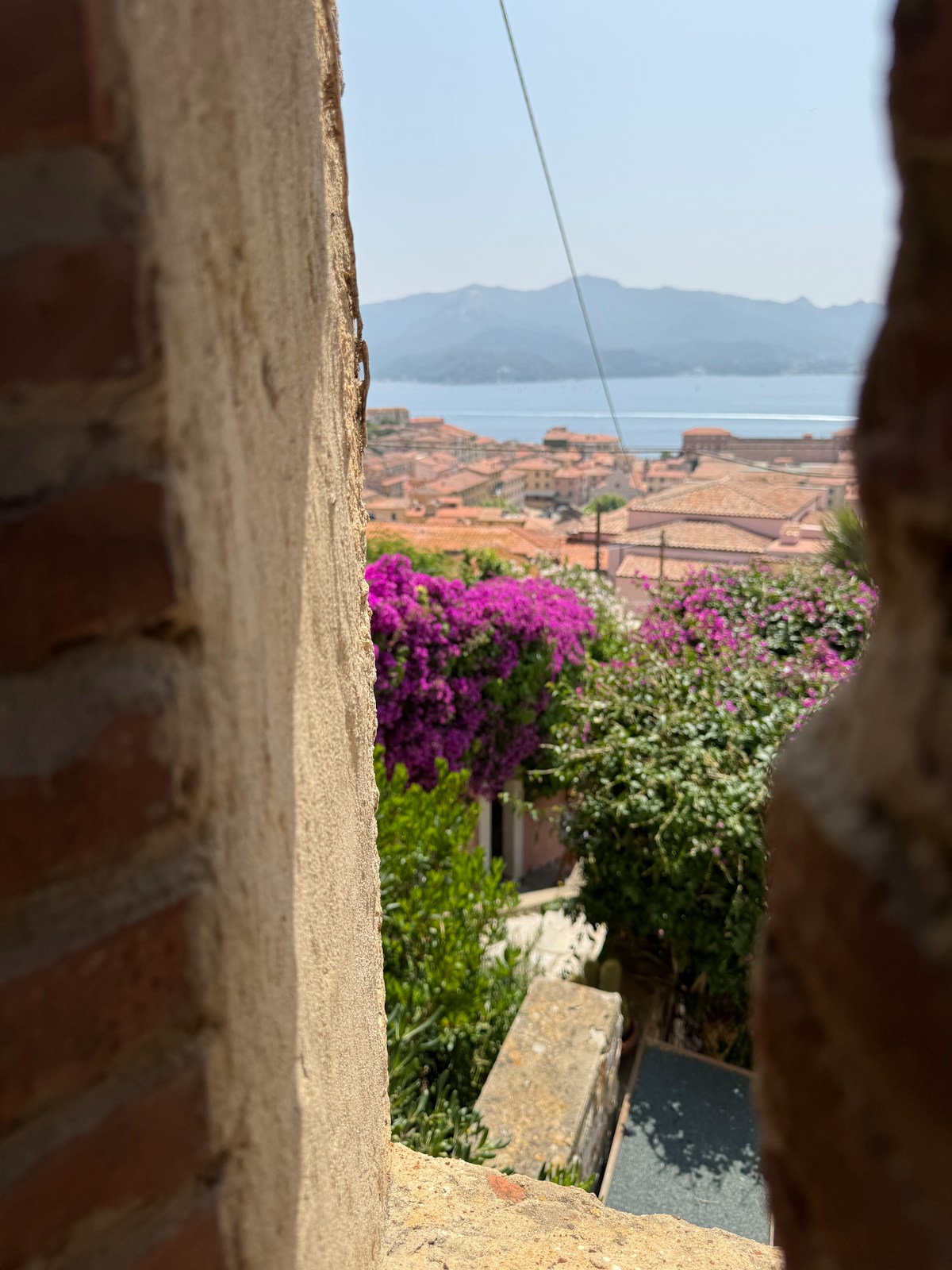
The island’s main town and ferry port. Founded by the Medici dukes in the 16th century as a fortified garrison town - the two hilltop forts (Forte Falcone and Forte Stella) still dominate the headland. The old town below them is compact and easy to walk in under an hour: the main street runs from the ferry dock through a grid of tall ochre and terracotta buildings to the market square (Piazza della Repubblica).
The Cosimo de’ Medici fortress walls are free to walk. The view from the Forte Falcone terrace over the harbour and ferry lanes is the best vantage point in town. For provisions, the market (Mercato di Portoferraio) on Via Carducci sells local produce on weekday mornings, including Elban wines (Aleatico is the island’s distinctive sweet red) and olive oil.
Where to eat
Osteria Libertaria (Calata Mazzini 12, Portoferraio) - On the ferry pier, with tables on the quay wall overlooking the harbour. Good for pasta with local seafood and grilled fish. Mains approximately €14–20. One of the better options in the town centre.
Il Chiasso (Via del Carmine 14, Portoferraio) - A small, unpretentious trattoria in the old town, known for bigoli con ragù di cernia (pasta with grouper ragù) and bottarga. Mains approximately €13–18. Cash preferred; reservations advisable in July and August.
Ristorante Rendez Vous (Via Capo Bianco 26, Biodola) - Directly behind the Biodola beach, reliable for fish secondi and seafood salads at lunch. Mains approximately €16–24.
Trattoria Da Lido (Lungomare Andrea Doria 18, Marciana Marina) - A small harbourfront trattoria with home-cooked Elban dishes: Elba-style salt cod, local anchovies, and pasta with cuttlefish ink. Mains approximately €12–18. Closed Wednesday.
Plan your trip:
- Browse day trips and tours from the Tuscan mainland
- Book hire a car to explore the island
- Get travel insurance for your trip
- Pick up an eSIM for Italy
- Search hotels in Elba
Where to Stay in Elba
Portoferraio is the most practical base, with the ferry port, the Napoleon museums, and a range of accommodation within walking distance. The north coast resorts (Biodola, Procchio) are better for beach-focused stays; Sant’Andrea and Marina di Campo suit those who want quieter, more scenic positions. Most visitors on a tight budget use the island’s several well-run campsites.
Budget (from approximately €55–85/night)
Camping Rosselba le Palme (Via delle Palme, Portoferraio area) is one of the best-equipped campsites on the island’s north coast, with bungalows sleeping two from approximately €55–90/night in high season and tent pitches from approximately €20. The site has a pool, bar, and direct beach access. From approximately €55/night for a bungalow as of 2026.
Hotel Airone (Via dei Platani, Portoferraio area) is a small, simply furnished hotel within easy reach of the ferry terminal. Rooms are no-frills but clean; a practical base for visitors focused on the Napoleon sites and day trips to the beaches by bus or scooter. From approximately €70/night as of 2026.
Hostel Tallinucci (Via Carducci 1, Portoferraio) is a central guesthouse with dorm beds from approximately €25 and private rooms from approximately €65/night. It suits budget travellers arriving by ferry who want to be close to Portoferraio’s old town and market. From approximately €65/night as of 2026.
Mid-range (from approximately €120–200/night)
Hotel Hermitage (Biodola) is a resort complex situated directly on the Biodola beach, with a pool, tennis courts, spa, and water sports. It is one of the island’s most established resort hotels and is well positioned for the north coast beaches. Half-board is often required in August. From approximately €130/night as of 2026.
Hotel Cernia (Marina di Campo) is a well-regarded property near Marina di Campo on the south coast, with a pool and gardens and access to the sandy beach. It suits families and couples who want a quieter south coast base away from Portoferraio’s ferry traffic. From approximately €140/night as of 2026.
Hotel Darsena (Via Vitaliani, Portoferraio) is the most central hotel at the ferry port, a practical choice for late arrivals and early ferry departures. Rooms are comfortable without resort amenities. From approximately €90/night as of 2026.
Luxury (from approximately €280/night)
Tombolo Talasso Resort (Marina di Campo) is Elba’s leading spa hotel, a large coastal property with a seawater thalassotherapy pool, multiple thermal treatments, a private beach, and sea views from most rooms. It attracts guests specifically for the spa programmes rather than general island tourism. From approximately €300/night as of 2026.
Hotel Baia Bianca Suites (Procchio beach) has suite-style accommodation on a sandy beach on the north coast, with a pool and restaurant. The hotel has only 14 rooms and books out well ahead for July and August. From approximately €200/night as of 2026.
Search hotels in Elba on Booking.com
Elba sits within easy reach of the Tuscan mainland - the ferry from Piombino takes 70 minutes. Most visitors base themselves in Florence or Pisa before the crossing; our Florence day trips guide notes Elba as one option for a Tuscan beach extension. For the regional cuisine of Tuscany - the food you will eat in Piombino before the ferry and in Portoferraio’s restaurants - our Tuscan food guide is the reference. Planning a broader Tuscany trip? Our Tuscany itinerary covers the mainland cities and can be extended with a few nights on Elba.
Upcoming Events in Elba
La Befana - Feast of the Epiphany 2027
La Befana 2027, January 6. Italy's Epiphany gift-giving day: children receive sweets or coal from the Befana witch, then decorations come down.
Book an experience
Top experiences in Elba
Explore the best tours and activities in Elba, with instant confirmation and free cancellation on most bookings.