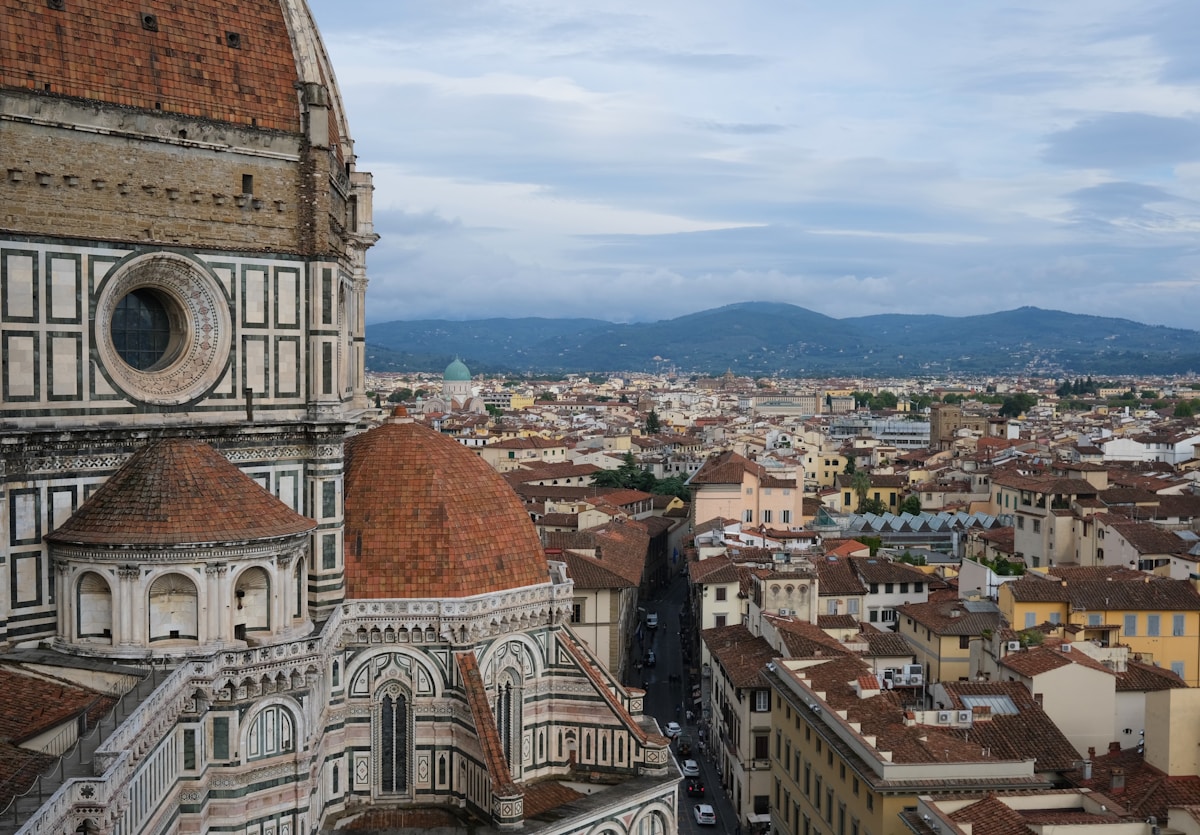
Florence is a small city measured by footprint - the historic centre is roughly 2 km across - but the compression of its sights, the crowds, and the summer heat make neighbourhood choice consequential. Unlike Rome, where the wrong side of the river can cost you 30 minutes on a bus, Florence’s problems are more about price and noise than physical distance. The key question here is not how far you are from the sights but what kind of street you wake up on.
Search Florence hotels on Booking.com to compare prices and check availability across all areas in this guide.
Centro Storico (Duomo and Piazza della Repubblica area)
The historical core - the streets between the Duomo, Piazza della Repubblica, and Via dei Tornabuoni - is where the density of accommodation, restaurants, and shops is highest, and where prices are consistently above the city average.
Pros: The Duomo is a five-minute walk from almost any hotel in this zone. The Uffizi is 10–12 minutes on foot. The concentration of museums, churches, and viewpoints is unmatched. For a short trip, this is the most efficient base.
Cons: The main streets are crowded with coach-party tourism from 9am until at least 7pm. Prices at hotels, restaurants, and cafes in this zone carry a significant location premium. Some hotel buildings are old and poorly soundproofed against the narrow streets below.
Budget (€90–150/night): Options genuinely worth recommending at the budget end are limited in Centro Storico proper. The Hotel Perseo (Via de’ Cerretani 1) is a reliable exception - a well-run two-star in a central position close to the station end of the historic core; doubles from approximately €95/night as of 2026. The rooms are not large but the location is very good for the price.
Mid-range (€150–280/night): The Hotel Davanzati (Via Porta Rossa 5) occupies a medieval palazzo on one of the more characterful streets between Piazza della Repubblica and Ponte Vecchio. Rooms are well maintained and the breakfast is above average; doubles from approximately €160/night as of 2026. The Hotel Botticelli (Via Taddea 8) is a solid three-star with spacious rooms in a 16th-century building near the Mercato di San Lorenzo; doubles from approximately €145/night as of 2026.
Top-end (€400+/night): Portrait Firenze (Lungarno degli Acciaiuoli 4) is the address in this category - a small-number-of-rooms property on the Arno with views across to Ponte Vecchio. Suites from approximately €600/night as of 2026. Fully booked well in advance during peak spring and autumn months.
Oltrarno (San Niccolò and Santo Spirito)
South of the Arno, Oltrarno - literally “beyond the Arno” - has been the artisan and workshop quarter of Florence for centuries. The shift in tone is immediate once you cross Ponte Vecchio or Ponte Santa Trinita: fewer tour groups, more independent restaurants, and streets that function for residents rather than solely for visitors.
Pros: Piazzale Michelangelo (the hilltop viewpoint) is a 15-minute walk uphill from San Niccolò. The Boboli Gardens are accessed from the Palazzo Pitti, which is in Oltrarno. Evening eating here is considerably better value per euro than on the north side. The atmosphere from around 6pm - aperitivo hour in the wine bars around Piazza di Santo Spirito - is one of the best in the city.
Cons: The Uffizi and Duomo are 10–15 minutes’ walk across the river. If heavy bags are involved, the bridges are a minor logistical issue. Hotel density is lower than on the north side, particularly at the budget end.
Budget (€85–130/night): B&Bs and smaller guesthouses in the lanes between Santo Spirito and Ponte Vecchio. The Soprarno Suites (Via Maggio 35) sits at the upper end of the mid-range bracket and is the most consistent option in this part of the city - an apartment-style hotel in a 16th-century palazzo on Via Maggio, one of Oltrarno’s most handsome streets. Studios and suites from approximately €130/night as of 2026 for the smallest configurations. Worth checking for shoulder-season rates.
Mid-range (€140–260/night): The Soprarno Suites fits here as well at its standard double rate. Also consider AdAstra Florence (Via Romana 99), a stylish guesthouse near the Boboli Gardens with attentive service; doubles from approximately €150/night as of 2026.
Top-end: Oltrarno is not where the five-star properties are - which is arguably an advantage if you prefer a quieter, less hotel-concentrated area. The Lungarno Suites (Lungarno Acciaiuoli, north Arno side but with Oltrarno views) is the nearest equivalent; suites from approximately €350/night as of 2026.
Santa Croce
East of the historic core, the neighbourhood around the Basilica di Santa Croce - where Galileo, Machiavelli, and Michelangelo are buried - is one of the most consistently recommended bases for visitors who want proximity to the sights without the worst of the Centro Storico prices.
Pros: The Uffizi is 10–12 minutes on foot west. The Duomo is about 12 minutes north. The neighbourhood has a larger permanent resident population than the blocks immediately around Piazza della Repubblica, which means better local restaurants, bakeries, and general shops. Prices are marginally lower than Centro Storico for equivalent hotel quality.
Cons: Slightly less convenient for the Accademia (Michelangelo’s David) and the northern museum cluster. The streets immediately around the basilica fill with tourist traffic during the day.
Budget (€80–130/night): The Hotel Perseo (mentioned above) is within walking distance. For Santa Croce specifically, a handful of B&Bs on Via delle Pinzochere and Via de’ Macci offer honest-priced rooms; check listings for independently run properties in this grid. Rates from approximately €85/night as of 2026.
Mid-range (€130–240/night): The Hotel Davanzati and Hotel Botticelli are also reachable on foot. For accommodation within the Santa Croce catchment, the Hotel degli Orafi (Lungarno degli Archibusieri 4) sits on the Arno with direct views of the Ponte Vecchio - technically on the boundary with Centro Storico but priced and positioned as a Santa Croce-adjacent mid-range; doubles from approximately €180/night as of 2026. The rooftop terrace is worth noting.
Top-end (€300+/night): The J.K. Place Firenze (Piazza Santa Maria Novella 7 - technically closer to the station but walkable) is a boutique luxury hotel in a 19th-century palazzo; doubles from approximately €450/night as of 2026.
San Frediano
Immediately west of Santo Spirito in Oltrarno, San Frediano is the most local-feeling quarter within easy walking distance of the historic sights. The streets around Via del Serragli and Borgo San Frediano have more independent food shops, neighbourhood bars, and fewer accommodation options marketed at tourists.
Pros: Noticeably lower prices for restaurants and coffee. Authentic neighbourhood feel with working artigiani (craft workshops) still operating. Walking distance to Ponte alla Carraia and the centre. The food market at Santo Spirito runs on weekend mornings.
Cons: The lowest concentration of hotels of any area on this list. If you want flexibility to change accommodation, options are limited. Uber/taxi availability is the same as elsewhere but some streets are narrow for vehicle access.
Budget (€70–110/night): San Frediano is the best area in Florence for self-catering apartments on platforms such as Airbnb - a week in a one-bed flat can be found for equivalent to €75–90/night as of 2026. For hotels, the choice is limited; this area rewards apartment booking over traditional hotels.
Mid-range: Small B&Bs and guesthouses through independent booking channels. The Oltrarno Splendid (Via dei Serragli 30) is a well-regarded small property in this zone; doubles from approximately €140/night as of 2026.
Santa Maria Novella (Train Station Area)
The neighbourhood around the Santa Maria Novella station - and the piazza of the same name - is Florence’s most transit-convenient base, but architecturally and atmospherically it is the least appealing of the areas covered here.
Pros: The station is a 90-second walk for day trips to Siena, Lucca, Pisa, and Cinque Terre. Airport shuttle and bus connections are at the station. The Duomo is about 10 minutes on foot east. The Accademia is also walkable.
Cons: The streets immediately around the station - particularly to the north side - have a higher concentration of low-quality souvenir shops, fast-food restaurants, and hotels where location is the main selling point rather than quality. The Piazza della Stazione area is functional rather than pleasant.
Budget (€70–110/night): Numerous options in this bracket, with widely varying quality. Look for properties on Via della Scala or Via Palazzuolo rather than directly on the station piazza. The Hotel Il Bargellino (Via Guelfa 87, technically just north of Santa Maria Novella) is a quirky independent B&B popular with return visitors; doubles from approximately €85/night as of 2026.
Mid-range (€130–250/night): The Hotel Garibaldi Blu (Piazza Santa Maria Novella 10) is a more considered option on the pleasant piazza itself, away from the station crowds; doubles from approximately €150/night as of 2026. The Starhotels Michelangelo (Viale Fratelli Rosselli 2) is a reliable four-star with good transport access; doubles from approximately €140/night as of 2026.
Top-end: Outside the scope of what makes sense here - the luxury options in Florence are mostly in Centro Storico and along the Arno.
Out of the centre: Fiesole and the Florentine hills
For visitors with a rental car, or those staying longer than three days, the hill towns immediately above Florence - particularly Fiesole, 8 km northeast - offer a different kind of base.
Top-end (€600+/night): The Belmond Villa San Michele (Via Doccia 4, Fiesole) is a former monastery designed in part by Michelangelo, converted into one of Tuscany’s most celebrated hotels. Views across the Florentine rooftops are exceptional. Doubles from approximately €800/night as of 2026 in peak season. A shuttle runs to and from Florence city centre. Not practical as a base for museum-heavy itineraries, but extraordinary for a special occasion.
Plan your trip:
- Browse day tours and experiences in Florence
- Book an airport transfer to your hotel
- Get travel insurance before you book
- Pick up an eSIM for Italy
- Search hotels in Florence on Booking.com
Booking and practical tips
- Book 6–10 weeks ahead for April, May, and September. These are Florence’s peak months. Mid-range rooms in Centro Storico and Oltrarno sell out fast; the city is compact enough that late-booking overspill to less convenient areas has a real cost.
- Request a rear-facing or upper-floor room at any hotel on the main streets between the Duomo and Ponte Vecchio. Ground-floor rooms on narrow streets with tourist foot traffic are noisy until 11pm.
- Oltrarno restaurants are meaningfully better value. Even staying in Centro Storico, crossing the river for dinner saves money and improves the meal. Budget approximately €25–40/head at a mid-range trattoria in Oltrarno versus €35–55 for equivalent quality north of the Arno.
- Florence’s city tourist tax is charged separately from your hotel rate - approximately €4–6.50/night per person as of 2026, varying by hotel category. It is not included in online rates from most booking platforms. Pay on arrival in cash or card.
- Self-catering apartments in Oltrarno and Santa Croce offer genuine value for stays of four nights or more. A one-bedroom apartment in San Frediano rents for approximately €120–160/night as of 2026 - often including a kitchen that makes lunch stops and breakfast unnecessary expenses.
- Parking: Florence’s ZTL (limited traffic zone) covers the entire historic centre. If you have a rental car, book accommodation outside the ZTL or with guaranteed parking included - fines for ZTL violations are automatic and common.
For the full Florence planning picture: Florence travel guide covers the Uffizi, Duomo, and neighbourhood character. For hostels and budget accommodation: best hostels in Florence. For what to eat by neighbourhood: Florence food guide and the Tuscan food guide. For a Tuscany trip combining Florence with the countryside: Tuscany itinerary and the Tuscany hotels guide. Comparing Florence and Venice? Our Venice vs Florence guide covers character and logistics.
Ready to Plan Your Trip?
See our itineraries for inspiration:
- Tuscany Itinerary - five days in the heart of Italy
- One Week in Italy - seven days through Rome, Florence, and Venice
- 10 Days in Italy - the classic grand tour of Italy’s highlights
- 2 Weeks in Italy - the ultimate two-week Italian itinerary
Hotels by price tier
The following hotels are grouped by nightly rate to help with budget planning.
Luxury hotels (from €300/night as of 2026)
Portrait Firenze (Lungarno Acciaiuoli, on Ponte Vecchio) - Salvatore Ferragamo family property with river views directly from Ponte Vecchio. Suites from approximately €500/night. Personalised service, rooftop terrace overlooking the Arno. One of the most exclusive addresses in Florence.
Hotel Lungarno (Borgo San Jacopo 14, Oltrarno) - Ferragamo-owned, art-filled boutique hotel on the south bank. Doubles from approximately €350/night. Contemporary art collection throughout. The Borgo San Jacopo restaurant has Arno views and a Michelin star. Request a river-view room.
Il Salviatino (Via del Salviatino 21, Fiesole hills) - A restored 15th-century villa in the hills above Florence, 15 minutes by car from the centre. Doubles from approximately €400/night. Infinity pool with panoramic views, extensive gardens, spa. The best option if you want countryside luxury within reach of the city.
Four Seasons Hotel Firenze (Borgo Pinti 99) - Two Renaissance palazzi connected by Florence’s largest private garden (4.5 hectares). Doubles from approximately €600/night. Frescoed ceilings in public spaces, outdoor pool, full-service spa. The Il Palagio restaurant serves Tuscan fine dining.
Hotel Helvetia & Bristol (Via dei Pescioni 2, near Piazza della Repubblica) - A grand 19th-century hotel in the heart of the city. Doubles from approximately €320/night. Traditional luxury with antique furnishings and a wood-panelled bar. Excellent breakfast served in the Winter Garden.
Mid-range hotels (€100–250/night as of 2026)
Hotel Palazzo Guadagni (Piazza Santo Spirito 9, Oltrarno) - A 15th-century palazzo on Oltrarno’s most atmospheric piazza. Doubles from approximately €140/night. The loggia terrace on the top floor has Duomo views. Simple, elegant rooms with high frescoed ceilings. Breakfast included. No lift - request a lower floor if needed.
Hotel Davanzati (Via Porta Rossa 5, Centro Storico) - Family-run four-star in a 14th-century palazzo between the Ponte Vecchio and Piazza della Signoria. Doubles from approximately €160/night. Free afternoon tea, wine tasting twice weekly, and a rooftop terrace. Rooms vary significantly in size - book a superior or deluxe for more space.
Hotel Monna Lisa (Borgo Pinti 27, Santa Croce) - A palazzo with an art collection and internal garden. Doubles from approximately €150/night. Period furniture, frescoed ceilings, genuinely atmospheric. The garden rooms are quieter but darker. Breakfast in the courtyard garden is a highlight.
Soprarno Suites (Via Maggio 35, Oltrarno) - Modern boutique suites in a 16th-century building. Doubles from approximately €130/night. Minimalist design within historic walls. Kitchenettes in some suites - useful for longer stays. Excellent location on Oltrarno’s main antique-shop street.
Hotel Orto de’ Medici (Via San Gallo 30, San Marco) - Well-maintained three-star near the Accademia (Michelangelo’s David). Doubles from approximately €110/night. Private garden courtyard, free parking for one car (unusual in Florence). A solid mid-range choice in a good location.
Budget hotels and B&Bs (under €100/night as of 2026)
Ostello Bello Firenze (Via de’ Cimatori 10, Centro Storico) - The best hostel in Florence, part of the Milan-based chain. Dorm beds from approximately €30/night, private doubles from approximately €90/night. Free breakfast and evening aperitivo included. Self-catering kitchen. Rooftop terrace. Central location near the Bargello.
Plus Florence (Via Santa Caterina d’Alessandria 15, north of centre) - A large hostel with a pool, gym, and sauna. Dorm beds from approximately €25/night, private rooms from approximately €75/night. A 15-minute walk from the Duomo. The facilities are the best of any Florence hostel.
Hotel Perseo (Via de’ Cerretani 1, near the Duomo) - Simple family-run three-star in an excellent location. Doubles from approximately €90/night. No frills but clean, central, and the breakfast room has Duomo views. One of the best budget options in the historic centre.
Soggiorno Battistero (Piazza San Giovanni 1, overlooking the Baptistery) - A B&B directly opposite the Baptistery with extraordinary views from the front rooms. Doubles from approximately €85/night. Basic rooms but the location and views more than compensate. Book a front-facing room or it’s not worth it.
Hotel Il Bargello (Via de’ Pandolfini 33, Santa Croce) - Affordable three-star near the Bargello museum. Doubles from approximately €80/night. Clean, well-maintained, and the owner provides excellent restaurant recommendations. No lift.
Practical notes
City tax (tassa di soggiorno): Florence charges approximately €4–5.50 per person per night depending on hotel category, as of 2026. Hostels charge approximately €2 per person.
Parking: Central Florence is a ZTL (restricted traffic zone) - entering with a rental car without a permit results in automatic fines of approximately €80–160 per violation, as of 2026. If arriving by car, book accommodation with parking (approximately €25–40/day) or use a peripheral garage (Parterre car park near Piazza della Libertà - approximately €20/day) and walk in.
Booking timing: For peak season (Easter, May–September), book 2–3 months ahead for mid-range hotels. Luxury properties require 3–6 months for the best rooms. November–February (excluding Christmas) offers significant savings - 30–40% below peak rates.
Transport: Florence is compact enough to walk everywhere in the centre. The tramway T1 connects the airport and Santa Maria Novella station. Airport taxis cost a fixed approximately €22 to the centre, as of 2026. The Volainbus shuttle from the airport to SMN station costs approximately €6. For a pre-booked private airport transfer into the centre, prices are comparable to a taxi and confirmed in advance.
For the full Florence travel guide covering the Uffizi, Duomo, neighbourhoods, and day trips. For a regional accommodation guide covering Tuscany more broadly, see hotels in Tuscany. Planning activities: the Florence things to do guide covers museum queues, walk routes, and the lesser-visited sites. For eating well on any budget, the Florence food guide covers bistecca, lampredotto, and the best trattorias. Choosing between Florence and other cities? Our Bologna vs Florence guide and Venice vs Florence guide cover the trade-offs.