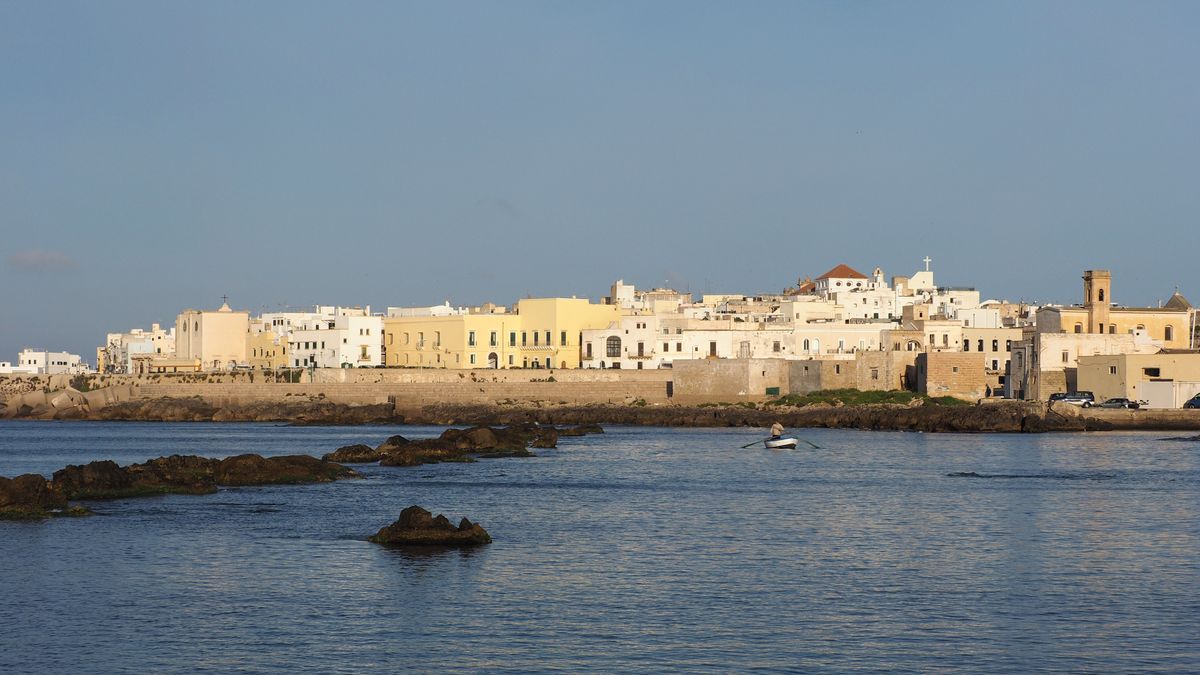
Gallipoli is the most theatrically sited city in Puglia. The old town sits on a small island in the Ionian Sea, connected to the mainland by a stone bridge built in the 1600s — from a distance the buildings appear to float. Guided walking tours of Gallipoli covering the castle, cathedral, and historic harbour are available from GetYourGuide, and offer good context for the Greek foundations and Baroque layering of the city. The name comes from the Greek Kallipolis (beautiful city), and the Greek heritage shows in the layout of the old town — a grid of narrow streets that runs counter to the typical medieval warren.
Castello di Gallipoli
The Angevin castle sits exactly at the bridge entrance to the old town, controlling access from the mainland. The original 13th-century structure was built by the Angevins and substantially expanded by the Aragonese in the 15th–16th centuries, making it one of the better-preserved coastal fortresses in Puglia. The cylindrical towers, the moat (now dry), and the drawbridge mechanism are all largely intact.
Entry is approximately €4 as of 2026; open Tuesday–Sunday, roughly 10am–1pm and 4pm–8pm in summer (hours reduce in winter). The ramparts give clear views across the fishing harbour to the north and the open Ionian to the west. The interior has a small permanent exhibition on the history of the city and its Greek and Byzantine phases.
Cathedral of Sant’Agata
The baroque cathedral at Piazza Immacolata was built in the 17th century in local limestone. The facade has the layered pilaster-and-pediment composition typical of Apulian baroque — not as elaborately decorated as Lecce’s Santa Croce, but well-proportioned and genuinely handsome. Free entry; open daily.
Inside, several paintings on the nave walls are attributed to Giovanni Andrea Coppola (1597–1659), a Gallipolino painter who trained in Rome under Guido Reni and produced work that hangs in museums in Naples and Madrid. Coppola is largely unknown outside the Salento, which makes the cathedral a genuine discovery. Look for the large canvases on the lateral walls — subjects include the Martyrdom of Sant’Agata and scenes from the life of the Virgin.
The Old Town on Foot
The centro storico of Gallipoli occupies the entire island, and the grid of streets is compact enough to explore thoroughly in 90 minutes. The main axis runs from the bridge along Corso Roma to the Cathedral; narrower lanes spiral out to the sea walls on all sides.
Riviera Armando Diaz — the sea-wall promenade on the south side of the island, where the limestone walls drop directly into the Ionian. Clear water below, fishing boats in the distance, the fortress visible to the west. The best light is in the morning.
Porto Vecchio (Old Harbour) — the working fishing harbour on the north side of the island. The day’s catch arrives here at dawn. In summer (July–August especially), sea urchin vendors set up stalls with polystyrene trays and open ricci di mare to order — approximately €8–12 per dozen, eaten raw with bread. This is one of the defining food experiences in southern Italy.
Fontana Greca — a small Greek-era fountain on the mainland side near the bridge approach, believed to date to the 4th century BC. The bas-relief carvings are weathered but legible. Easy to miss; worth a pause for context on Gallipoli’s pre-Roman history.
Via Antonietta De Pace — the main street of the old town, lined with small shops selling local ceramics, preserved fish, and capocollo. The street is named after a Gallipolina revolutionary (1818–1893) who organised anti-Bourbon resistance in the Salento during the Risorgimento.
Beaches South of the City
The beaches immediately south of Gallipoli are the finest stretch of Ionian coastline in this part of Puglia — fine sand, shallow entry, calm and brilliantly clear water.
Baia Verde — The closest beach to the old town (approximately 2km south), with a long strip of beach clubs (lidi) charging approximately €15–20 per day for two sunbeds and an umbrella as of 2026. Popular in summer; book a lido spot in advance for July–August.
Punta della Suina — Approximately 4km south, partly within a natural protected area. Pine forest runs to the dunes on the western section; the water here is exceptionally clear even by Ionian standards. Some free beach sections alongside the paid lidi. One of the most photographed beaches in the Salento.
Lido Pizzo — A long, gently sloping beach approximately 8km south. Calmer than Baia Verde, popular with families. Good snorkelling on the rocky northern sections. Some free beach areas.
Local STP buses run south along the coast from the stop on Via Matteo Camera (mainland side) in summer, approximately every 30–60 minutes. A taxi to Punta della Suina costs approximately €8–10 one way as of 2026.
Book Gallipoli Tours on GetYourGuide
| Tour | Duration | From price | Highlights |
|---|---|---|---|
| Gallipoli old town walking tour with local guide | 2 hrs | From €18 | Castello Angioino, Cathedral of Sant’Agata, Porto Vecchio fish market |
| Gallipoli and the Salento coast by boat | 4 hrs | From €35 | Sea caves, Ionian coastline, swimming stops, sea-urchin tasting |
| From Lecce: Gallipoli and Otranto full day | 9 hrs | From €65 | Both coasts of the Salento, baroque old towns, beach stop |
Browse all Gallipoli tours on GetYourGuide →
Back to the full Gallipoli travel guide for transport, accommodation, and seasonal advice. For what to eat in the city — ricci di mare, tiella gallipolina, pasticciotto — see the Gallipoli food guide. For day trips from Gallipoli to Otranto, Santa Maria di Leuca, and the Salento coast, see day trips from Gallipoli. For the broader context of the Salento region, the Lecce travel guide covers the peninsula’s baroque capital. For a Puglia circuit itinerary connecting Bari, the Valle d’Itria, Lecce, and Gallipoli, see our Puglia itinerary.
Where to stay in Gallipoli: Find hotels in Gallipoli — search accommodation across all budgets.