Gallipoli is, above all, a fishing town — and its food reflects that directly. The fish market at the Porto Vecchio is where the day’s catch arrives, and the chain from harbour to table here is shorter and more transparent than almost anywhere in Italy. The Ionian Sea around the Salento produces octopus, red mullet (triglia), sea bass (spigola), sea bream (orata), and — most distinctively — sea urchins. Food tours of Gallipoli that combine the harbour market with local restaurants and wine tastings are available and give good context for the Salento food culture.
Ricci di Mare — Sea Urchins from the Harbour
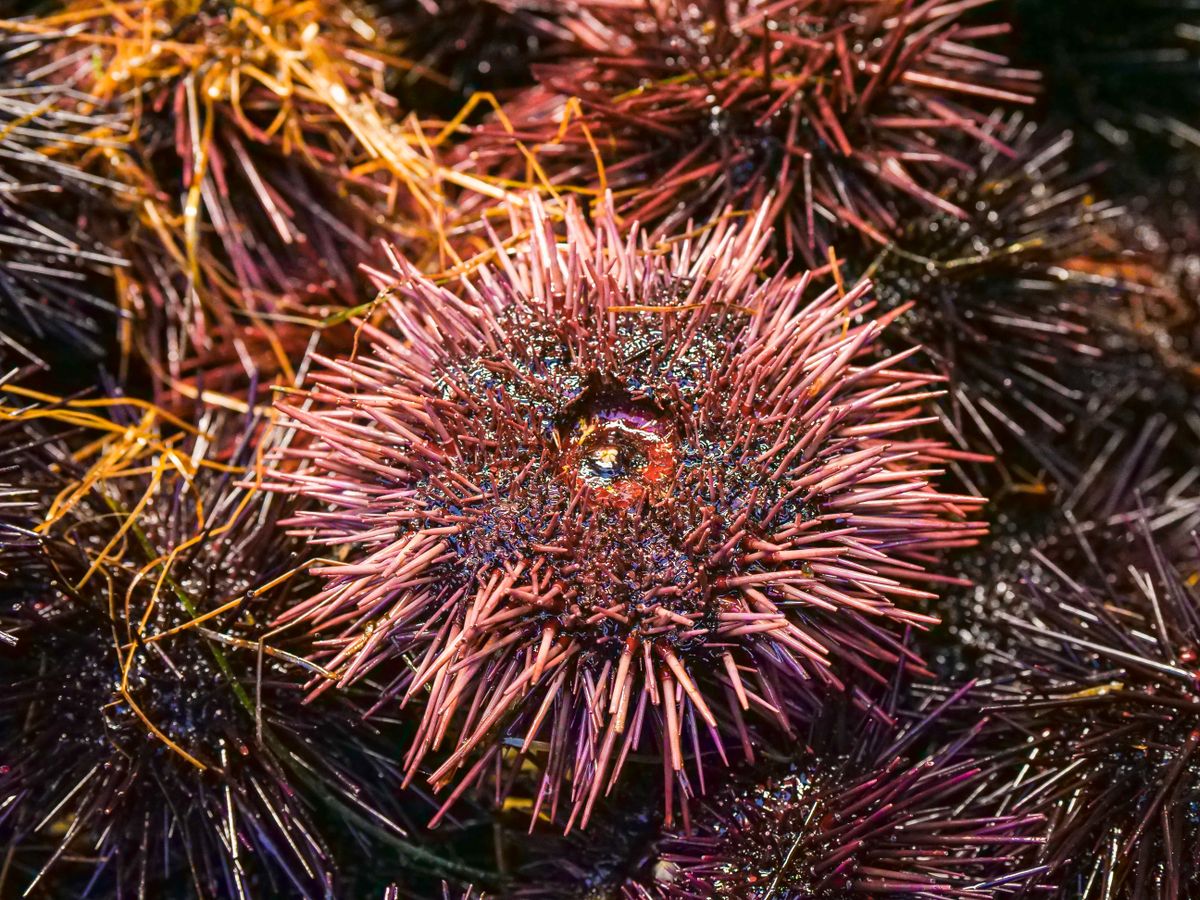
The defining food experience of Gallipoli. Between June and August, vendors at the Porto Vecchio (the old fishing harbour, north side of the island) set up trestle tables covered in polystyrene trays of fresh sea urchins. They open them with a pair of scissors on the spot: the top is cut off, the black interior scooped away, and you are left with five orange-gold lobes of roe (corallo) arranged inside the spiny shell.
You eat them with a small teaspoon or a crust of bread, standing at the stall, in the smell of the harbour. Approximately €8–12 per dozen as of 2026.
The taste is intensely oceanic — saline and slightly sweet, with a mineral depth that has no close comparison in food from the land. Urchin season peaks in July and August (that is when the roe is fullest); outside these months they become harder to find and the flavour is less reliable.
Tiella Gallipolina
Tiella is both the name of the dish and the name of the terracotta pot it is cooked in. Every coastal town in Puglia has a version; the Gallipoli version (tiella gallipolina) is built in layers: fresh mussels (cozze) on the bottom, then a layer of Arborio rice, sliced potatoes, courgette rings, and tomato, all moistened with the mussel liquid, olive oil, and white wine. A crust of breadcrumbs forms on top. It bakes slowly in the oven.
The Gallipoli version tends to have more mussel and less potato than the Bari version, and the rice here absorbs the sea-mineral flavour of the mussels more aggressively. It is served in portions from the pot directly at the table — a dish for sharing. Most traditional restaurants in the old town offer it, particularly at lunch. Expect to pay approximately €10–14 per portion as of 2026.
Orecchiette con Cime di Rapa
The signature pasta dish of Puglia appears on almost every menu in the Salento. Orecchiette — small ear-shaped pasta made from semolina and water, shaped by dragging a small disc of dough across a ridged board — are tossed with cime di rapa (turnip tops, also called rapini), chilli, garlic, and anchovy. The bitter brassica flavour of the turnip greens cuts through the richness of the olive oil.
In Gallipoli as elsewhere in the Salento, the pasta is usually made fresh by hand. A portion costs approximately €9–13 as of 2026 at most trattorias.
Spaghetti alle Vongole and Grilled Fish
The harbourside trattorias run almost entirely on what came in that morning. Spaghetti alle vongole (spaghetti with clams) and spaghetti ai frutti di mare (with a mixed shellfish and tomato sauce) are the staple primi. For secondi, the whole grilled fish — red mullet, sea bream, or sea bass — priced approximately €14–20 per portion as of 2026 depending on weight, are usually the best option.
Octopus (polpo) appears in multiple forms: as a salad (cold, with olive oil and parsley), grilled over charcoal, or slow-cooked in tomato sauce (polpo alla pignata). The polpo alla pignata is cooked for hours in a sealed terracotta pot until tender; Gallipoli is one of the few places in Puglia where you can reliably find it on the menu.
Pasticciotto and Breakfast
Pasticciotto leccese — a short-pastry case filled with custard cream — is the Salento’s most famous pastry and is found at bakeries and bars throughout Gallipoli. It is eaten warm for breakfast, with espresso, at approximately €1.50 as of 2026. Some bars offer a variant with sour cherry jam (amarena) in addition to the custard.
Caffè leccese — espresso poured over crushed ice with almond milk (latte di mandorla) — is the Salento summer coffee and is available at most bars in Gallipoli in the warmer months. A distinctive and specifically local experience.
Where to Eat
- Osteria del Mare (Via Riviera Armando Diaz) — Right on the sea walls of the old town. Fish of the day, tiella, and orecchiette. Mains approximately €14–18; full dinner with wine approximately €30–40 per person as of 2026. Cash preferred; book ahead in July–August.
- Il Bastione (Riviera Nazario Sauro) — Reliable mid-range restaurant with sea views, a broad menu of local pasta and grilled fish, and slightly less pressure than restaurants on the main corso. Mains approximately €12–18 as of 2026.
- Trattoria del Porto (old harbour, Via del Porto) — Basic tables near the fishing boats, excellent for a quick seafood lunch. Primi from approximately €9, secondi from approximately €12 as of 2026. Closes by 3pm; no dinner service.
- Ristorante Il Canneto (Lungomare Marconi, mainland side) — Busy with locals year-round. The spaghetti alle vongole and the octopus salad are consistently good. Approximately €25–35 per person as of 2026.
Negroamaro and Salento Wines
The Salento produces some of the most characterful red wines in Italy.
Negroamaro — the dominant grape of the Salento, the name meaning “black and bitter” in a mix of Greek and Latin. It produces dark, full-bodied wines with notes of black fruit, tobacco, and dried herbs. The Salice Salentino DOC and Brindisi DOC are the main appellations. Cosimo Taurino and Leone de Castris are two reliable producers widely available in local restaurants; a glass costs approximately €4–7, a bottle approximately €15–25 in a restaurant as of 2026.
Primitivo — a grape of Puglian origin, genetically related to Zinfandel and brought to California in the 19th century. The Primitivo di Manduria DOC is approximately 60km north of Gallipoli. It produces a riper, more jam-like wine than Negroamaro, with higher alcohol. The two are sometimes blended.
Verdeca — the main white grape of the Valle d’Itria, producing a crisp, slightly aromatic white wine that pairs well with the seafood of the coast. Less well-known than the reds but worth seeking out.
Back to the full Gallipoli travel guide for beaches, transport, and accommodation. For what to see in the city — castle, cathedral, harbour, and sea walls — see things to do in Gallipoli. For day trips from Gallipoli to Otranto, Santa Maria di Leuca, and Alberobello, see day trips from Gallipoli. For the full context of Pugliese food culture — orecchiette, burrata, taralli, fave e cicoria — see our Pugliese food guide. For the broader region, the Puglia travel guide covers all the major destinations.
Where to stay in Gallipoli: Find hotels in Gallipoli — search accommodation across all budgets.