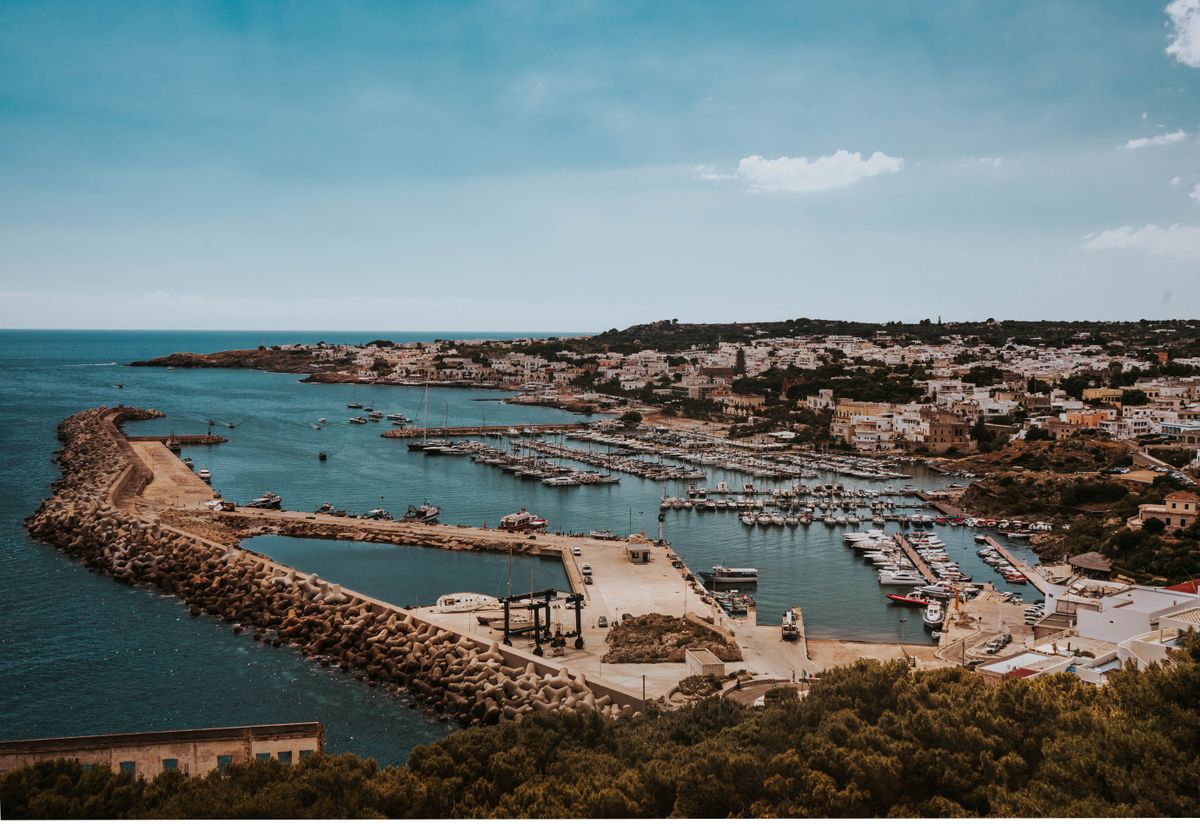
Gallipoli sits at the western edge of the Salento peninsula — the extreme heel of Italy — with the Adriatic coast 60km to the east and the open sea to the south. The FSE (Ferrovie del Sud-Est) train network connects it north to Lecce and the Valle d’Itria; by car or hire vehicle the coastal towns of the peninsula are within an hour in most directions. Day tours from the Salento area covering Otranto, the Leuca peninsula, and sea caves are available for those who prefer not to navigate independently.
Lecce (35 km north, approximately 50 minutes by train)
The baroque capital of Puglia and the natural base for exploring the Salento. Lecce’s historic centre is built in pietra leccese — a local limestone so soft when quarried and so hard when it dries that the 17th-century craftsmen carved it with extraordinary density. The Basilica di Santa Croce (Piazza del Duomo — free) took over 150 years to complete and remains one of the most elaborate baroque facades in Italy. The Piazza del Duomo (the enclosed cathedral square, free) is a theatrical baroque space with the bishop’s palace, seminary, and cathedral all facing each other across a single paved square.
The Roman amphitheatre in Piazza Sant’Oronzo (free) was discovered in 1901 under the main square and seated approximately 25,000. Lecce’s food scene offers pasticciotto (custard-cream pastry, approximately €1.50 from any bakery) and rustico leccese (puff pastry filled with mozzarella, tomato, and béchamel).
Getting there: FSE train from Gallipoli to Lecce, approximately 50–60 minutes, approximately €5–7 as of 2026. About 10–15 services per day in summer.
Otranto (60 km northeast, approximately 1.5 hours by train)
The easternmost city in Italy and the first place in the country to see the sunrise. Otranto’s greatest attraction is inside its cathedral: the Cattedrale dell’Annunziata (free) has a complete Norman mosaic floor (1163–1165) covering the entire nave — 54 metres long, depicting the Tree of Life, the months of the year, allegorical animals, historical scenes, and Alexander the Great ascending to heaven on a pair of griffins. It is the largest medieval mosaic floor in Europe and genuinely extraordinary.
The Cappella dei Martiri (inside the cathedral, free) contains the bones of 800 Otrantini who refused to convert to Islam and were executed by the Ottoman forces that sacked the city in 1480. The Castello Aragonese (Piazza Castello — entry approximately €5 as of 2026) was built immediately afterwards as a defensive response.
The beach at Baia dei Turchi (8km north of Otranto, accessible by bicycle or car) has some of the clearest Adriatic water in Puglia, with a pine forest backing the sand. From the road it is approximately a 20-minute walk to the beach.
Getting there: Train from Gallipoli to Lecce (approximately 55 minutes), then FSE train from Lecce to Otranto (approximately 1 hour). Total approximately 1.5 hours. By car, approximately 1 hour directly via the SP358 and SP87.
Santa Maria di Leuca (40 km south, approximately 45 minutes by car)
The southernmost point of Puglia — where the Adriatic and Ionian seas officially meet under a promontory known as Punta Ristola. The town of Santa Maria di Leuca has a baroque basilica (free, with views from the esplanade) and a lighthouse at the tip. The town itself is quiet and slightly melancholy off-season; its real purpose is the symbolic end of the Italian heel.
More rewarding is the coastal road south from Gallipoli (SP274 and SP358): the limestone cliffs drop directly into the sea, with sea stacks (faraglioni), natural arches, and tiny coves accessible by boat. The stretch between Santa Maria di Leuca and Castro (Adriatic side) has some of the most dramatic coastal scenery in the Salento.
The Grotta Zinzulusa (near Castro, approximately 55km from Gallipoli — entry approximately €6 as of 2026) is a sea cave open to guided visits, with stalactites and a small internal lake. Boat tours from Castro harbour visit additional sea caves inaccessible from land (approximately €10–15 per person, seasonal as of 2026).
Getting there: By car, approximately 45 minutes to Leuca via the SS274 south. By bus: infrequent STP services connect Gallipoli to Leuca — check timetables in advance.
Alberobello and the Valle d’Itria (90 km north, approximately 2.5 hours by train)
The trulli district of the Valle d’Itria is a long but feasible day trip from Gallipoli. The FSE train goes north to Lecce (55 minutes), then connects to Martina Franca (approximately 1 hour 30 minutes more), from where a local service reaches Alberobello in approximately 20 minutes.
Alberobello (UNESCO World Heritage Site) has more than 1,500 trulli — the conical-roofed dry-stone houses unique to this part of Puglia — concentrated in the Rione Monti and Rione Aia Piccola districts. Entry to the districts is free; individual trullo interiors can be visited for small entry fees. The Trullo Sovrano (Piazza Sacramento — entry approximately €3 as of 2026) is the only two-storey trullo and has a small museum inside.
Locorotondo (20 minutes from Alberobello by local bus or taxi) is a circular hilltop town with a well-preserved white centro storico and good views across the Valle d’Itria. Martina Franca has an elegant baroque centre and is worth 90 minutes even as a transit point.
Getting there: Total journey approximately 2.5 hours each way by train. Organised day tours from Lecce or Bari covering the Valle d’Itria are available and avoid the train changes.
Practical notes
- FSE (Ferrovie del Sud-Est, fseonline.it) and Trenitalia are separate systems; most Salento routes use FSE
- The Salento coast is extremely crowded in July–August; April–June and September–October offer better conditions and empty roads
- Hiring a car from Gallipoli (from approximately €25–35/day as of 2026) transforms the southern Salento — the coastal road south to Leuca is one of the finest drives in Puglia
- Prices listed are approximate as of 2026
Back to the full Gallipoli travel guide for transport, accommodation, and seasonal advice. For what to see in the city itself — castle, cathedral, old harbour, sea walls — see things to do in Gallipoli. For the seafood culture of the city — ricci di mare, tiella gallipolina, orecchiette — see the Gallipoli food guide. For Lecce’s baroque centre and Salento transport connections, see the Lecce travel guide. For a Puglia circuit connecting Bari, the Valle d’Itria, Matera, and the Salento, see our Puglia itinerary.
Book Salento Day Tours from Gallipoli
| Tour | Duration | From price | Highlights |
|---|---|---|---|
| From Lecce: Otranto, Castro & Gallipoli day tour | 9 hrs | From €65 | Adriatic and Ionian coasts, cathedral mosaic, sea caves, Gallipoli old town |
| Salento coast by boat from Gallipoli | 4 hrs | From €35 | Sea caves, Ionian coastline, swimming, ricci di mare tasting |
| Valle d’Itria day trip — Alberobello, Locorotondo & Martina Franca | Full day | From €55 | Trulli UNESCO site, baroque hilltop towns, Valle d’Itria landscape |
Where to stay in Gallipoli: Find hotels in Gallipoli — search accommodation across all budgets.