After the fall of the Western Roman Empire in 476 AD, the Italian peninsula spent centuries as a contested territory - invaded by Visigoths, Ostrogoths, Lombards, Byzantines, and Franks. What emerged from this fragmentation was not a unified state but a patchwork of city-states, kingdoms, and papal territories that competed, warred, and innovated their way to the Renaissance. Understanding medieval Italy means understanding why Italy never became a single kingdom when France, England, and Spain did.
The fragmentation of Italy
The Lombard Kingdom (568–774 AD): The Lombards, a Germanic people, conquered most of northern Italy after the Byzantines had briefly reunited it. They created kingdoms centred on Pavia, Milan, and Benevento. When Charlemagne conquered the Lombard Kingdom in 774, he added “King of the Lombards” to his titles - but actual rule over the north passed to his heirs and eventually dissolved into competing local powers.
The Papal States: The papacy, based in Rome, claimed temporal power over central Italy. The Donation of Pepin (756) gave the popes formal control over territories that would remain the Papal States until Italian unification in 1870. This temporal power made the papacy both a religious and a political force - and a constant source of conflict with the Holy Roman Emperors.
Norman Sicily (1072–1194): The most remarkable medieval kingdom in Italy. Norman adventurers (descendants of Vikings who had settled in northern France) conquered Sicily from the Arabs and southern Italy from the Byzantines. The Kingdom of Sicily under Roger II (1130–1154) was one of the wealthiest and most sophisticated states in Europe - multicultural, multilingual, with Arab administrators, Byzantine mosaics, and Norman architecture. The Cathedral of Cefalù, the Palatine Chapel in Palermo, and Monreale Cathedral are its monuments.
The Commune movement (11th–12th centuries): Northern and central Italian cities progressively broke free from feudal overlords and established self-governing communes - city-states run by merchant and artisan guilds. Florence, Milan, Venice, Genoa, Pisa, Siena, Bologna, Verona all became effectively independent powers. This communal independence, unique to Italy in the medieval period, was the political precondition for the Renaissance.
The Guelphs and Ghibellines
Medieval Italian politics was dominated by the conflict between two factions: the Guelphs, who supported the papacy, and the Ghibellines, who supported the Holy Roman Emperor. The conflict between Pope and Emperor over who had ultimate authority in Christian Europe divided Italian cities for over two centuries (roughly 1125–1350). Cities switched sides; factions within cities expelled or massacred their opponents. Dante was exiled from Florence as a Ghibelline in 1302 and never returned.
The names are thought to derive from German war cries at the Battle of Weinsberg (1140): “Welf!” (the pro-papal family) and “Waiblingen!” (the pro-imperial Hohenstaufen castle). Italianised to Guelfo and Ghibellino.
What to see
Siena: The best-preserved medieval city in Italy. The Piazza del Campo is one of the finest public spaces in Europe, designed and regulated since the 13th century. The Duomo, the Palazzo Pubblico, the Torre del Mangia. The Palio horse race held every July and August in the Campo is a direct continuation of medieval civic rivalry.
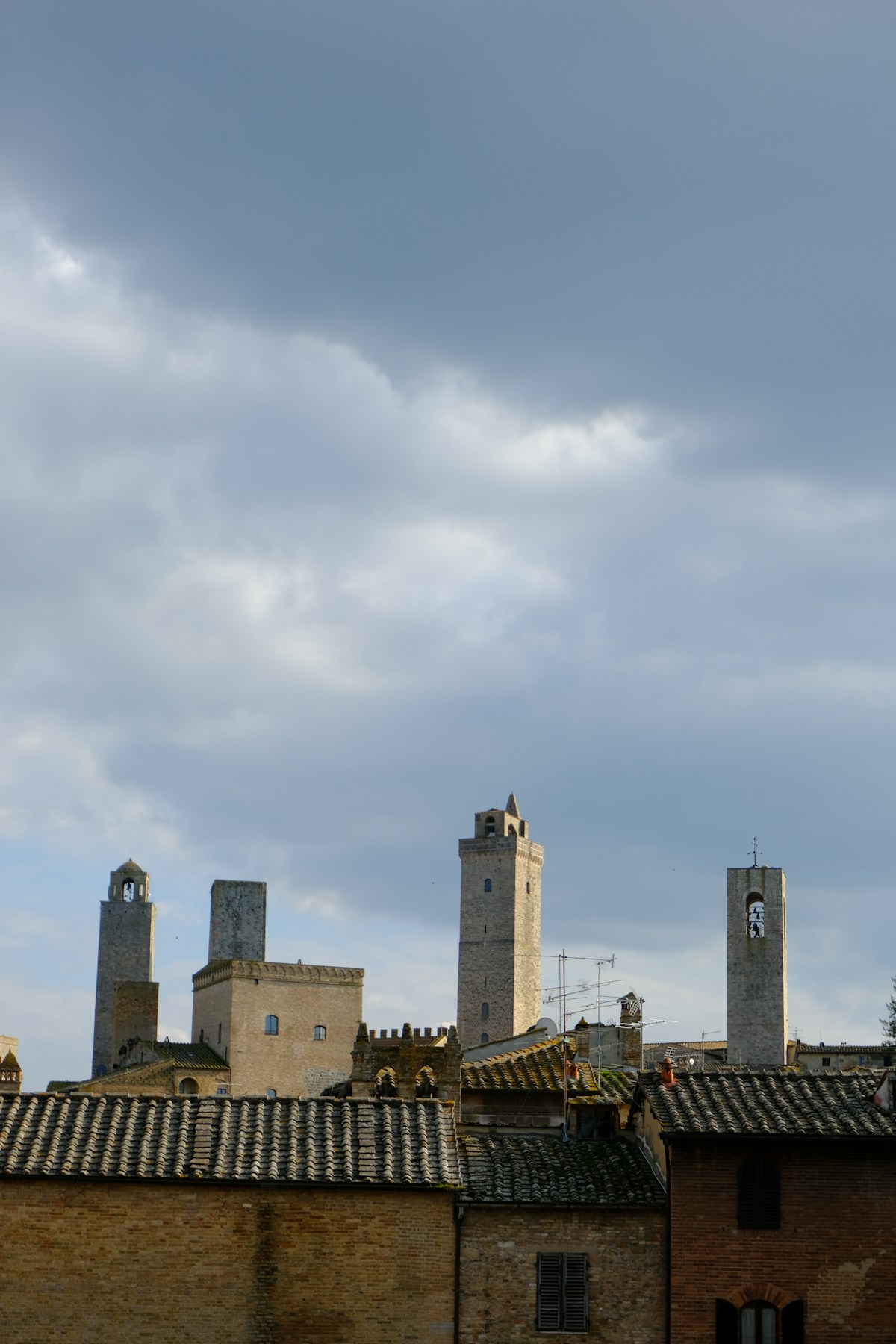
San Gimignano: The “medieval Manhattan” - 14 of its original 72 towers survive. Tower-building was the medieval equivalent of skyscraper construction: a demonstration of family wealth and power. UNESCO World Heritage Site.
Lucca: Perfectly intact medieval walls (converted to a promenade in the 19th century). Romanesque churches. The amphitheatre shape of the Piazza dell’Anfiteatro traces the outline of a Roman amphitheatre absorbed into the medieval city.
Palermo: Norman mosaics at the Palatine Chapel (1132–1140) - the finest 12th-century mosaics outside Ravenna. Monreale Cathedral (1174), 6,340 square metres of gold mosaic. The Zisa palace. This was the court of a Norman-Arab-Byzantine civilisation unlike anything in Europe.
Ravenna: Earlier than the medieval period but foundational - the capital of the Western Roman Empire’s final years, then of the Ostrogothic Kingdom, then the Byzantine Exarchate. Eight UNESCO-listed buildings with extraordinary early Christian mosaics (5th–6th centuries). The Mausoleum of Galla Placidia, the Basilica of San Vitale, Sant’Apollinare in Classe.
Assisi: The Basilica of St Francis (begun 1228, two years after his death) with Giotto’s fresco cycle of the Saint’s life - the beginning of the transition from medieval to Renaissance painting. The upper and lower churches.
Bologna: The oldest university in the Western world (founded 1088). The two towers (Asinelli and Garisenda) - remnants of the medieval tower-building competition. The basilica of San Petronio, begun in 1390 and never finished, is still the fifth-largest church in the world.
Orvieto: The Duomo (begun 1290) with façade mosaics and Luca Signorelli’s frescoes of the Last Judgment in the San Brizio Chapel (1499–1504) - Michelangelo studied these before painting the Sistine ceiling.
Plan your trip:
- Browse tours covering medieval Italy’s historic sites
- Get travel insurance for your trip
- Search flights to Italy
Dante and the late medieval mind
Dante Alighieri (1265–1321) wrote the Divine Comedy in the vernacular Tuscan that would become modern Italian - not in Latin. The Commedia is simultaneously a theological treatise, a political satire (Dante places his enemies in Hell), and a supreme work of imagination. To understand medieval Italy - its cosmology, its politics, its obsession with sin, punishment, and salvation - read Dante. Or at least the Inferno.
His birthplace in Florence is marked; his tomb is in Ravenna, where he died in exile.
For visiting the medieval sites covered here: Siena travel guide for the finest surviving medieval city in Italy. Venice guide for the maritime republic architecture. Palermo guide for the Arab-Norman churches. Assisi guide for the Basilica of St Francis. Bologna guide for the medieval towers and the world’s oldest university. For the period that followed: guide to the Italian Renaissance.