Rome was the capital of an empire that, at its peak in the 2nd century AD, ruled 60–70 million people across Europe, North Africa, and the Middle East. The physical evidence of that civilisation is extraordinary - in Italy alone, you can walk streets laid in the 1st century BC, stand in a forum where Julius Caesar was assassinated, and descend into catacombs used by early Christians while Nero persecuted them above ground.
The timeline
753 BC - Traditional founding date of Rome. Archaeological evidence shows continuous settlement from the 10th century BC on the Palatine Hill.
509 BC - The Roman Republic founded after the expulsion of the last king, Tarquinius Superbus. The Senate, consuls, and tribunes govern for the next 500 years.
264–146 BC - The Punic Wars against Carthage. Rome defeats Hannibal and establishes dominance over the western Mediterranean. The destruction of Carthage in 146 BC marks Rome’s emergence as a superpower.
44 BC - Julius Caesar assassinated on the Ides of March (15 March) in the Theatre of Pompey. The site is now the Largo di Torre Argentina, a cat sanctuary near Campo de’ Fiori.
27 BC - Augustus becomes the first Roman Emperor. The Pax Romana begins - 200 years of relative peace and prosperity across the empire.
79 AD - Mount Vesuvius erupts and buries Pompeii and Herculaneum under metres of volcanic ash and pyroclastic flow. The cities are preserved almost intact, providing the most complete picture of daily Roman life anywhere.
80 AD - The Colosseum completed under Emperor Titus. The inaugural games lasted 100 days.
113 AD - Trajan’s Column completed, commemorating the conquest of Dacia. The 35-metre spiral relief contains 2,662 carved figures.
313 AD - The Edict of Milan: Constantine I grants religious tolerance, beginning the Christianisation of the Empire.
476 AD - The Western Roman Empire falls when the Germanic chieftain Odoacer deposes the last emperor, Romulus Augustulus. The Eastern Empire (Byzantium) continues until 1453.
Where to see ancient Rome
Rome
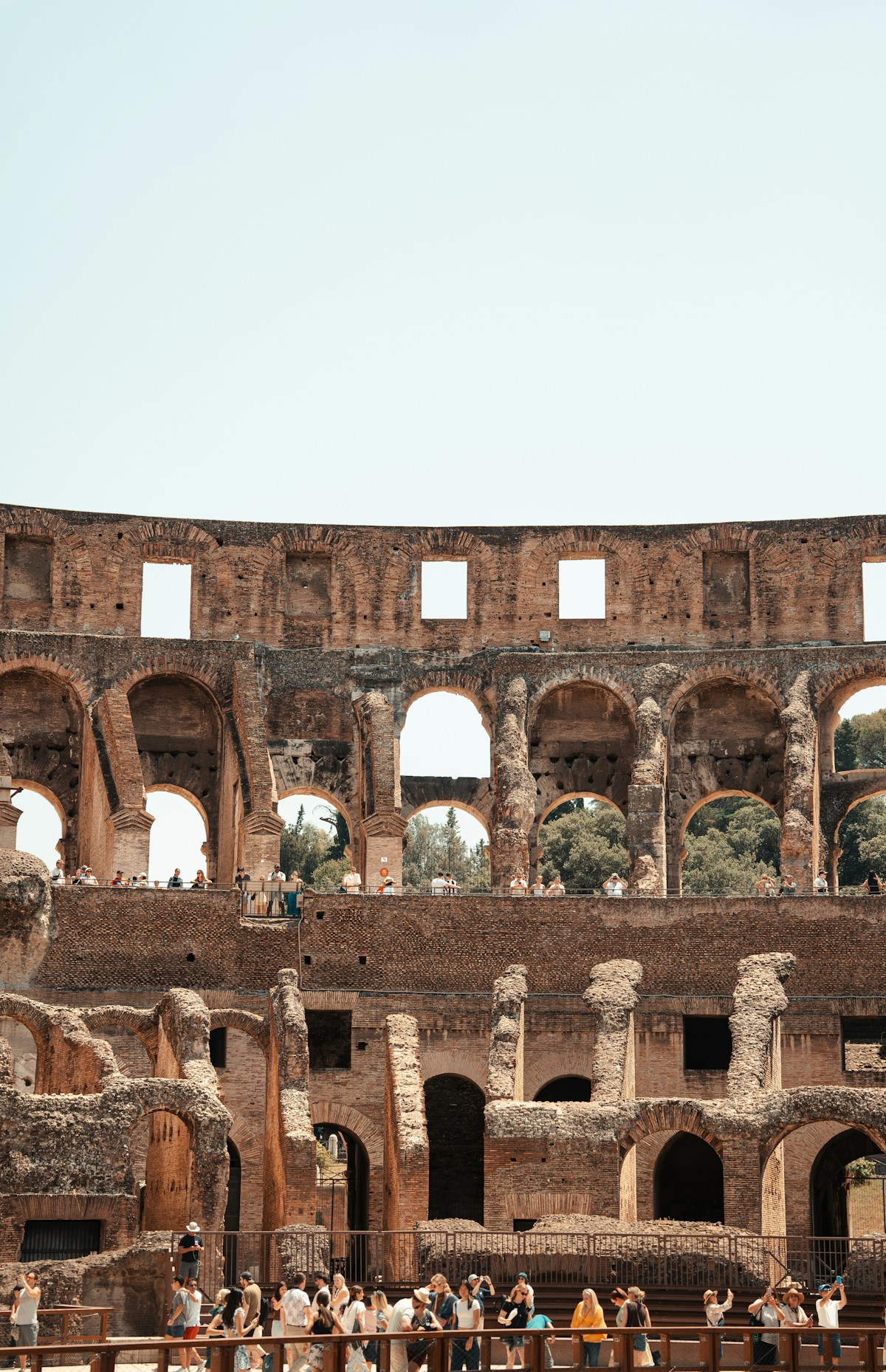
The Colosseum - The amphitheatre that defined Roman spectacle. Built in 8 years (72–80 AD), it held approximately 50,000 spectators for gladiatorial combat, animal hunts, and public executions. Entry approximately €16 (standard) or €22 (with underground and upper tier access) as of 2026. The combined ticket includes the Roman Forum and Palatine Hill and is valid for 24 hours. Open 8:30am–sunset (closing varies seasonally from 4:30pm in winter to 7:15pm in summer). Book online at coopculture.it to skip the ticket queue. Audio guide approximately €6. Guided tours of the underground hypogeum (where gladiators and animals waited) must be booked separately - approximately €9 supplement. For skip-the-line access and guided underground tours with expert commentary on gladiatorial logistics and amphitheatre engineering, Rome historical tours include hypogeum options.
The Roman Forum - The civic, commercial, and religious centre of Republican Rome. Walk the Via Sacra past the Temple of Antoninus and Faustina, the Curia (Senate house), the Arch of Septimius Severus, and the Temple of Saturn. Allow 1.5–2 hours. Included in the Colosseum combined ticket. Best visited early morning before tour groups arrive.
Palatine Hill - Where Rome began and where the emperors built their palaces. The Domus Augustana (Augustus’s palace) and the Domus Flavia are the main ruins. The views over the Forum and Circus Maximus are worth the climb. Included in the Colosseum combined ticket.
The Pantheon - The best-preserved ancient building in the world. Built by Hadrian around 125 AD, the concrete dome (43.3 metres in diameter) was the largest in the world for over 1,300 years. The oculus (9-metre opening at the apex) is open to the sky - rain falls through it. Entry approximately €5 as of 2026 (previously free). Open Monday–Saturday 9am–7pm, Sunday 9am–6pm. Free on the first Sunday of each month.
Baths of Caracalla - The largest bath complex in Rome, completed in 216 AD. Could serve 1,600 bathers simultaneously. Now hosts summer opera performances (Rome Opera season, June–August - tickets from approximately €25). Entry approximately €10 as of 2026. Open 9am–sunset, closed Mondays. Take Metro Line B to Circo Massimo.
Ostia Antica - Rome’s ancient port city, 30km southwest. Less-visited than Pompeii but extraordinary - complete streets, multi-storey apartment buildings (insulae), a theatre, taverns with intact counters, and the Piazzale delle Corporazioni (a marketplace with mosaic floors indicating each trader’s business). Entry approximately €12 as of 2026. Open 8:30am–sunset, closed Mondays. Take the Roma-Lido train from Roma Porta San Paolo (approximately 45 minutes, €1.50 each way).
Catacombs - Underground burial tunnels used by early Christians from the 2nd to 5th centuries. The Catacombs of San Callisto (Via Appia Antica) are the largest - 20km of tunnels on four levels, holding an estimated 500,000 burials. Guided tours only, approximately €10 as of 2026. Open 9am–12pm and 2pm–5pm, closed Wednesdays and during February. The Catacombs of San Sebastiano and Domitilla are alternative options.
Campania
Pompeii - The city preserved by the 79 AD eruption. Houses with wall frescoes, a forum, an amphitheatre, a brothel with explicit frescoes, bakeries with intact stone ovens, and plaster casts of victims. Entry approximately €18 (full) or €2 (EU citizens 18–25) as of 2026. Open 8:30am–7:30pm (summer) or 8:30am–5pm (winter). Allow 3–4 hours minimum. Take the Frecciarossa to Naples (1 hour from Rome, from €20), then the Circumvesuviana to Pompeii Scavi (approximately 35 minutes, €3.60).
Herculaneum - Better-preserved organic materials than Pompeii because it was buried under pyroclastic flow rather than ash. The carbonised library (containing scrolls now being read by AI), the wooden boat houses where skeletons were found, and two-storey houses with intact upper floors. Entry approximately €13 as of 2026. Smaller and easier to visit in half a day.
Museo Archeologico Nazionale di Napoli - Holds the finest finds from both Pompeii and Herculaneum, including the Alexander Mosaic, the Farnese Hercules, and the Secret Cabinet (erotic art from Pompeii). Entry approximately €18 as of 2026. Open 9am–7:30pm, closed Tuesdays. One of the most important archaeological museums in the world.
Elsewhere in Italy
Verona’s Arena - Roman amphitheatre completed in 30 AD, holding 22,000 spectators. Still in active use for opera (the Verona Opera Festival runs June–September - tickets from approximately €30). Entry approximately €10 as of 2026. Open 8:30am–7:30pm. The best-preserved large Roman amphitheatre in Italy.
The Arch of Augustus, Rimini - One of the finest surviving Roman triumphal arches, built in 27 BC. Free to view (standing at the entrance to Rimini’s old town).
Segesta, Sicily - A complete Doric temple in extraordinary condition, dating to approximately 420 BC. Never finished - the columns were never fluted. Entry approximately €12 as of 2026, including the nearby Greek theatre.
Valley of the Temples, Agrigento, Sicily - The largest Greek temple complex outside Greece. The Temple of Concordia (5th century BC) is one of the best-preserved Greek temples in the world. Entry approximately €12 as of 2026. Open 8:30am–8pm.
Paestum, Campania - Three Greek temples south of Salerno, dating from the 6th–5th centuries BC. Less visited than Agrigento but equally impressive. Entry approximately €12 (site and museum combined) as of 2026. Take the regional train from Naples (approximately 1.5 hours, €7).
For visiting the Roman sites in person: Rome travel guide covers the Colosseum, Forum, and Palatine Hill with current prices and booking advice. For skip-the-line tickets: Colosseum tickets guide. Pompeii is the single best window into daily Roman life - see Pompeii travel guide and our Pompeii history guide. For the history of the period before the emperors: Roman Republic guide.