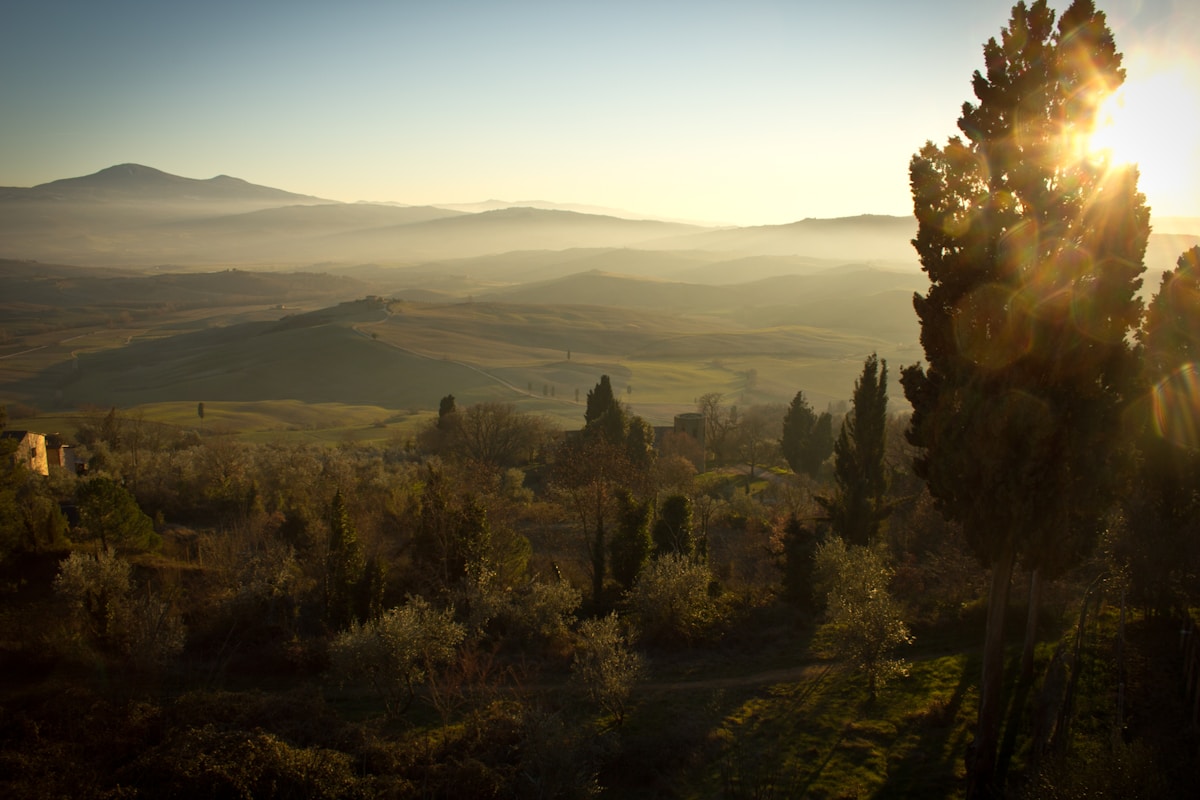
Siena’s position at the heart of southern Tuscany makes it an excellent base for day trips in all directions. San Gimignano is 30 km northwest; the Val d’Orcia UNESCO landscape begins 30 km south; Volterra is 60 km northwest through the Metalliferous Hills; and Florence is 75 km north. Public buses cover most of these routes, though a car significantly opens up the valley landscapes in between.
San Gimignano (30 km northwest, approximately 50 minutes by bus)
San Gimignano’s 14 surviving medieval towers - remnants of the original 72 built by competing noble families in the 12th and 13th centuries - are visible from kilometres away across the Tuscan hills. The town is small, the streets are steep, and in summer the crowds are intense. It is, nonetheless, genuinely worth seeing.
Torre Grossa (the tallest remaining tower, 54 metres, inside the Palazzo Comunale) is the only publicly climbable tower - combined entry to the tower and museum approximately €9 as of 2026. The view from the top encompasses the full Val d’Elsa valley and, on clear days, the sea. La Collegiata (the cathedral - note: San Gimignano has no bishop, so it is technically a Collegiata not a Cattedrale) has remarkably vivid 14th-century frescoes covering all three nave walls - biblical scenes painted in a style that predates the Renaissance by several decades. Entry approximately €6 as of 2026.
Vernaccia di San Gimignano DOCG is the local white wine - a dry, mineral-inflected wine that pairs well with the area’s food. The best approach: buy a glass at the Rocca (the ruined fortress at the south end of town, free entry, wooden terrace with panoramic views) and drink it in the garden. Wine bar tastings in town from approximately €10 for 3–4 wines as of 2026.
Gelato note: Gelateria Dondoli (Piazza della Cisterna 4) has won the World Gelato Championship twice and serves unusual flavours (saffron and pine nuts, Vernaccia wine sorbet). The queue is long but moves fast.
Getting there: Autolinee Toscane bus from Siena bus terminal (Piazza Gramsci) toward Poggibonsi, then connecting bus to San Gimignano - total approximately 1 hour to 1 hour 15 minutes, approximately €6–8 return as of 2026. Alternatively, a private car makes the drive in approximately 50 minutes via the SP54. Organised half-day tours from Siena (from approximately €45 per person including wine tasting) run daily in season.
Val d’Orcia (50–80 km south)
The Val d’Orcia is a UNESCO Cultural Landscape - the rolling hills, farmhouses, and cypress-lined roads south of Siena that have appeared in Italian travel imagery since the Renaissance. The landscape itself is the attraction; the towns scattered through it are secondary.
Pienza (approximately 50 km south, approximately 1.5 hours by bus) is the ideal Renaissance town - built almost entirely from scratch in 1459–1462 by Pope Pius II as a model city. The main square (Piazza Pio II) has four civic buildings designed by Bernardo Rossellino in a single coordinated scheme: the Cathedral, Palazzo Piccolomini, Palazzo Vescovile, and town hall. The Palazzo Piccolomini garden terrace has one of the best views in Tuscany, looking directly across the Val d’Orcia to Monte Amiata. Entry to the palazzo approximately €7 as of 2026. Pienza is also known for pecorino di Pienza - the local sheep’s cheese, sold in various stages of aging in shops along Via Rossellino (wedge approximately €2–5 as of 2026).
Montalcino (approximately 40 km south, approximately 1.5 hours by bus) sits on a hilltop above the Brunello vineyards. The Fortezza (14th-century fortress at the top of town) has an enoteca inside the walls where you can taste Brunello from approximately 10–15 producers in a single session - tastings from approximately €5–15 per glass, or approximately €18–30 for a structured tasting as of 2026. The fortress walls are walkable. The town itself is small but rewarding.
Sant’Antimo (10 km south of Montalcino, accessible by car or occasional local bus) is a 12th-century Romanesque abbey in a natural hollow in the valley - one of the most beautiful buildings in Tuscany. The French Benedictine monks hold multiple daily services with Gregorian chant; attending the morning mass (approximately 7:15am) or evening vespers (approximately 6pm) is free and genuinely atmospheric.
The landscape itself: The most famous Val d’Orcia photographs are taken near Monticchiello and along the SP116 between Pienza and San Quirico d’Orcia - the cypress-lined roads (viali di cipressi) and isolated farmhouses (poderi) on bare hilltops. These are accessible only by car; they are not near any bus route. The light is best in early morning and late afternoon.
Montepulciano (65 km southeast, approximately 1.5–2 hours by bus)
Montepulciano is a hilltop Renaissance town that rises sharply from a valley floor - the main street climbs through several hundred metres of elevation from the town gate to the main piazza, lined with Renaissance palaces, wine shops, and churches.
Piazza Grande at the summit has the Gothic-Renaissance Duomo (facade never completed), the Palazzo Comunale (the town hall with a tower climbable for views - approximately €2.50 as of 2026), and the Palazzo Contucci - one of the prime Vino Nobile producers, with a cantina beneath the palazzo accessible to visitors.
Vino Nobile di Montepulciano DOCG is the local wine - the town’s signature red since the 16th century, made primarily from Sangiovese (Prugnolo Gentile locally). Tastings in town: Cantina de’ Ricci (beneath the Palazzo Ricci, Via Ricci 11 - one of the most historic wine cellars in Montepulciano, with a labyrinthine underground vault; tastings approximately €10–20 per person as of 2026). Contucci (Piazza Grande 13 - walk-in tastings available most days, approximately €10–15 as of 2026).
Bruscello - Montepulciano’s traditional outdoor theatre festival - runs over several summer evenings in August in Piazza Grande. Performances are in Italian, tickets approximately €10–15. The setting (the square lit up, medieval backdrop, wine available) is the experience.
Getting there: Bus from Siena toward Torrenieri or Bettolle, then onward bus to Montepulciano - approximately 1.5–2 hours total. Check Autolinee Toscane timetables. By car approximately 65 km via the SP146 (the Strada del Vino) - approximately 1.5 hours. The drive through the Val d’Orcia landscape along the SP146 is itself scenic.
Volterra (60 km northwest, approximately 1.5 hours by bus or car)
Volterra is an Etruscan and medieval city that most Tuscan visitors skip in favour of San Gimignano - similar hilltop position, far fewer tourists, more authentic atmosphere. The Etruscan civilization flourished here before Rome - the Museo Etrusco Guarnacci (Via Don Minzoni 15) has one of the finest Etruscan collections in Italy, including the extraordinary Ombra della Sera (an elongated bronze figure of a boy) and over 600 Etruscan urns. Entry approximately €8 as of 2026. Open daily.
Volterra has specialised in alabaster carving since Etruscan times - the hills around the city contain alabaster deposits not found elsewhere in Tuscany. Via Porta all’Arco and Via delle Prigioni have alabaster workshops where craftspeople still work the stone by hand. Small pieces from approximately €10; demonstrations sometimes free or at low cost.
The Roman Theatre (2nd century BC, partially excavated in the 20th century) is visible from the Viale Lungo le Mura - one of the better-preserved Roman theatres in northern Tuscany, with the stage wall still rising several metres. Entry to the excavated interior approximately €5 as of 2026. The Piazza dei Priori (13th-century town hall facing a well-proportioned medieval square) is one of the finest pre-Renaissance squares in Tuscany.
Getting there: CPT bus from Siena toward Colle di Val d’Elsa, then connection to Volterra - approximately 1.5–2 hours total. Check timetables carefully as services are infrequent. By car approximately 1 hour via the SP68.
Terme di Petriolo and Bagni di Petriolo (55 km south, free thermal springs)
The Farma river in the Farma valley south of Siena has natural hot sulphurous springs flowing into the riverbanks - free to access, open at all hours, with temperatures around 40°C. The free springs (vasca libera or bagni liberi) are approximately 30 minutes’ walk from the car park at the bottom of the Petriolo hill - pools of varying temperature in a gorge setting, very popular with locals and considerably more atmospheric than the paid spa above.
The Terme di Petriolo (the paid hotel/spa complex on the hill above) charges approximately €25–35 for a day pass to their pools as of 2026.
Getting there: A car is necessary - the free springs are not accessible by public transport. From Siena approximately 55 km south via the SP73 and the road through Monticiano. Turn off toward Petriolo; the signposted parking is at the valley floor. The walk from parking to the springs takes approximately 25–30 minutes.
Abbazia di Monte Oliveto Maggiore (35 km southeast)
The Monte Oliveto Maggiore is a large Benedictine monastery founded in 1313, set in the distinctive crete senesi landscape - bare, eroded clay hills unique to this part of southern Tuscany. The Great Cloister has an extraordinary fresco cycle of the Life of Saint Benedict painted by Luca Signorelli (1497) and Giovanni Antonio Bazzi called Il Sodoma (1505–1508). The frescoes are large-scale, brilliantly coloured, and include portraits of the artists themselves. Entry to the cloister is free; the church is also free. Open daily.
The monastery is still active - approximately 30 monks live and work here. A small shop sells the monks’ products: honey, herbal medicines, and Chianti Classico wine produced from their vineyards.
Getting there: By car approximately 35 km southeast via Asciano - approximately 45 minutes. There is an infrequent bus from Siena to Asciano (approximately 1 hour) then a taxi or further local bus to the monastery, but a car is more practical.
Practical notes
- Siena’s bus terminal is in Piazza Gramsci, one level below street level; Autolinee Toscane operates most regional routes; buy tickets at the terminal or online
- For Val d’Orcia drives: the SP146 (Cassia Antica) between San Quirico d’Orcia and Chianciano Terme is the most scenic road, lined with cypresses and passing through the heart of the landscape - hire a car from Siena for at least a half-day if this is a priority
- San Gimignano is extremely crowded July–August; go on a weekday and arrive before 10am
- The Palio in Siena (July 2 and August 16) means hotels in Siena are fully booked for the surrounding days - if visiting during Palio, arrange accommodation well in advance or base yourself in San Gimignano, Montepulciano, or Montalcino instead
- Brunello di Montalcino is not cheap to drink; Rosso di Montalcino at approximately €5–10 per glass gives a genuine taste of the appellation at more reasonable cost
Back to the full Siena travel guide for the Palio, the Duomo, and city essentials. For Florence - the most popular day trip from Siena - our full Florence travel guide covers museums, eating, and getting around. For the Tuscan wine context driving many of these excursions, our Italian wine guide covers Chianti Classico, Brunello, and Vernaccia di San Gimignano. The Tuscany itinerary maps a full week connecting Siena, the Val d’Orcia, Florence, Lucca, and the coast.
Book Siena Day Tours on GetYourGuide
| Tour | Duration | From price | Highlights |
|---|---|---|---|
| San Gimignano & Volterra Day Tour from Siena | 8 hours | From €55 | Medieval towers, alabaster workshops, Vernaccia wine tasting, Monteriggioni stop |
| Pienza & Montepulciano Small-Group Tour from Siena | 8 hours | From €65 | Val d’Orcia UNESCO landscape, Vino Nobile tasting, Renaissance hilltowns |
| Chianti Wine Tour with Castle Visit from Siena | 5 hours | From €50 | Wine cellar visit, Chianti Classico tasting, scenic countryside drive |
Where to stay in Siena: Find hotels in Siena — search accommodation across all budgets.