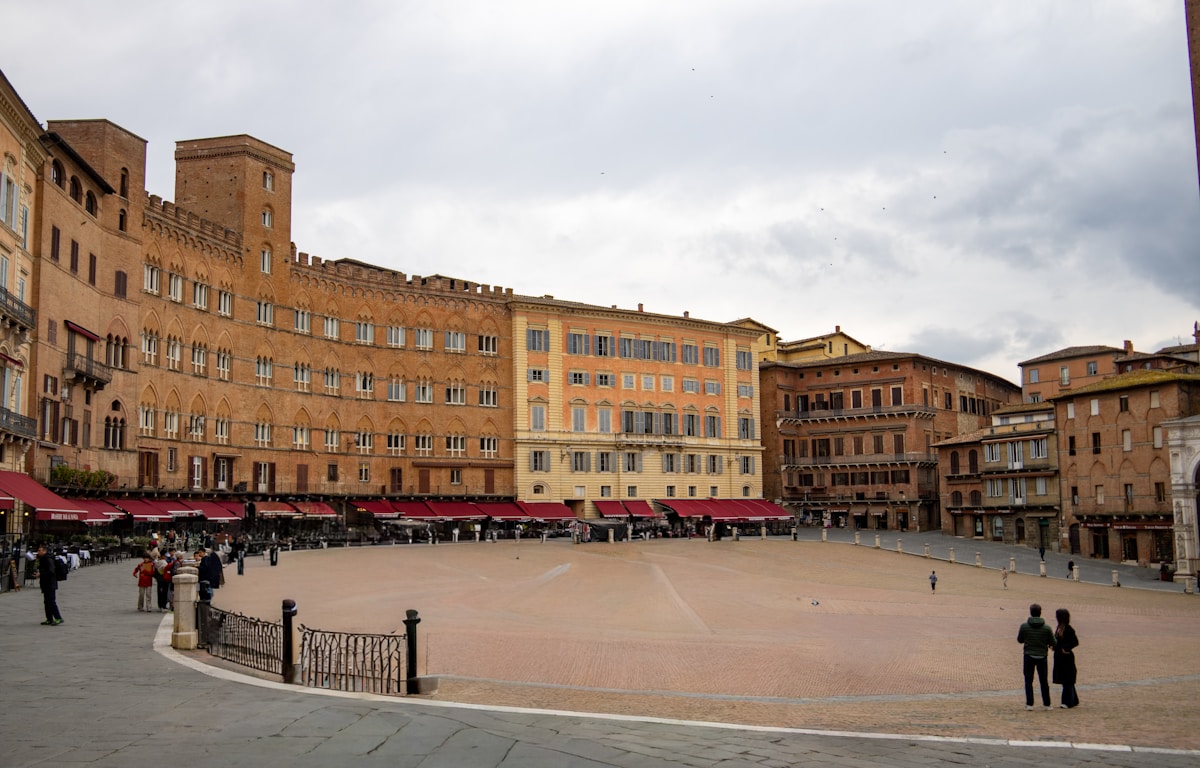
Siena is the most completely preserved medieval city in Italy. While Florence was being rebuilt in the Renaissance, Siena was in decline after the Black Death of 1348 killed perhaps two-thirds of its population - and that catastrophe, paradoxically, preserved its medieval character. The city has changed very little in 700 years. Walking its contorted streets and into the Piazza del Campo remains one of the great experiences of Italian travel.
Piazza del Campo
The Campo is the defining space of Siena - a concave, shell-shaped piazza built from red brick, divided into nine sections by pale marble lines (representing the Nine, the ruling council of 14th-century Siena). The slope runs down toward the Palazzo Pubblico at the lower end. On the 2nd July and 16th August each year, it becomes the track for the Palio horse race.
Sit on the brickwork, not a café chair. The Campo is a public space that functions as Siena’s living room - people sit on the paving from morning to midnight. The café terraces around the perimeter charge tourist premiums.
Top Tours at a Glance
| Tour | Duration | Price (from) | Group Size | Highlights |
|---|---|---|---|---|
| Siena walking tour with Duomo | 2.5 hrs | from €35 | Up to 15 | Campo, Palazzo Pubblico, Duomo, contrade history |
| Siena + San Gimignano day tour from Florence | 8 hrs | from €55 | Up to 20 | Two medieval cities, Tuscan countryside |
| Siena food and wine tasting tour | 3 hrs | from €65 | Up to 12 | Brunello tasting, pici, panforte, local producers |
| Palio di Siena experience and contrade tour | 2 hrs | from €40 | Up to 15 | Contrade museums, Palio history, Campo |
Browse all Siena tours → GetYourGuide
Palazzo Pubblico and the Torre del Mangia
The Palazzo Pubblico (1297–1310) is the Gothic town hall that terminates the south end of the Campo. The Museo Civico inside contains the most important collection of medieval Sienese painting, including Simone Martini’s Maesta (1315) - a large enthroned Madonna that is a landmark of Italian art - and Ambrogio Lorenzetti’s Allegory of Good and Bad Government (1338–1339), one of the most significant secular paintings of the medieval period. The scenes of the effects of good and bad government on the city and countryside are detailed, political, and humane.
The Torre del Mangia (€10, separate ticket) is the bell tower adjacent to the Palazzo, 88 metres high. The climb is worth it: views over the Campo and the roofscape of Siena.
The Duomo
The Cathedral of Siena is one of the great Gothic churches of Italy - and one of the most ambitious. Construction began in the mid-13th century; in the 1330s, the Sienese planned to expand it into the largest church in Christendom. The Black Death ended that ambition. The incomplete nave (Facciatone) stands as a wall at the east end - you can climb it for views.
The existing Duomo is extraordinary: a striped black-and-white marble exterior, a polychrome marble interior, and a floor covered with 56 inlaid marble panels depicting Old Testament scenes and allegorical figures (1369–1547). The floor is usually covered for protection; it is uncovered in August–September.
The Piccolomini Library (inside the Duomo, separate ticket) contains Pinturicchio’s fresco cycle depicting the life of Pope Pius II - vivid, detailed, and in excellent condition.
The Baptistery, in the crypt below the east end, has a 15th-century marble font with bronze reliefs by Donatello, Ghiberti, and Jacopo della Quercia.
The Contrade and the Palio
Siena is divided into 17 contrade (districts), each with its own symbol, church, museum, and fierce civic identity. The rivalry between them is expressed most intensely in the Palio - the horse race run on 2 July and 16 August in the Piazza del Campo. Ten of the 17 contrade participate; the race lasts 90 seconds and is preceded by days of preparation, alliances, betrayals, and street celebrations.
Guided tours of Siena covering the Duomo, Palazzo Pubblico, and contrade history are widely available and worthwhile for context on the Palio and medieval civic life. The Palio is not a tourist event - it is the most emotionally intense event in Italian civic life. Contrada members have genuine allegiance to their district from birth; winning or losing the Palio produces celebrations that last weeks or grief that lasts years. Watching from inside the Campo is free but requires arriving hours ahead and standing in a dense crowd in summer heat. Bleacher seats around the edge cost €200–400 and must be booked months ahead.
Even if you are not here for the Palio, the Contrade museums (most open on request or specific afternoons) give the best insight into this extraordinary institution.
Santa Maria della Scala
A former hospital opposite the Duomo (in continuous operation from the 9th century to the 1990s), now a major museum. The Pellegrinaio - the pilgrims’ ward - has a complete 15th-century fresco cycle by Domenico di Bartolo depicting hospital life with unusual realism. The vast underground Etruscan and medieval deposits beneath the hospital are still being excavated.
Day trips from Siena
Val d’Orcia (30–45 minutes): The UNESCO landscape of rolling hills, cypress lines, and hill towns. Pienza, Monticchiello, San Quirico d’Orcia, and Montepulciano are all within 40 minutes by car.
San Gimignano (40 minutes): The tower village. Easy half-day trip.
Montalcino (40 minutes): Home of Brunello di Montalcino - one of Italy’s great red wines. The town has a fortress with enoteca selling the wine and views across the Val d’Orcia.
Abbazia di Sant’Antimo (1 hour): A 12th-century Romanesque abbey in an isolated valley. Gregorian chant services if the resident monks are present. The alabaster translucency of the stone columns is extraordinary.
Back to the full Siena travel guide for an overview of the city. For food - pici, wild boar, panforte, and Brunello - see the Siena food guide. For Val d’Orcia day trips and other Tuscan escapes, see the day trips from Siena guide. For the Tuscan food tradition in context, our Tuscan food guide and Italian wine guide cover Chianti Classico, Brunello, and the broader regional cuisine. Planning a Tuscany circuit? Our Tuscany itinerary maps the best route connecting Florence, Siena, the Val d’Orcia, and the coast.
Where to stay in Siena: Find hotels in Siena — search accommodation across all budgets.