Bari is Puglia’s capital and the best base for exploring the region. Ferrovie del Sud-Est (FSE) trains fan out south and southeast toward the trulli valleys; Trenitalia regional trains run south to Brindisi and Lecce; and the FAL railway connects west toward Matera and the Basilicata interior. Most of Puglia’s headline attractions are within 90 minutes.
Alberobello (55 km south, approximately 90 minutes by train)
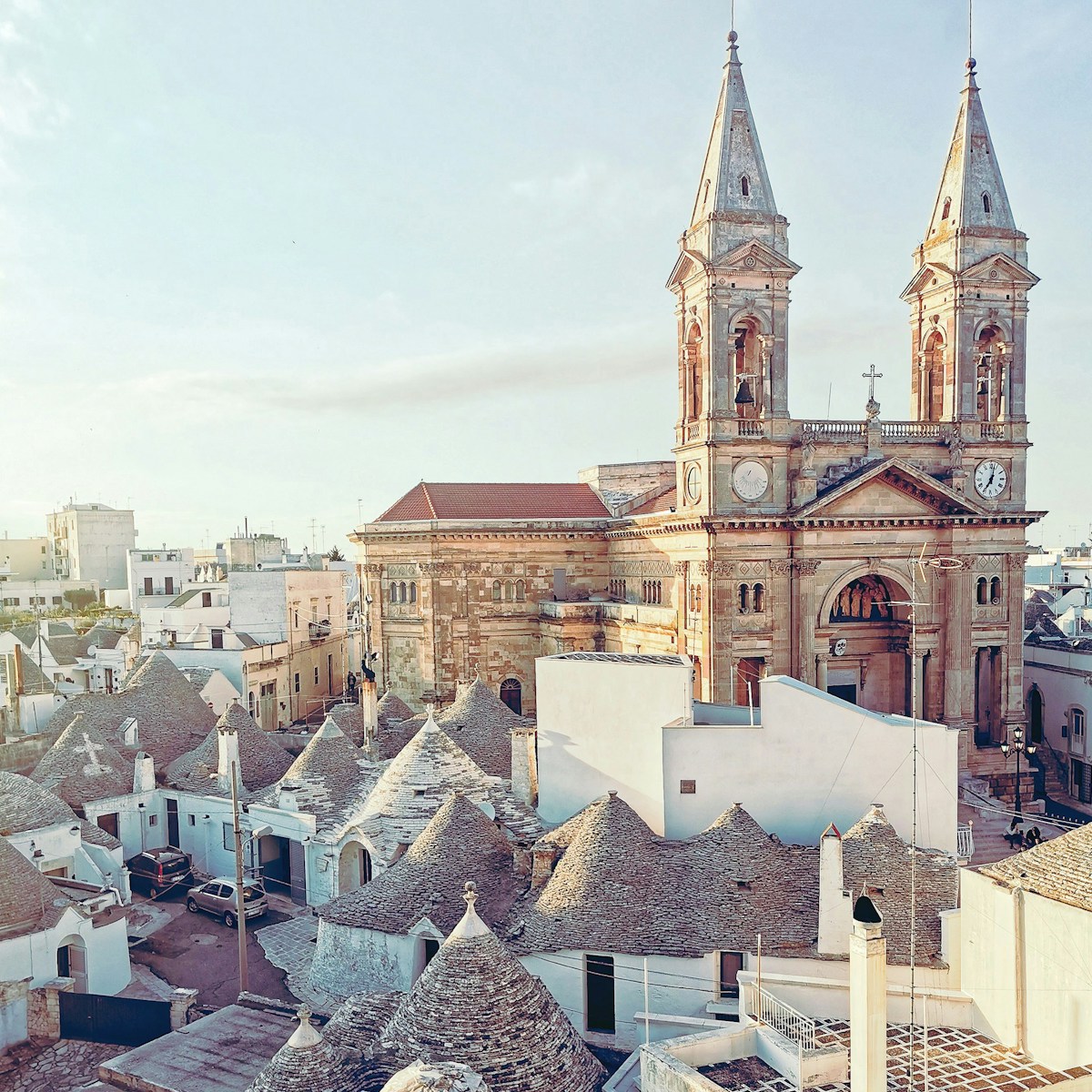
Alberobello is the largest concentration of trulli - the distinctive dry-stone dwellings with conical limestone roofs that exist almost nowhere else in the world. The Rione Monti district has over 1,000 trulli climbing a hillside, and the effect of looking down the lanes at their pointed roofs is genuinely distinctive. The Aia Piccola neighbourhood on the other side of the main piazza is residential - fewer souvenir shops, quieter atmosphere, and you can walk close to trulli that people actually live in.
The Trullo Sovrano (Piazza Sacramento 1) is the only two-storey trullo in Alberobello - entry approximately €3 as of 2026. Most trulli are single-storey and single-room; this one was constructed for a wealthy family in the 18th century and gives a sense of the interiors. The interior is modest but the building itself is the point.
Honest assessment: Alberobello is heavily commercialised. Rione Monti during peak season (July–August) can feel like a theme park - souvenir shops, photo queues, and crowds. Early morning visits (before 10am) and off-season trips (November–March, when the light on the limestone is particularly good) give a more authentic experience. The trulli themselves remain remarkable regardless.
Getting there: FSE train from Bari Centrale to Alberobello - approximately 90 minutes, approximately €5–7 as of 2026. FSE trains run several times daily. Check current FSE timetables at fseonline.it; the line is regional and services are less frequent than Trenitalia mainlines. From Alberobello station, the trulli districts are approximately 15 minutes on foot uphill.
Polignano a Mare (35 km south, approximately 30 minutes by train)
Polignano a Mare sits on a limestone cliff with the Adriatic 20 metres below - the old town built directly on the cliff edge, with several houses cantilevered above the sea. It is one of the most photographed towns in southern Italy.
The Lama Monachile cove (directly below the old town centre, reached by stairs) has striking turquoise water against white limestone. It is genuinely beautiful, and extremely crowded in summer. Arrive before 9am in July and August to find space.
Sea cave tours depart from the small harbour below the old town - motorboat trips into the sea caves and grottos of the surrounding coast, approximately €15–20 per person as of 2026, departures when boats fill. The grottos are accessible only by sea; the boat trip is the only way to see them.
The old town itself is small - compact lanes, a church on the cliff edge, and the terrace above the cove. Street food: polpo alla brace (grilled octopus, approximately €5–8 as of 2026) and raw sea urchin on half-shell (seasonal, approximately €3–5) are the Polignano specialities.
Getting there: Trenitalia regional train from Bari Centrale toward Lecce/Brindisi - approximately 30 minutes, approximately €3–4 as of 2026. Very frequent services. From Polignano station, the old town is approximately 15 minutes on foot.
Matera (approximately 60 km west, 1.5 hours)
Matera is one of the oldest continuously inhabited settlements in the world - the Sassi (cave quarters) have been lived in for approximately 9,000 years, carved into the ravine of the Gravina river. UNESCO World Heritage since 1993. It was European Capital of Culture in 2019.
The two Sassi districts - Sasso Caveoso and Sasso Barisano - descend into the ravine in tiers of cave-houses, cave churches, and rock-cut cisterns. The views from the opposite ridge across the ravine are the most famous image of Matera. Peer into the Casa Grotta di Vico Solitario (an intact cave house, entry approximately €3 as of 2026) for a sense of what life in the Sassi looked like in the 1950s, when the Italian government forcibly evacuated the population.
The Parco della Murgia Materana across the ravine has dozens of cave churches (rupestrian churches) with medieval frescoes intact - including the Madonna delle Virtù and San Nicola dei Greci complex. Guided tours from approximately €12 per person as of 2026, run by local guides associating at the park entrance.
Allow at least half a day; the full Sassi circuit with the cave churches is better suited to an overnight. Matera has excellent accommodation in converted cave-houses (from approximately €80–150/night as of 2026) if you want to stay.
Getting there: FAL bus from Bari Centrale bus station to Matera (Piazza Matteotti) - approximately 1.5 hours, approximately €5–7 as of 2026. Buses run several times daily. No direct train from Bari. By car via the SS96 and SP175 - approximately 1 hour.
Trani (45 km northwest, approximately 50 minutes by train)
Trani is one of the most elegant towns on the Adriatic - a honey-coloured medieval city with a cathedral built directly on the waterfront, its apse overhanging the sea. The Cattedrale di San Nicola Pellegrino (built 1097–1200, still largely intact in its original Romanesque form) sits at the water’s edge on a broad limestone terrace - one of the most dramatic cathedral settings in Italy. Free entry; crypt and underground church complex below the main floor.
The Jewish quarter (Giudecca) behind the cathedral is one of the best-preserved in southern Italy - Trani had a significant Jewish community in the medieval period, and several former synagogues survive, including the 13th-century Scolanova (now a church, but with Hebrew inscriptions still visible). The Castello Svevo (Frederick II’s 13th-century fortress) guards the harbour entrance - entry approximately €4 as of 2026.
Trani produces the Castel del Monte DOC wines, particularly the local red grape Nero di Troia. Wine bars around the waterfront serve local wines by the glass from approximately €3.
Getting there: Trenitalia regional train from Bari Centrale toward Foggia/Barletta - approximately 50 minutes, approximately €4–6 as of 2026. Frequent services.
Castel del Monte (approximately 60 km west, 1.5 hours)
Frederick II’s castle is one of the most mysterious buildings in medieval Europe - an octagonal fortress on a hilltop, with octagonal towers at each corner, built in the 1240s. No moat, no drawbridge, no interior courtyard stables - it was never a military fortress and was probably not a hunting lodge. Nobody knows exactly what it was built for. UNESCO World Heritage since 1996. Entry approximately €5 as of 2026. Open daily 9am–7:30pm in summer.
The interior is largely empty - stripped of its marble floors and furnishings over the centuries - but the building’s geometry and the views from the hilltop across the Murge plateau make the visit worthwhile.
Getting there: A car is essentially required - Castel del Monte is on an isolated hilltop with no practical public transport. From Bari approximately 1.5 hours via the SS96 toward Minervino Murge. Some organised day tours from Bari include Castel del Monte alongside Trani (from approximately €35–50 per person as of 2026). Alternatively, hire a car in Bari for the flexibility to combine Castel del Monte with Trani or the Valle d’Itria in one day.
Lecce (approximately 160 km south, 2 hours by train)
Lecce is the Baroque capital of Puglia - a city of extraordinary decorated facades in the local golden limestone (pietra leccese), so soft that it was carved in extraordinary detail. The churches, palaces, and piazzas of the historic centre have elaborate ornamental stonework that earns Lecce the description “Florence of the South” - an overused phrase but in this case apt.
Santa Croce (Via Umberto I) is the centrepiece - the facade took 150 years to complete and features fantastical zoomorphic and floral carvings. The interior is simpler. Piazza del Duomo (the Cathedral square) is enclosed on three sides and feels theatrical. The Museo Faggiano (Via Ascanio Grandi 56 - entry approximately €6 as of 2026) is a private house where excavations revealed 2,500 years of stratified history - Messapian walls, Roman pipes, medieval cellars - all visible through floor panels.
Getting there: Trenitalia direct train from Bari Centrale to Lecce - approximately 2 hours, approximately €15–25 as of 2026 (price varies by train type). Services every 30–60 minutes on the mainline. Lecce is better as an overnight but a long day trip is feasible.
Practical notes
- FSE (Ferrovie del Sud-Est) and Trenitalia are separate rail systems; FSE serves Alberobello, Locorotondo, and the Valle d’Itria; Trenitalia serves Polignano, Trani, and Lecce
- Buy FSE tickets at Bari Centrale from the FSE ticket windows or online at fseonline.it - Trenitalia tickets do not cover FSE trains
- Matera is in Basilicata (not Puglia); check return bus times before you go as evening services can be limited
- Carry water and sun protection - July and August temperatures regularly exceed 35°C in inland Puglia
- Castel del Monte has minimal shade and no on-site cafés - bring provisions
Book Bari Day Trip Tours on GetYourGuide
| Tour | Duration | From price | Highlights |
|---|---|---|---|
| Valle d’Itria day trip from Bari — Alberobello, Locorotondo, and Cisternino | 9 hrs | From €55 | Trulli UNESCO site, whitewashed Locorotondo, FSE railway, small group |
| Matera guided tour from Bari — Sassi cave dwellings and rupestrian churches | 10 hrs | From €65 | Sasso Barisano and Caveoso, Casa Grotta di Vico Solitario, expert guide |
| Castel del Monte and Trani full-day tour from Bari | 9 hrs | From €50 | Frederick II’s octagonal castle, Trani cathedral on the sea, coastal drive |
Browse all Bari tours on GetYourGuide →
Back to the full Bari travel guide for city sights and connections. For Matera as a destination in its own right - the Sassi cave dwellings, the rock churches, and where to stay - our dedicated city guide covers it in detail. Lecce is also worth a full guide: see our things to do in Lecce and best hotels in Lecce. For a full Puglia circuit itinerary - Bari, Valle d’Itria, Lecce, Matera - our Puglia itinerary maps the route. For Puglia vs Sicily as a southern Italy choice, our Puglia vs Sicily guide covers the trade-offs.
Where to stay in Bari: Find hotels in Bari — search accommodation across all budgets.