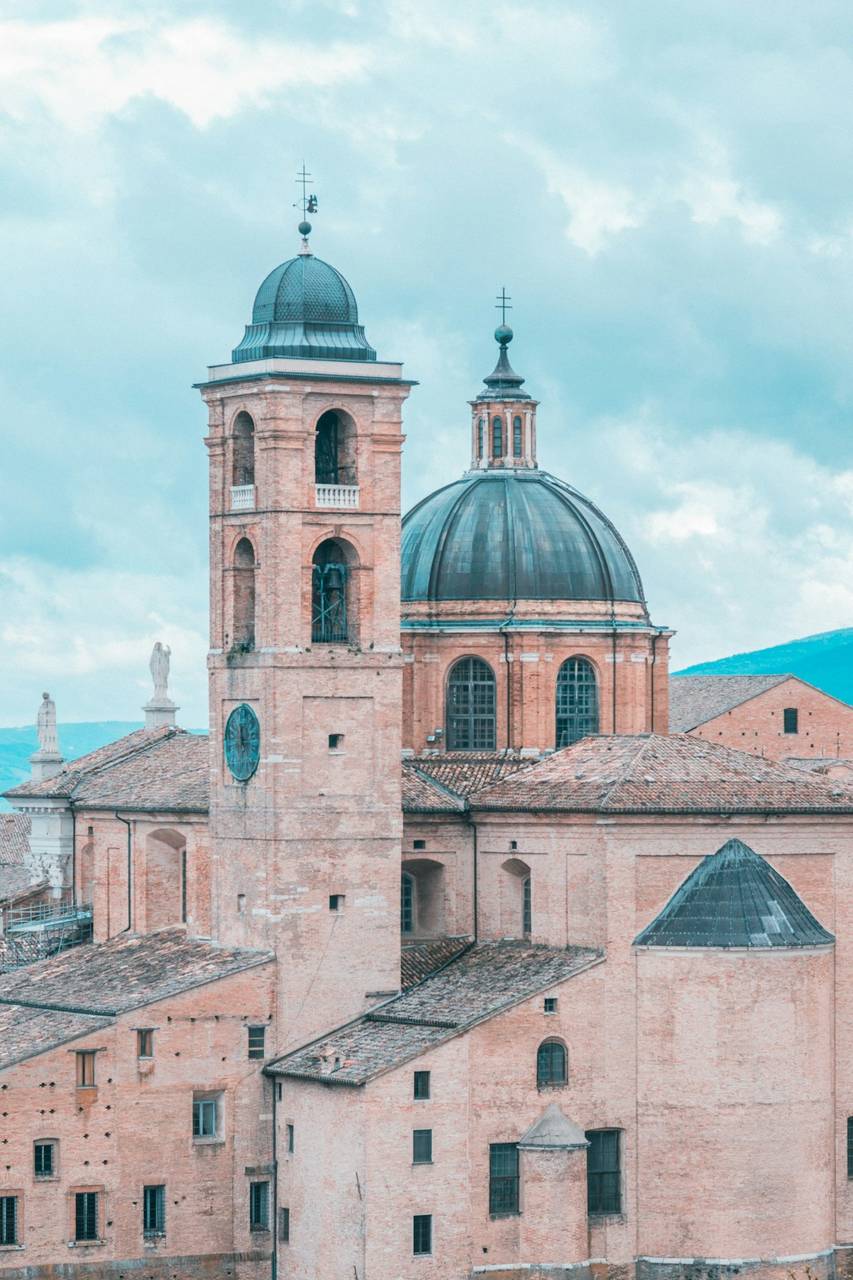
Le Marche — or simply Marche — occupies the central Adriatic slope of the Italian peninsula between the Apennines and the sea. It borders Emilia-Romagna to the north, Tuscany and Umbria to the west, Abruzzo to the south, and the Adriatic to the east. The region is long and narrow, its landscape running in parallel east-west strips: the high Apennines along the western border, a belt of rolling hills and river valleys in the middle, and a coastal strip of beach towns and small cliffs to the east. This geography produces a region of considerable variety within a compact area.
Le Marche is one of the most consistently underrated regions in central Italy. Its hill towns are as old and well-preserved as those of Tuscany; its main city, Urbino, produced Raphael and contains one of the finest Renaissance palaces in Europe; its coast is cleaner and less developed than Rimini or Riccione; and its food — the region’s olive oil, Verdicchio wine, and seafood brodetto — is genuinely excellent. What it lacks is international name recognition, which means prices remain more honest and the main sites are manageable year-round. Guided tours in Le Marche cover the Ducal Palace in Urbino, Grotte di Frasassi cave tours, and truffle-hunting experiences in the Apennine foothills.
Urbino
Urbino sits on a double-peaked hill in the northern interior of Le Marche — a university city and Renaissance monument that has been a UNESCO World Heritage Site since 1998. Federico da Montefeltro, Duke of Urbino from 1444 to 1482, built the city’s defining structure and assembled one of the most sophisticated courts in 15th-century Europe.
The Palazzo Ducale (Piazza Duca Federico) dominates the hilltop with two distinctive cylindrical towers on its façade and an interior courtyard that is a textbook example of Renaissance civic architecture. The palace now houses the National Gallery of the Marche (Galleria Nazionale delle Marche), with works by Raphael (born in Urbino in 1483), Piero della Francesca, Titian, and the Città Ideale — the anonymous painting of an ideal Renaissance city that has become one of the most reproduced images in art history. Entry costs approximately €8 as of 2026; open Tuesday to Sunday 08:30–19:15, Monday 08:30–14:00.
Raphael’s birth house, the Casa Natale di Raffaello (Via Raffaello 57), is a museum in the house where the painter grew up, with a fresco attributed to his father Giovanni Santi. Entry costs approximately €3.50; open Monday to Saturday 09:00–13:00 and 15:00–19:00, Sunday 10:00–13:00.
Read our detailed guide to Urbino’s attractions, hotels, and restaurants for complete information on visiting.
Ascoli Piceno
In the south of Le Marche, where the Tronto and Castellano rivers meet, Ascoli Piceno is built almost entirely from local travertine — a pale limestone that gives the city an unusually uniform and luminous appearance. The Piazza del Popolo at its centre, flanked by the 13th-century Palazzo dei Capitani del Popolo and the Church of San Francesco, is one of the most attractive town squares in central Italy and was voted Italy’s most beautiful piazza in a national survey in 2008.
The city is the origin of olive all’ascolana — green olives stuffed with meat, breadcrumbed, and deep-fried — which have been produced and exported from this area since the 19th century. They are eaten as an antipasto or street food and are inseparable from the city’s culinary identity.
Read our full guide to Ascoli Piceno’s attractions, where to eat, and where to stay for details.
Ancona and the Riviera del Conero
Ancona is the regional capital and the main port for ferries to Croatia, Greece, and Albania. The city itself is workmanlike rather than beautiful, but the Riviera del Conero immediately south — a 20-kilometre stretch of cliffs, coves, and beaches protected within the Parco del Conero — is the finest coastal scenery on the Adriatic. The beaches at Portonovo and Sirolo are reached by local bus from Ancona and are significantly better than anything in the Riviera romagnola further north. The hiking trail from Sirolo to Numana along the cliff edge takes approximately 1.5–2 hours and passes through scrubland above some of the cleanest water on the Italian Adriatic.
Where to stay in Ancona:
- Grand Hotel Passetto — Overlooking the sea near the Passetto cliff steps, with comfortable rooms and a reliable restaurant. Rooms from approximately €100–180 per night.
- Hotel Fortuna — Central, mid-range option a short walk from the port and train station. Rooms from approximately €65–100 per night.
Pesaro and the Northern Coast
Pesaro is a medium-sized Adriatic resort town with a wider cultural claim — it is the birthplace of Gioachino Rossini (1792–1868), and the Museo Nazionale Rossini (Palazzo Machirelli) and the summer Rossini Opera Festival (held annually in August, tickets from approximately €50–200 as of 2026) draw visitors who might otherwise pass through without stopping.
The Museo Civici di Pesaro (Piazza del Popolo 22) holds a significant collection of decorated Renaissance ceramics — the Della Robbia ware and local maiolica are among the best-preserved examples in the region. Entry approximately €8 as of 2026; open Tuesday to Sunday 10:00–13:00 and 16:00–19:00.
Grotte di Frasassi
The Grotte di Frasassi (Frasassi Caves) in the Sentino gorge near Genga are among the largest cave systems in Europe, with chambers big enough to contain the Milan cathedral. The caves were discovered in 1971 and opened to the public in 1974. Guided tours run approximately every 30–45 minutes and last around 75 minutes; tickets cost approximately €18 as of 2026, including the guide. The caves maintain a constant temperature of 14°C — bring an extra layer regardless of outside weather. Reach Genga by train from Ancona (approximately 1 hour to Genga station) or by car via the SS76.
Monti Sibillini National Park
The Sibillini mountains form the western border of Le Marche and extend into Umbria. The highest peak, Monte Vettore at 2,476 metres, is accessible by trail from Forca di Presta (approximately 4–5 hours return). The Piano Grande di Castelluccio — a high flat valley at 1,452 metres — is famous for its annual wildflower bloom in late May and June, when the plateau floor turns red, yellow, and white with poppies, lentils, and wild flowers. The small town of Castelluccio di Norcia at the plateau edge is the main base; the village was severely damaged in the 2016 earthquake and reconstruction is ongoing (check current access before visiting).
The Forca Canapine ski area on the Marche-Umbria border operates in winter, with ski passes from approximately €25 per day as of 2026.
Macerata
Macerata is a compact hill town in the geographic centre of Le Marche, known primarily for the Sferisterio — a neoclassical open-air arena built in 1829 for pallone col bracciale (a traditional ball sport) and now used for the Macerata Opera Festival each summer (July–August). The Sferisterio seats approximately 3,000 and the opera performances, staged against its long curved wall, are among the most distinctive in Italy. Tickets range from approximately €25–100 as of 2026; book well in advance for main productions.
Getting to and around Le Marche
From Rome: Direct Intercity and Frecciabianca trains from Roma Termini reach Ancona in approximately 3 hours (fares from approximately €20–45 as of 2026) and Pesaro in around 2.5–3 hours. The A24/A25 and SS76 by car takes approximately 3 hours to Ancona. Ryanair and other low-cost carriers serve Ancona International Airport (Falconara), with connections to London Stansted, Brussels Charleroi, and other northern European cities.
Within Le Marche: The coastal railway line connects Pesaro, Fano, Senigallia, Ancona, and Porto San Giorgio. Inland, buses connect Ancona with Jesi and Macerata; buses also reach Urbino from Pesaro (approximately 1 hour). The hill towns and Sibillini approaches are significantly easier by car. Compare car hire rates for Le Marche and read our renting a car in Italy guide before booking.
Best time to visit
Late spring (May–June): The Piano Grande wildflower bloom is in late May and June, the Frasassi caves are at a manageable crowd level, and the coast is not yet at capacity.
Summer (July–August): High season on the coast; the Sferisterio opera festival and Rossini festival both run. Inland towns are warm but manageable. Book accommodation well ahead for coastal locations.
Autumn (September–October): The best compromise — warm enough for the coast, excellent for hill town visits, good walking in the Sibillini.
Winter: Quieter throughout, with skiing at Forca Canapine and the Apennine resorts. Ascoli Piceno is particularly atmospheric in winter when the travertine is lit at night.