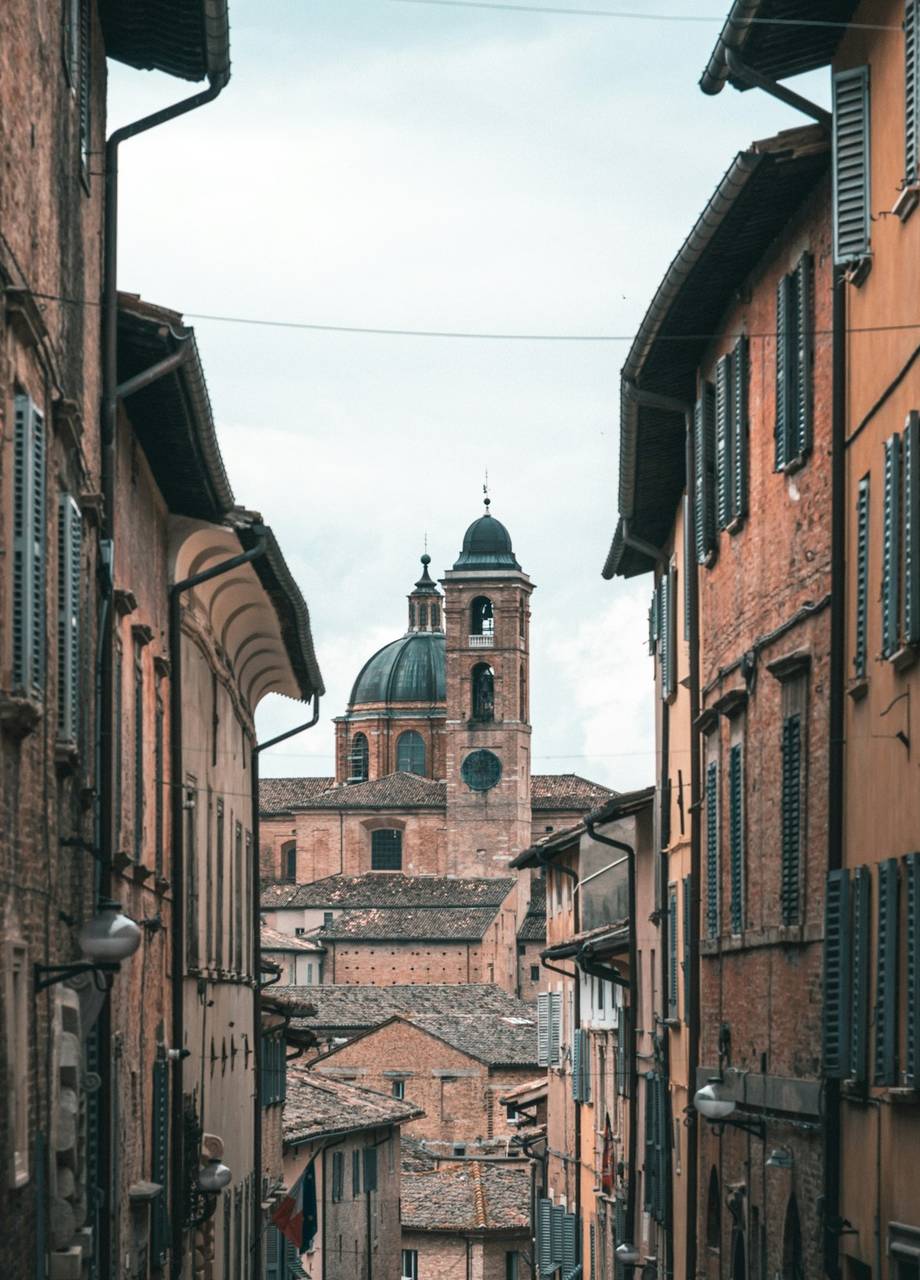
Urbino is one of the most important Renaissance cities in Italy and one of the least visited by international travellers. Set on a double-peaked hill in the northern interior of Le Marche, it was transformed in the 15th century by Federico da Montefeltro (Duke of Urbino 1444–82) from a modest town into a seat of humanist culture, built around a palace complex that represents some of the finest civic architecture of the period. Raphael was born here in 1483, eight years after the palace’s main construction phase, and the connection — the most famous painter of the Renaissance born in a city built around a monument to Renaissance ideals — is not coincidental.
The city is a UNESCO World Heritage Site and a functioning university town. The university (founded 1506) gives it a younger, livelier atmosphere than most hill towns of comparable size, and its population of approximately 15,000 means there are real bars, shops, and restaurants rather than the tourist infrastructure that has replaced everyday life in more visited places.
Palazzo Ducale and the National Gallery of the Marche
The Palazzo Ducale (Piazza Duca Federico 107) is the defining monument of Urbino and the reason to come. Federico da Montefeltro commissioned the Dalmatian architect Luciano Laurana to design the main structure in the 1460s, and the result — particularly the internal courtyard and the façade with its twin cylindrical towers facing the valley — is one of the most harmonious architectural compositions of the 15th century.
The palace now houses the Galleria Nazionale delle Marche (National Gallery of the Marche), whose collection includes:
- Piero della Francesca — Flagellation of Christ (c.1455–1460), one of the most analysed paintings in Italian art for its complex geometry and unexplained narrative. Also the Madonna di Senigallia and the double portrait of Federico da Montefeltro and his wife Battista Sforza (the originals are in the Uffizi; a copy is displayed here).
- Raphael — The Muta (c.1507), a portrait of a young woman that shows Raphael’s early debt to Leonardo’s psychological portraiture.
- Paolo Uccello — Profanation of the Host (c.1467–1469), a predella panel in six scenes that is one of the most disturbing and technically accomplished narrative paintings of the 15th century.
- The Città Ideale — A large panel painting (attributed to various artists, possibly Luciano Laurana) of a perfectly symmetrical Renaissance urban space with no figures. Its precision and stillness have made it one of the most reproduced images of the Renaissance period.
- Studiolo of Federico da Montefeltro — A small private study lined with extraordinary intarsia (marquetry) panelling depicting books, instruments, and armour in trompe-l’œil. One of the few survivals of Renaissance interior decoration at this level.
Entry to the Palazzo Ducale and gallery costs approximately €8 as of 2026. Open Tuesday to Sunday 08:30–19:15, Monday 08:30–14:00. Allow at least 2–2.5 hours for a thorough visit.
Casa Natale di Raffaello
The Casa Natale di Raffaello (Via Raffaello 57) is a modest two-storey house in a lane off the main corso — the house where Raphael grew up until leaving for Perugia to train with Perugino at around age eleven. The ground floor contains a fresco of the Virgin and Child attributed to his father Giovanni Santi, who was the court painter to the Montefeltro and a significant figure in his own right. The upstairs rooms are largely unfurnished but the structure of the house is intact.
Entry costs approximately €3.50 as of 2026. Open Monday to Saturday 09:00–13:00 and 15:00–19:00, Sunday 10:00–13:00.
The Town: Piazza della Repubblica and Beyond
The Piazza della Repubblica is the functional centre of the town — the point where the main streets converge and where the city’s daily life concentrates. The square is not monumental in the way of Italian piazze in larger cities; it is more of a broad intersection surrounded by useful buildings, with the city’s central bar and several bookshops nearby. Sit here for coffee in the morning and you are among students and academics rather than tourists.
The Duomo di Urbino (Piazza Duca Federico) stands adjacent to the Palazzo Ducale and is the city’s cathedral. The interior was rebuilt in neoclassical style in the early 19th century after earthquake damage; the most notable work inside is Federico Barocci’s Last Supper (c.1592–1599). Entry is free; open daily approximately 07:30–12:30 and 14:30–19:00.
The Oratorio di San Giovanni Battista (Via Barocci) contains a fresco cycle by the Salimbeni brothers (1416) depicting the life of St John the Baptist — one of the earliest dated fresco cycles in Le Marche and unusually expressive for its period. Entry approximately €2.50; open Monday to Saturday 10:00–13:00 and 14:30–17:30.
The Fortezza Albornoz (Viale Bruno Buozzi) is a medieval fortress on the hill above the town that was converted to public gardens in the 20th century. Entry is free and the views from the ramparts — over the terracotta roofline of Urbino to the hills of Le Marche and the Apennines — are the best available in the area. Open daily from approximately 08:00 to sunset.
Where to Stay in Urbino
Urbino’s accommodation is primarily in small hotels and B&Bs within or just outside the historic walls. The town is also accessible as a day trip from Pesaro (50–60 minutes by bus).
Mid-range:
- Hotel Bonconte (Via delle Mura 28) — The most consistently recommended hotel in Urbino, situated just inside the city walls with views over the valley. Rooms from approximately €90–150 per night; the superior rooms with valley views command a premium.
- Hotel Raffaello (Vicolo Santa Margherita 40) — Comfortable three-star hotel in the historic centre, close to Raphael’s birth house. Rooms from approximately €75–120 per night.
Budget:
- Residenza Ducale (Via Veneto 35) — A guesthouse-style option with simple rooms and a friendly host, about 10 minutes’ walk from the historic centre. Doubles from approximately €55–75 per night.
Student residences as summer hotels: The university residences in Urbino open to tourists in July and August at very competitive rates — typically €40–60 per double room. The university accommodation office (Ersu Urbino) handles bookings; ask at the tourist office for current options.
Where to Eat in Urbino
Le Marche cuisine appears clearly in Urbino’s restaurants: crescia (a flatbread stuffed with cold cuts or cheese), vincigrassi (a local variation of lasagne with chicken giblets and bechamel), roasted meats, and the excellent local Verdicchio and Sangiovese wines.
- Ristorante Il Cortegiano (Via Puccinotti 13) — A reliable mid-range restaurant near the Palazzo Ducale with a menu that covers both Le Marche classics and slightly more adventurous dishes. Vincigrassi, grilled fish when available, good local wine list. Approximately €28–45 per person.
- Trattoria del Leone (Via Battisti 5) — More informal, with a fixed-price lunch menu at approximately €15 for two courses plus water. A practical option for lunch before or after the Ducal Palace.
- Ristorante Vecchia Urbino (Via dei Vasari 3) — An established trattoria in an old stable space near the Mercatale. Strong on roasted meats and local cured meats. Budget approximately €25–40 per person.
- Caffè del Sole (Via Mazzini 21) — The best coffee in Urbino, also serving local pastries including ciambellone (a ring-shaped butter cake) and fiadoni (small pastries filled with cheese). Useful for breakfast.
Local food to buy: Casciotta d’Urbino — a DOP-protected semi-soft cheese from local sheep and cow’s milk — is the most specific product to look for. Raphael’s mother used to sell it in the local market, according to local tradition. Available in the food shops around Piazza della Repubblica, from approximately €12–18 per kg.
Getting to Urbino
- By bus from Pesaro: Bucci/Adriabus buses run from Pesaro bus station to Urbino approximately every 30–60 minutes during the day; journey time approximately 50–60 minutes; fares approximately €4 as of 2026. Pesaro is on the main Adriatic railway line with frequent trains from Ancona (approximately 40 minutes) and Bologna.
- By car: From Pesaro approximately 35 km via SS73bis, taking 45–50 minutes. From Ancona approximately 110 km, around 1.5 hours. Parking in Urbino is at the Mercatale (the lower parking area below the Palazzo Ducale ramp) or along the approach roads. Most of the historic centre is vehicle-restricted.
- From Rome: Train to Pesaro (approximately 2.5–3 hours) then bus to Urbino. Total journey approximately 3.5–4 hours. Driving from Rome is around 3 hours via the A24 and SS3.
Book Urbino Tours on GetYourGuide
| Tour | Duration | From price | Highlights |
|---|---|---|---|
| Urbino Palazzo Ducale guided tour — Raphael’s birthplace and Federico da Montefeltro’s court | 2.5 hrs | From €25 | Ducal Palace state rooms, Galleria Nazionale delle Marche, Raphael’s birthplace |
| Le Marche coastal towns day trip — Pesaro and Fano from Urbino | 5 hrs | From €40 | Adriatic coast, Pesaro’s Rossini museum, Roman Fano archaeological sites |
| Urbino and Castel Durante ceramic tradition — artisan workshop visit | 3 hrs | From €45 | Maiolica pottery tradition, working ceramic workshop, Le Marche crafts |
[Browse all Le Marche tours on GetYourGuide →](/go/tours-le-marche)
For the Le Marche circuit connecting Urbino with Pesaro (35 km), Fano (50 km), and Ancona (110 km), all on the Adriatic railway line, Pesaro is the most practical transport hub. Ascoli Piceno is the other main Le Marche city worth combining with Urbino — the two are 120 km apart by car (no direct train). For the broader northern Italy circuit, our northern Italy itinerary connects the Po Valley cities with the Adriatic coast. For Bologna as the nearest major city with good onward connections, the guide covers the full range of accommodation and things to do.