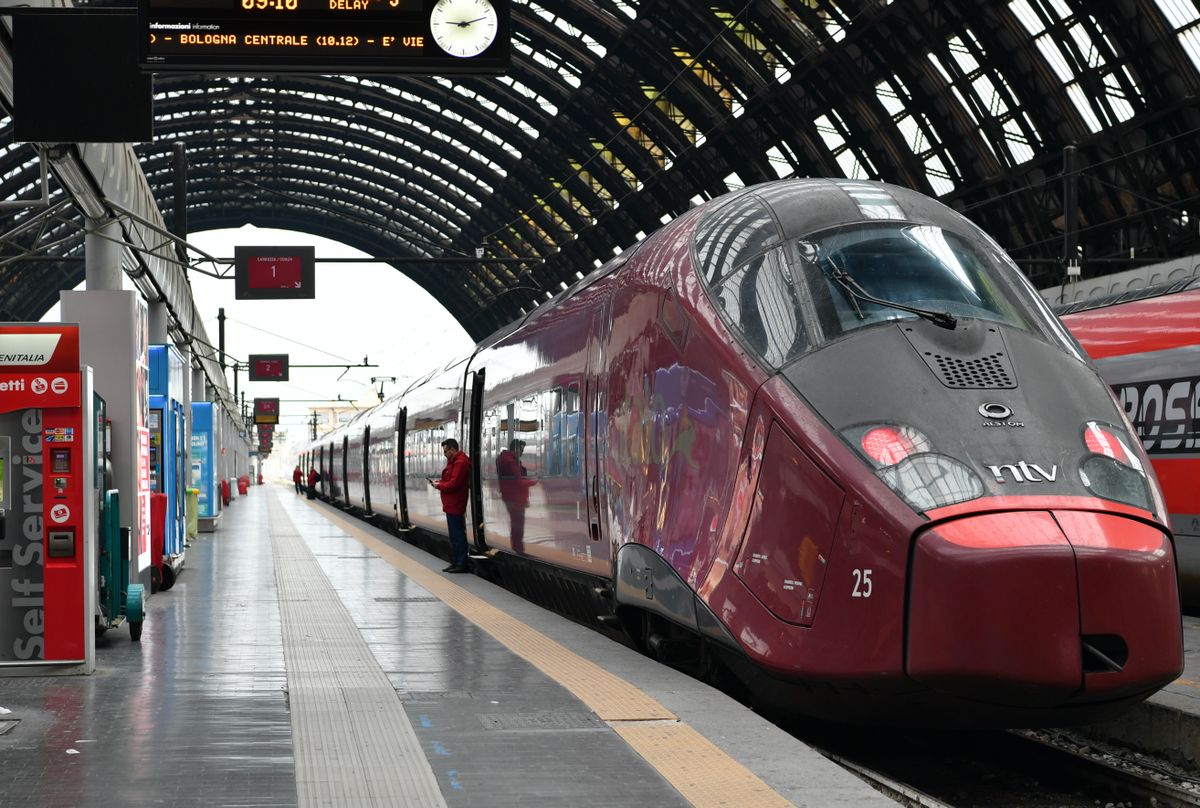
The train is the overwhelming first choice for Milan to Rome — and for good reason. The Frecciarossa covers the 570km between Milano Centrale and Roma Termini in under 3 hours, departures run every 30 minutes throughout the day, and fares start around €25 if you book a few weeks ahead. A flight, when you add airport time at both ends, takes longer door-to-door and usually costs more. This guide covers everything you need.
Train: the main option
The direct high-speed train is the fastest, most convenient, and most comfortable way to travel from Milan to Rome. Two competing operators run the route, which keeps prices honest.
Milano Centrale to Roma Termini
All direct high-speed services depart from Milano Centrale — Milan’s main station — and arrive at Roma Termini, Rome’s central station. Both are major transport hubs in the heart of their respective cities.
| Service | Journey time | Frequency |
|---|---|---|
| Frecciarossa direct | ~2h 55min | Every 30 min |
| Italo direct | ~3h 00–3h 15min | Every 30–60 min |
| Intercity (slow) | ~5h 30min | 3–4x daily |
The fastest Frecciarossa departures are non-stop between the two cities. A handful of services stop at Bologna Centrale or Firenze Santa Maria Novella; check your specific train when booking, as these add 20–30 minutes.
Frecciarossa vs Italo
Frecciarossa (Trenitalia) is the state operator. The red trains run the widest schedule — departures from around 05:30 to 22:00 — and carry four classes: Standard, Premium, Business, and Executive. Standard class seats are spacious with power sockets, fold-down tray tables, and luggage racks. Free WiFi is provided but variable in quality. Book at trenitalia.com or through an aggregator.
Italo (NTV) is the private competitor. Trains are slightly less frequent on this route but fares are often competitive with Frecciarossa, especially on advance tickets. Italo’s loyalty programme (Italo Più) is worth joining if you use Italian trains regularly. Book at italotreno.it.
We recommend checking both operators when booking — departure times and availability differ, and a 15-minute flexibility on either side of your ideal time can sometimes save €15–20.
You can compare both operators side by side on Omio: compare Milan to Rome train times and prices.
Ticket prices and classes
Current fares for the 2026 season (advance booking, 2–3 weeks ahead):
| Operator | Class | From |
|---|---|---|
| Frecciarossa | Standard | ~€25 |
| Frecciarossa | Premium | ~€38 |
| Frecciarossa | Business | ~€55 |
| Italo | Smart | ~€20 |
| Italo | Comfort | ~€35 |
| Italo | Prima | ~€55 |
Walk-up fares on the day typically run €70–100 in standard class on either operator. Booking more than 2–3 weeks in advance gives access to the cheapest non-flexible fares. If you need flexibility, mid-tier fares (Base on Frecciarossa, Economy on Italo) allow changes for a fee; premium-class fares often include free changes.
Both operators use dynamic pricing — the earlier you book, the cheaper the ticket. The cheapest fares (Super Economy / Low Cost) are non-refundable and non-changeable. Read the conditions before purchasing.
Best times to travel
Trains run from around 05:30 to 22:00 in each direction, with departures every 30 minutes. The 07:00–09:30 window from Milan (commuter peak) and the 17:00–20:00 window from Rome are consistently the most expensive departure windows. Travelling outside these windows — particularly 10:00–15:00 — often brings fares down 20–30%.
The cheapest days are Tuesday and Wednesday. Weekends, Easter, Ferragosto (mid-August), and the Christmas–New Year period carry a significant premium; book 4–6 weeks ahead for these dates.
Slow train option
Trenitalia’s Intercity (IC) trains serve the Milan–Rome route in approximately 5 hours 30 minutes with several intermediate stops. Fares are roughly fixed at €20–35 in second class regardless of how far in advance you book. If speed matters, the IC is not the right choice — but for travellers on a tight budget with time to spare, it covers the route without dynamic pricing surprises.
Flying from Milan to Rome
Two airports serve Milan: Linate (LIN) is 7km from the city centre (25 minutes by metro); Malpensa (MXP) is 50km northwest (50–90 minutes by Malpensa Express train or bus to Centrale).
From Rome, you land at Fiumicino (FCO) — 30km from the centre (35 minutes by Leonardo Express train) — or occasionally Ciampino (CIA), used by Ryanair and Wizz Air (40–60 minutes by bus to Termini).
In practice, a Milan–Rome flight door-to-door typically takes 4–5 hours once you factor in the recommended 90-minute check-in window, the 1-hour flight, and the transfer at each end. Compared with 3 hours on the Frecciarossa from city centre to city centre, the train wins on total travel time for most itineraries.
Flights can undercut train fares on certain days — check if you’re booking last-minute or travelling during a train price spike. Compare flights from Milan to Rome.
Driving from Milan to Rome
The drive from Milan to Rome is approximately 570km via the A1 Autostrada (Autostrada del Sole), Italy’s main north–south motorway. Google Maps estimates around 5 hours 30 minutes in normal traffic; in practice, expect 6–7 hours with service stops. Tolls add approximately €35–45 each way. Fuel for a typical car costs a further €40–60 each way, depending on fuel type and vehicle efficiency.
Driving makes sense only if you are carrying substantial luggage, travelling with a large group splitting costs, or planning stops en route — Bologna or Florence are natural break points on the A1. For a point-to-point city trip, the train is faster, cheaper, and avoids the cost and stress of parking in Rome (where ZTL zones restrict access in the historic centre). Car rental in Italy if you do need wheels for the wider trip.
Bus
FlixBus and other coach operators run overnight and daytime services between Milan and Rome. Journey times vary from 8 to 11 hours depending on the route and number of stops. Fares start from €10–15 booked early. The bus is significantly slower than the train and only makes sense for travellers on the tightest budgets or those who prefer overnight travel to save on a night’s accommodation.
Getting to and from the stations
Milano Centrale
Milano Centrale is on Piazza Duca d’Aosta in the northeast of the city centre. It’s served by:
- Metro M2 (green line) and M3 (yellow line) — stop: Centrale FS
- Trams and buses — multiple routes stop outside the main entrance
- Taxi rank outside the main exit — metered, approximately €15–20 to most central destinations
- Malpensa Express trains depart from tracks 1–4 inside Centrale (approximately 55 minutes to Malpensa Airport Terminal 1)
For transfers from Malpensa: Milan Malpensa airport transfer guide.
Roma Termini
Roma Termini is Rome’s central station, on Piazza dei Cinquecento. It connects to:
- Metro A and B — both lines intersect at Termini
- City buses and trams — dozens of routes serve the square outside
- Leonardo Express — direct train to Fiumicino Airport in 32 minutes, every 30 minutes
- Taxi rank — outside the main exit; insist on the meter or pre-agree a fixed fare
For airport transfers at the Rome end: Rome Fiumicino airport transfer guide.
Where to stay
In Rome, the area around Termini is convenient but not the most pleasant neighbourhood to base yourself. We recommend the historic centre (Pantheon, Trastevere, Campo de’ Fiori) or the Prati neighbourhood near the Vatican — all 20–30 minutes by metro or bus from Termini: hotels in Rome.
In Milan, the Brera and Navigli areas are the most characterful neighbourhoods; Centrale itself is practical but not the most atmospheric base: hotels in Milan.
What to do at each end
Rome rewards at least three full days — the Colosseum and Roman Forum, Vatican Museums and St Peter’s, Trastevere at night, and the four canonical Roman pastas. Tours and experiences in Rome.
Milan is best experienced over two to three days — the Duomo rooftop, Leonardo’s Last Supper (book well ahead), aperitivo in the Navigli, and the Brera gallery district. Tours and experiences in Milan.
For planning both cities together, see our Milan vs Rome comparison — which city first, how long to spend, and how to combine them in a single trip.
Plan Your Trip
✈️ Book your flights to Italy 🛡️ Get travel insurance 📱 Stay connected with an eSIM 🚂 Compare Milan to Rome trains 🏨 Hotels in Rome