Capri Travel Guide: Blue Grotto, Boat Trips & Getting There
The Blue Grotto, Villa Jovis, Anacapri, boat tours: complete Capri guide with where to eat, where to stay, and ferries from Naples and Sorrento.
Guides for Capri
Capri covers just 10.4 square kilometres of limestone in the Bay of Naples. The Roman emperor Tiberius spent the last decade of his reign here, from 26 to 37 AD, and built twelve villas across the island. That telling detail - an emperor choosing this island over Rome - still describes why people come: the combination of dramatic cliffs, transparent sea, and a small town with an international reputation that has somehow stayed walkable.
Getting to Capri
There is no bridge or tunnel to Capri. Every visitor arrives by ferry or hydrofoil.
From Naples: Hydrofoils (aliscafi) run from Molo Beverello and take approximately 50 minutes. Ferries (traghetti) run from Calata di Massa and take approximately 80 minutes. Hydrofoil tickets cost approximately €20–24 one way as of 2026; ferry tickets approximately €14–18. Multiple operators run services - Caremar, SNAV, Alilauro, and NLG. Services run year-round, though frequency drops in winter. In summer, the first hydrofoil from Naples leaves around 6:30am.
From Sorrento: Hydrofoil from the Marina Piccola takes approximately 20 minutes and costs approximately €18–22 one way as of 2026. This is the most convenient crossing if you are basing yourself on the Sorrentine Peninsula. Departures run roughly every 30–60 minutes in season.
From Positano: Seasonal ferry service (April–October) takes approximately 50 minutes and costs approximately €20–26 one way as of 2026. A day return from Positano to Capri is a long day - factor in both crossings plus time on the island.
Getting around Capri: The island has two ports - Marina Grande (main arrival point) and Marina Piccola (smaller, on the south coast). From Marina Grande, a funicular climbs to Capri Town in approximately 5 minutes, costing approximately €2.20 as of 2026. Buses run from Capri Town to Anacapri approximately every 15–20 minutes (approximately €2 as of 2026). Taxis are available but expensive - approximately €15–25 for short island journeys as of 2026. Walking between Capri Town and Anacapri takes around 1 hour on foot via the Scala Fenicia steps or longer via the road.
The Blue Grotto
The Grotta Azzurra is a sea cave on the northwest coast of the island, approximately 54 metres long and 30 metres wide. Sunlight enters through an underwater opening approximately 1 metre high, refracting off the white sandy floor and producing the blue light the cave is known for. The effect is strongest between 11am and 1pm on sunny days.
How to visit: Boats from Marina Grande run to the grotto entrance (approximately €15 for the boat trip each way as of 2026), where small rowboats take visitors in (approximately €14 per person for the rowing boat entry, plus the mandatory state entrance ticket of approximately €5 as of 2026). Total cost is approximately €34 per person for the full experience. Time inside is approximately 5 minutes - the rowboat fits four or five people and the boatman sings.
Opening hours: Generally 9am to 1 hour before sunset, though the grotto closes when sea conditions are rough, when the entrance is flooded by high tide, or when visibility is poor. Closures are common and not always announced in advance.
When to skip it: If the weather has been unsettled, if it is after noon when the light is less intense, or if the queue at the entrance looks long (the bottleneck is the rowboat transfer, not the main boat). Many visitors report the experience itself - five minutes, cramped, expensive - doesn’t match the anticipation. You can see the grotto by swimming to the entrance in the early morning before tour boats arrive, though it requires fitting through a narrow gap at low tide and is not recommended for inexperienced swimmers.
Capri Town and Anacapri
Capri Town sits on a saddle between Monte Tiberio and Monte Solaro, centred on the Piazzetta (officially Piazza Umberto I). This small square with its four cafés is the social hub of the island - and the most expensive place on it for a coffee (approximately €6–10 for an espresso at the terrace tables as of 2026). The shopping streets around Via Camerelle carry international luxury brands. The Church of Santo Stefano, the Certosa di San Giacomo (14th-century charterhouse, free entry), and the Giardini di Augusto (Gardens of Augustus, approximately €1 entry as of 2026) with their view over the Faraglioni rocks are all within walking distance of the Piazzetta.
Anacapri is the higher, quieter town on the western side of the island. The bus from Capri Town takes approximately 15 minutes (approximately €2 as of 2026). The main draw is the Seggiovia Monte Solaro chairlift - a single-seat chairlift that climbs to the summit of Monte Solaro (589 metres) in approximately 13 minutes, costing approximately €12 one way or €16 return as of 2026. The summit view takes in the entire Bay of Naples, Vesuvius, the Sorrentine Peninsula, and on clear days the Amalfi Coast. Anacapri also has fewer souvenir shops, lower café prices, and the Villa San Michele (Via Axel Munthe 34), the early 20th-century house built by Swedish physician Axel Munthe, with a terrace and collection of Roman antiquities. Entry is approximately €8 as of 2026; it opens daily from 9am.
Villa Jovis
Villa Jovis (Via Tiberio) is the largest and best-preserved of the twelve villas Tiberius built on Capri. It sits on the northeast tip of the island, a 45-minute walk from Capri Town. The ruins cover an extensive area and include the emperor’s private apartments, a bath complex, a lighthouse base, and the cliff edge from which, according to ancient sources, disfavoured courtiers were thrown into the sea. Entry costs approximately €6 as of 2026. Opening hours are typically 10am to 6pm (reduced hours outside peak season - check current schedules before visiting). The walk from Capri Town involves some uphill sections but nothing technically demanding. Views from the terrace across to the Sorrentine Peninsula are among the best on the island.
Via Krupp and Arco Naturale
Via Krupp is a spectacular zigzag path cut into the cliffs below the Gardens of Augustus, leading from Capri Town down to Marina Piccola. Commissioned by German industrialist Friedrich Alfred Krupp in 1902, it was closed for decades and has since reopened in sections - check current status before planning your descent as it has had intermittent closures for rockfall remediation. The Gardens of Augustus above the path entrance (approximately €1 entry as of 2026) offer excellent views of the Faraglioni sea stacks and are worth visiting regardless.
Arco Naturale is a natural limestone arch carved by erosion at the island’s eastern tip, reachable on a well-marked 30-minute walk from Capri Town. The arch itself is free to view and the path is one of the more dramatic on the island.
Boat Tours
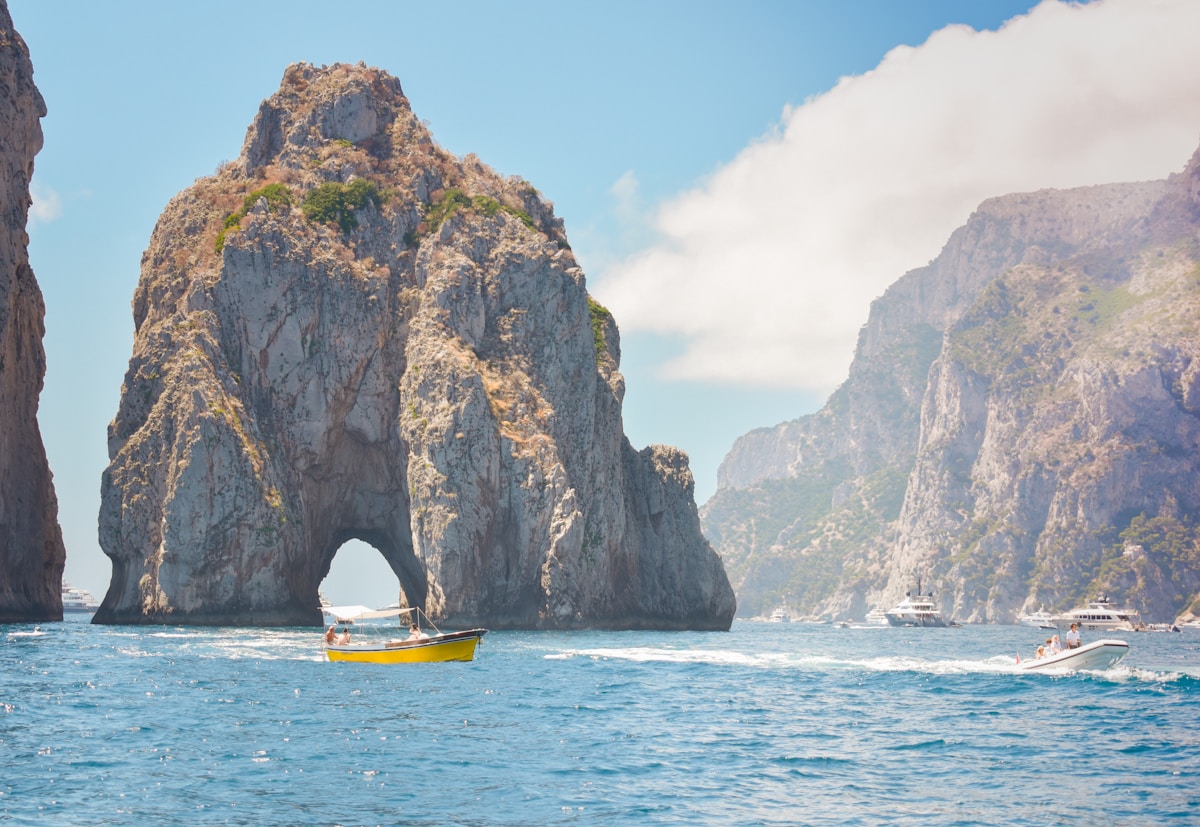
A circumnavigation of the island by boat is the single best way to see the cliffs, sea caves, and rock formations that are inaccessible on foot. The Faraglioni - three sea stacks rising from the water off the south coast - are the most photographed, and boats pass through the arch of the middle stack. Other highlights include the Grotta Verde (Green Grotto), the Grotta Bianca, and the natural arch at Arco Naturale.
Shared group tours depart from Marina Grande, typically lasting 2 to 2.5 hours. Prices run approximately €20–30 per person as of 2026 for a shared motorboat. Private boat hire costs approximately €200–400 for a half-day as of 2026 depending on the boat size and whether a skipper is included. Several operators at Marina Grande sell tickets - compare prices, as they vary. Book a Capri boat tour in advance in peak season when the best morning slots sell out quickly. Departures are weather-dependent and the morning slot (around 9–11am) typically has calmer sea conditions.
Where to Eat
Da Gemma (Via Madre Serafina 6, Capri Town) has been open since 1882 and remains one of the more honest restaurants on the island for the price. Pasta dishes cost approximately €16–22, fish mains approximately €24–34 as of 2026. The ravioli alla caprese - stuffed with local caciotta cheese and marjoram - is the dish to order.
Il Solitario (Via G. Orlandi 96, Anacapri) serves traditional Campanian cooking at lower prices than anything in Capri Town. A full meal with wine costs approximately €30–45 per person as of 2026. The garden setting makes it one of the more pleasant places to sit for an unhurried lunch.
Pulalli Wine Bar (Piazza Umberto I 4, Capri Town) sits above the Piazzetta clock tower. The terrace view is excellent and the wine list is serious. Bar snacks and a glass of local Falanghina runs approximately €18–25 per person as of 2026. Not a full dinner - but a good choice for an early evening drink with a view before finding somewhere cheaper for food.
Lo Sfizio di Anacapri (Via G. Orlandi 215, Anacapri) is a straightforward pizza restaurant with tables on the street. Pizza from approximately €10–16 as of 2026, making it one of the few places on the island where dinner for two stays comfortably under €50.
Da Paolino (Via Palazzo a Mare 11, Anacapri) is famous for its setting under full-size lemon trees. The menu runs to classic Caprese dishes: spaghetti alle vongole, linguine with local scorpionfish, grilled sea bass. Expect approximately €20–35 per main as of 2026. Book in advance in summer.
La Fontelina (Località Faraglioni, Marina Piccola) is a beach club and restaurant at the water’s edge beneath the Faraglioni sea stacks. The setting is genuinely spectacular; food is good and prices reflect the location (approximately €25–50 per main as of 2026). Reachable by water taxi or on foot via the Via Krupp path - book well in advance in season.
Where to Stay in Capri
Capri has two distinct zones for accommodation: Capri Town, the more commercial and fashionable area closest to the Piazzetta and designer shopping streets, and Anacapri, higher on the island and notably quieter with lower prices for similar quality. Staying anywhere on the island puts you within 15 minutes by bus of the main sights.
Budget (from approximately €90–140/night)
Hotel La Tosca (Via Birago 5, Capri Town) is the closest thing to genuinely budget accommodation on Capri. It is a small, simply furnished property about 10 minutes on foot from the Piazzetta, clean and well-run with no pool. Given the island’s pricing, it offers good relative value. Book well in advance for July and August. From approximately €90/night as of 2026.
Villa Eva (Via La Fabbrica 8, Anacapri) is a family-run property in the Anacapri hills, set in citrus gardens away from the tourist centre. Rooms vary in size; some have garden terraces. It is a more relaxed alternative to the Capri Town options and is close to the Monte Solaro chairlift. From approximately €100/night as of 2026.
Mid-range (from approximately €160–280/night)
Hotel Villa Krupp (Viale Matteotti 12, Capri Town) overlooks the Gardens of Augustus and the Faraglioni sea stacks. The building dates from the early 20th century and was home to the Russian writer Maxim Gorky from 1906 to 1913. Rooms are comfortable rather than luxurious; the terrace breakfast and the position make the rate reasonable. From approximately €180/night as of 2026.
Hotel Caesar Augustus (Via G. Orlandi 4, Anacapri) has one of the most dramatic terraces on the island, a pool, and significantly lower prices than equivalent hotels in Capri Town. The views from the terrace extend across the Bay of Naples to Vesuvius and the mainland. From approximately €200/night as of 2026.
Hotel La Minerva (Via Occhio Marino 8, Capri Town) sits on a quiet terrace above the main town with a pool and well-kept rooms. It is a reliable mid-range option for visitors who want a central position without the full luxury premium that the top Capri Town hotels command. From approximately €200/night as of 2026.
Luxury (from approximately €400/night)
Grand Hotel Quisisana (Via Camerelle 2, Capri Town) is the island’s best-known luxury hotel, with a large pool, two restaurants, a spa, and a position in the heart of Capri Town. It has operated as a hotel since 1845 and remains the definitive Capri luxury experience. From approximately €400/night as of 2026.
Capri Palace Jumeirah (Via Capodimonte 14, Anacapri) is the more design-led alternative, with an art collection, a thalassotherapy medical spa, and terraced gardens with sea views. The pool area is among the most photographed on the island. From approximately €600/night as of 2026.
Search hotels in Capri on Booking.com
Practical Notes
Capri accepts cards widely, but smaller boat operators and beach attendants sometimes prefer cash. There is one ATM at Marina Grande and one near the Piazzetta; both have queues in summer. There is no regular car hire available to tourists - the island effectively bans it. Transport options are: local buses (affordable, crowded in summer), taxis (expensive), electric scooters (available for hire in Capri Town, approximately €30–50/day as of 2026), or walking. The island is compact enough that most attractions are reachable on foot.
Day Trip Reality Check
Capri works as a day trip from Naples or Sorrento if you are organised about timing. The key constraint is that day-trippers from Naples typically arrive between 9am and 11am, and the island - particularly the Piazzetta and the Blue Grotto queue - is most crowded between 10am and 3pm. Take the earliest hydrofoil possible (departing Naples around 6:30–7am in season) and the last one back. That gives you roughly 8 to 9 hours, enough to cover the Blue Grotto, Anacapri via bus, Monte Solaro, and a lunch. A guided Capri island tour removes the queue and timing logistics, leaving you to concentrate on the island itself.
An overnight stay changes the experience materially. After 6pm, once the last day-tripper ferries leave, the island quiets significantly. The Piazzetta at 8pm in June is a different place from the Piazzetta at 1pm. If your budget allows, one night is worth it.
FAQs
Is Capri worth the cost? Yes, if the combination of dramatic scenery, Roman history, and boat access appeals. The island is expensive by Italian standards - budget approximately €150–200 per day per person for ferry, food, and attractions on a day trip - but it is genuinely spectacular. If the price is the issue, Sorrento gives you sea views and Amalfi Coast access for less.
Is the Blue Grotto worth the price? Borderline. The light effect is real and striking, but the experience inside the cave lasts 5 minutes and the total cost is approximately €34 per person. If the sea is calm and it is a sunny morning, we think it is worth doing once. If conditions are marginal or the queue is long, skip it and use a boat tour to see the cave entrance from outside instead.
Day trip from Naples vs Sorrento - which is better? Sorrento is significantly easier. The crossing takes 20 minutes compared to 50 minutes from Naples, meaning you spend more time on the island and less time on water. The ferry from Sorrento also allows a later last departure. Naples works if you are already there for the day.
When is the best time to visit Capri? May, early June, and September offer the best balance - the water is warm enough to swim, boats are running, and the island hasn’t hit peak summer density. July and August are mobbed from around 10am to 6pm with day trippers; if visiting then, arrive on the first boat from Naples or stay overnight. The island is significantly quieter from October through April, but many hotels and restaurants close and the Blue Grotto is often inaccessible due to rough seas.
Is there a difference between Capri Town and Anacapri? Yes - and it matters for planning. Capri Town is the more commercial, fashionable area: the famous Piazzetta, designer shops on Via Camerelle, and most of the high-end hotels. Anacapri, reachable by bus in about 15 minutes, sits higher on the island and has a quieter, more residential feel, lower café prices, and the Monte Solaro chairlift. Most visitors cover both in a day trip; if staying overnight, Anacapri is generally quieter and slightly less expensive.
Capri vs Ischia - which should you choose? They are different islands. Capri is smaller, more dramatic, more expensive, and better for a concentrated day of sightseeing. Ischia is larger, has natural thermal spas, more beaches, and suits a longer stay at lower cost. For a single day trip from the Bay of Naples, Capri is more rewarding. For a 3–5 night island stay, Ischia offers more variety and better value.
Capri is most often visited from Naples or Sorrento. The Amalfi Coast is accessible by seasonal ferry from Positano and makes a natural extension. For Neapolitan food before or after the crossing - pizza, sfogliatella, and the street-food circuit - our Neapolitan food guide covers what to order and where.
For hotels across the island from budget to luxury: Capri hotels. For boat tours, Blue Grotto logistics, and Villa Jovis: things to do in Capri. For Capri-style food - ravioli alla caprese, limoncello, and where to eat beyond tourist traps: Capri food guide.
Upcoming Events in Capri
La Befana - Feast of the Epiphany 2027
La Befana 2027, January 6. Italy's Epiphany gift-giving day: children receive sweets or coal from the Befana witch, then decorations come down.
Book an experience
Top experiences in Capri
Explore the best tours and activities in Capri, with instant confirmation and free cancellation on most bookings.