Capri is small enough to cover in a single intense day, but rewarding enough to justify two or three. The island sits at the southern end of the Bay of Naples - roughly 6km long and 3km wide - and packs extraordinary variety into that space: sea caves, Roman ruins, cliffside gardens, designer boutiques, and some of the best coastal views in the Mediterranean.
The key to enjoying Capri is timing. The island receives well over three million visitors per year, the majority concentrated between June and August. A mid-morning ferry in peak season lands you on an island that feels like a theme park. The same island in May, October, or even September feels manageable and genuinely beautiful.
The Blue Grotto (Grotta Azzurra)
The Blue Grotto is Capri’s most famous sight and also its most logistically demanding. The cave is accessible only by sea - boats leave from the small dock on the northwest coast - and entry depends entirely on sea conditions. When waves are even slightly elevated, the low entrance (about 1 metre high) becomes impassable and the cave closes without notice.
Entry costs approximately €14 as of 2026 for the cave itself, plus approximately €14 for the rowboat transfer from the motorboat into the cave. The rowing boats seat two or three passengers and are operated by local boatmen who navigate the entrance lying flat in the boat. The cave itself is about 54 metres long - a short visit, perhaps five minutes inside - but the effect is exceptional: sunlight enters through an underwater opening and reflects off the white sandy floor, turning the water a vivid, electric blue.
Book a guided Capri boat tour that includes the Blue Grotto rather than attempting to organise transport independently - it simplifies the motorboat transfer and the timing. If you are going independently, take the bus from Anacapri to the Grotta Azzurra stop (approximately €2 as of 2026) and join the queue for the rowboats directly.
Visit before 10am. That is the single most useful piece of logistics on the island.
The Faraglioni and the Coastal Walk
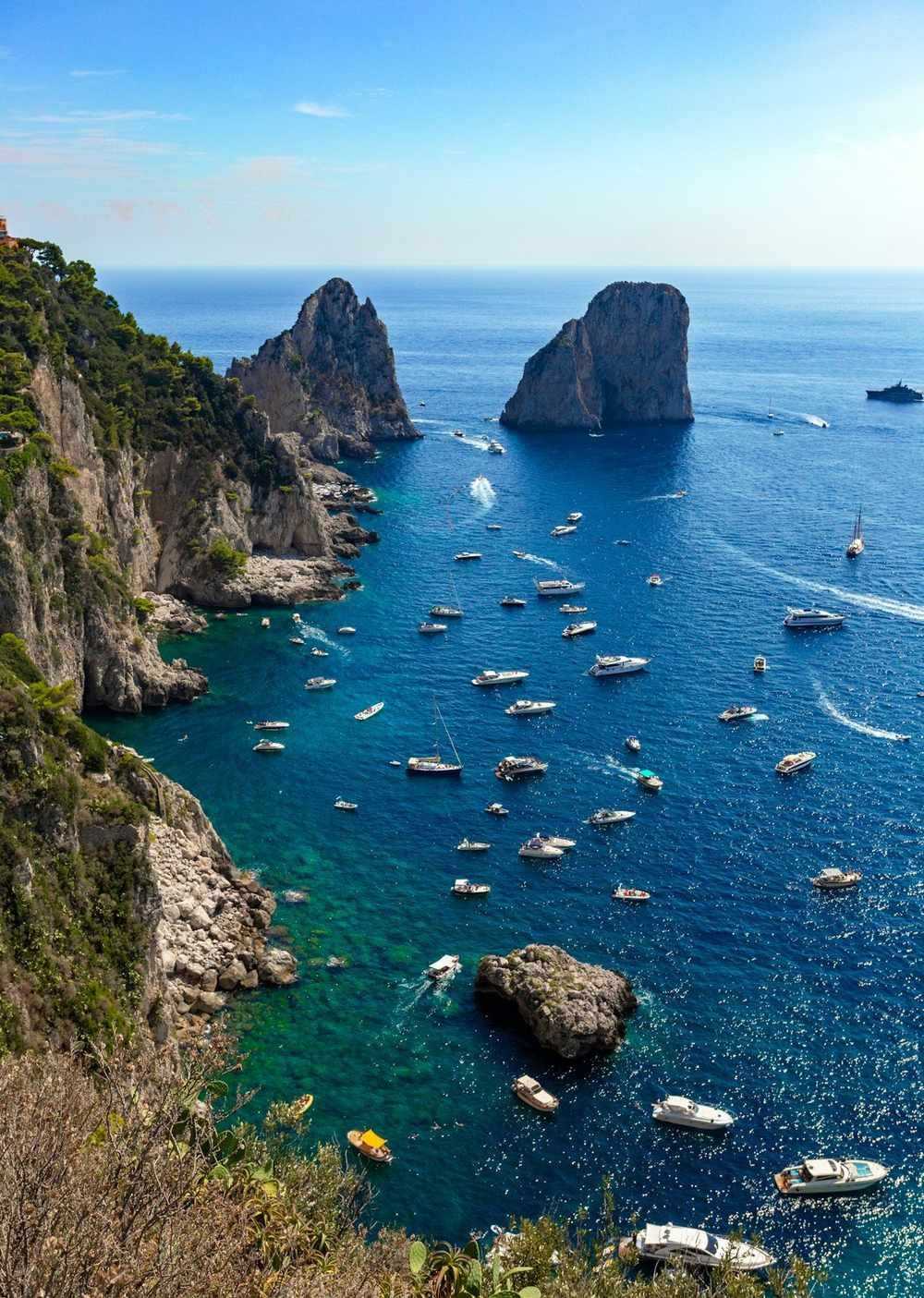
The Faraglioni are three rock stacks rising from the sea off Capri’s southeast coast - the most photographed image of the island and genuinely spectacular in person. The largest stack is attached to the shore; the middle one has an arch large enough for small boats to pass through; the third, Scoglio Fuori, stands alone 150 metres offshore.
The best ground-level views are from the Punta Tragara belvedere at the end of Via Tragara, a 20-minute walk from the Piazzetta. The path descends from there to the Faraglioni themselves, where a small rocky terrace sits at water level. The descent is steep - sensible shoes are essential. The views back toward the stacks from the water are better still from a boat.
Via Krupp, the famous switchback path cut into the cliff face in 1902 by Friedrich Krupp, descends from the Gardens of Augustus to Marina Piccola. At the time of writing it periodically closes for rockfall maintenance - check locally before planning the descent.
Anacapri and Monte Solaro
Anacapri is the island’s second town, quieter and more residential than Capri town, reached by bus from Marina Grande (approximately €2 as of 2026). The chairlift from Anacapri to the summit of Monte Solaro (589 metres) runs year-round and costs approximately €12 one way or €16 return as of 2026. The summit takes about 13 minutes to reach, and the views cover the entire Bay of Naples, the Sorrento Peninsula, and on clear days the coast as far south as Paestum.
Monte Solaro is the highest point on the island. Go up by chairlift and walk down through the forest if you want the exercise - the trail is well-marked and takes about 40 minutes.
In Anacapri itself, the Church of San Michele (approximately €2 as of 2026) contains an extraordinary 18th-century majolica tile floor depicting the Garden of Eden, best viewed from the gallery above.
Villa Jovis
At the island’s eastern tip, Villa Jovis is the largest and best-preserved of the twelve villas Emperor Tiberius built on Capri. He moved here permanently in 27 AD and governed the Roman Empire from this remote clifftop until his death ten years later, without once returning to Rome. Entry is approximately €6 as of 2026.
The walk from the Piazzetta takes 45 minutes on foot, uphill through quiet residential streets. The site rewards time - the cistern system, the imperial apartments, and the belvedere with its sheer drop to the sea are all impressive, and you are unlikely to be sharing it with crowds. Allow two hours for the walk and the visit combined.
Certosa di San Giacomo
Founded in 1363, the Certosa di San Giacomo is a Carthusian monastery at the southern end of the island, a 10-minute walk from the Piazzetta. Entry to the courtyard and cloister is free; the small museum (approximately €6 as of 2026) contains Roman-era statues dredged from the sea and a collection of paintings. The monastery gardens are quiet and genuinely beautiful, with bougainvillea growing over the old walls.
The Piazzetta and Aperitivo
Capri’s main square - officially Piazza Umberto I but universally called the Piazzetta - is tiny, pedestrianised, and lined with café tables charging Rome-level prices for the privilege of sitting in it. A coffee or Aperol spritz here costs roughly triple what it would in a bar with no view. Accept this gracefully. The square is at its most pleasurable in the early evening, when the day-trippers have left on the last ferries and the atmosphere calms considerably.
Boat Tours Around the Island
A circumnavigation of Capri by boat is one of the best ways to see the island - the sea caves, the Faraglioni from water level, the Green Grotto and White Grotto (free to enter, less dramatic than the Blue Grotto), and the Villa Malaparte on the eastern cliffs. Shared Capri island boat tours depart from Marina Grande and typically run approximately 90 minutes; expect to pay approximately €18–25 as of 2026 for a shared tour. Private boat hire starts from approximately €150 for a half-day as of 2026 depending on boat size and season.
Shopping on Via Camerelle
Via Camerelle is Capri’s designer shopping street - Prada, Gucci, Dolce & Gabbana, and a string of Italian fashion houses. The quality of what is on offer is genuine; the prices reflect the location. More interesting, and considerably cheaper, are the small artisan shops selling sandals made to order on the spot. Capri sandal-making is a genuine local craft - a pair can be made in under an hour from approximately €50 as of 2026.
What Not to Do
Do not visit in August unless you have no alternative. The island’s permanent population of about 14,000 is submerged by tourist numbers that can reach 20,000 on a single day in high season. Ferries fill up, the Blue Grotto queues become multi-hour affairs, and the Piazzetta is uncomfortably crowded. May, June (before mid-July), and September/October offer the same sights at a fraction of the congestion.
Do not bring a car. No private cars registered outside Capri are allowed on the island in summer, and there is nowhere useful to put one regardless. Marina Grande has taxis (shared convertible cabs, a Capri institution), buses to Anacapri and points around the island, and the funicular up to the Piazzetta (approximately €2 as of 2026).
Getting There
Ferries and hydrofoils operate from Naples Molo Beverello (approximately 50–60 minutes by hydrofoil, approximately €24–28 as of 2026), Sorrento (approximately 25 minutes, approximately €18–22), and Positano (approximately 50 minutes, seasonal). Sorrento is the most popular and most convenient departure point. Buy tickets online in advance during peak season - the boats do fill up.