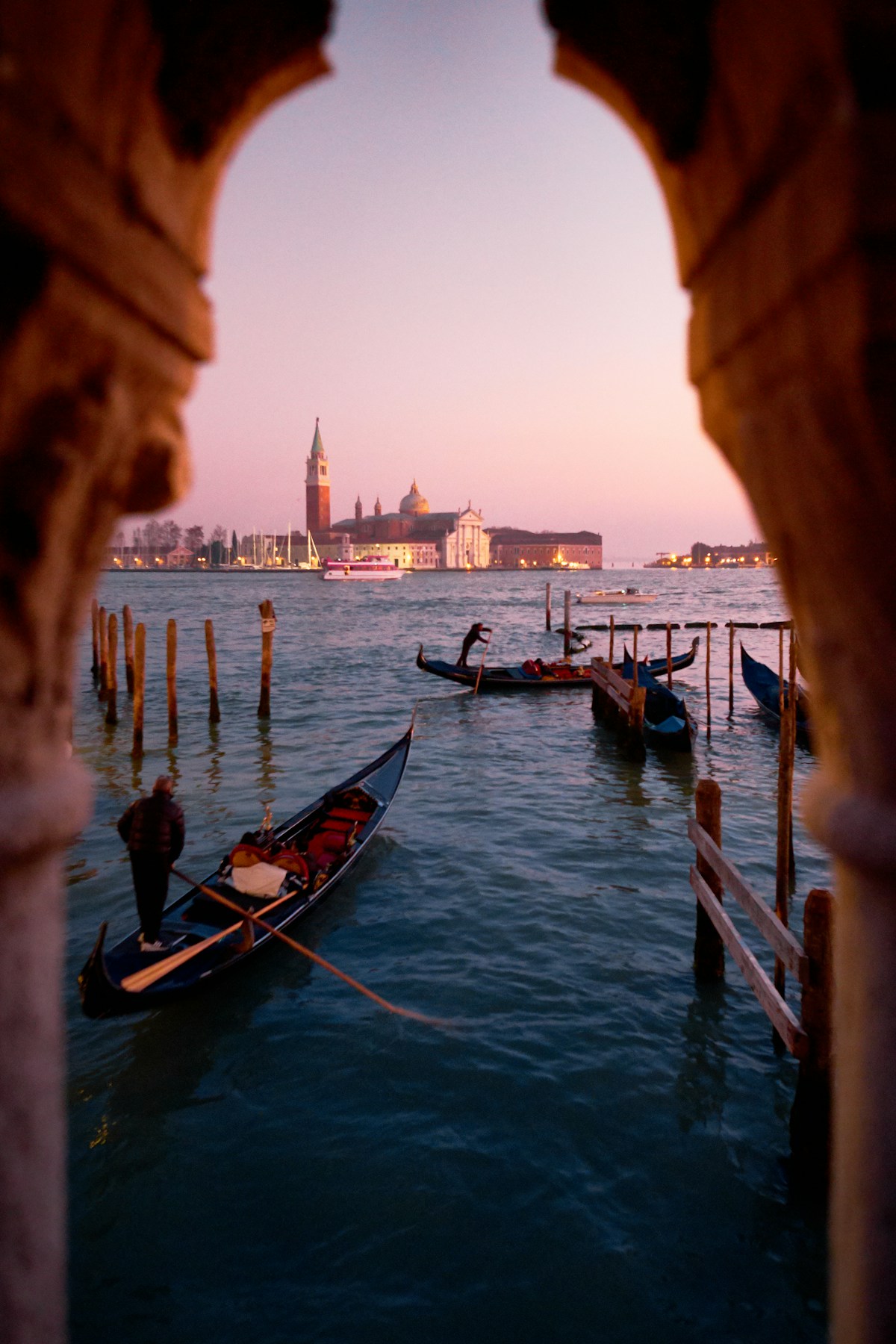
Venice solves the neighbourhood question differently from every other city in Italy. There are no taxis, no buses, no scooters - only vaporetti (water buses), water taxis, and your feet. The city is small enough that the distance from the furthest outlying sestiere to Piazza San Marco is rarely more than 40 minutes on foot. But those feet will cover countless bridges, steps up and over those bridges, and narrow calli that do not allow wheeled luggage. Where you stay in Venice affects how heavy your bags feel at arrival more than it affects how long anything takes.
Search Venice hotels on Booking.com to compare prices and check availability across all areas in this guide.
San Marco
The sestiere containing Piazza San Marco, the Doge’s Palace, and the Basilica di San Marco is the most visited square kilometre in Italy. It is also where many of Venice’s most expensive hotels are, and where the daytime crowd is densest.
Pros: Piazza San Marco, the Basilica, the Doge’s Palace, and the Campanile are all within a few minutes’ walk. The Rialto Bridge is about 10 minutes. Vaporetto stops on both the Grand Canal and the Riva degli Schiavoni waterfront connect you quickly to the rest of the city and to the islands. For a first-time visitor who wants to be in the heart of it from day one, San Marco makes immediate sense.
Cons: The most expensive sestiere in the city. The streets around the piazza are saturated with tourist commerce at every price level - menus in eight languages, gondola touts, overpriced cafes with famous names. Piazza San Marco itself floods regularly during acqua alta (high water) from October to March; check forecasts.
Budget: There is no meaningful budget accommodation in San Marco. The price floor for a double in this zone is approximately €150/night as of 2026 even in low season, and that generally reflects a low-grade property.
Mid-range (€170–350/night): The Hotel al Ponte dei Sospiri (Riva degli Schiavoni, Castello border) overlooks the Bridge of Sighs; doubles from approximately €180/night as of 2026. The Hotel Flora (Via XXII Marzo 2283/a) is a small, garden-courtyard hotel on one of San Marco’s quieter streets; doubles from approximately €200/night as of 2026.
Top-end (€500+/night): The Gritti Palace (Campo Santa Maria del Giglio 2467) is the landmark property in San Marco - a 15th-century palazzo on the Grand Canal that has operated as a hotel since 1948. Doubles from approximately €700/night as of 2026 in peak season. The Hemingway associations are well documented; the Grand Canal terrace is genuinely exceptional. Aman Venice (Palazzo Papadopoli, San Polo border) is equally positioned at the very top of the market; suites from approximately €1,500/night as of 2026.
Dorsoduro
South of the Grand Canal, Dorsoduro contains the Gallerie dell’Accademia (the definitive collection of Venetian painting), the Peggy Guggenheim Collection, and the Zattere - a wide waterfront promenade facing the Giudecca canal where the afternoon light in winter and spring is exceptional. It is a residential neighbourhood with a university presence (Ca’ Foscari) that keeps a mix of wine bars and good independent restaurants operating year-round.
Pros: Two of Venice’s most important museums are within the neighbourhood. The Zattere is one of the best waterfront walks in the city. Prices for accommodation and meals are noticeably lower than San Marco. Vaporetto stops at Accademia and Zattere give direct connections to the Grand Canal and Giudecca. The neighbourhood has a quieter, more residential character during the day and evening.
Cons: About 20 minutes on foot from Piazza San Marco (which is a feature as much as a drawback). The area around Campo Santa Margherita - the social hub of Dorsoduro - has some student-oriented nightlife that can be noisy late at night.
Budget (€90–150/night): B&Bs and small guesthouses in the streets south of Campo Santa Margherita. The Ca’ Pisani Hotel (Rio Terà Antonio Foscarini 979/a) has art deco interiors and a genuinely considered design approach at the lower end of the mid-range bracket; doubles from approximately €150/night as of 2026 in shoulder season.
Mid-range (€160–300/night): The Oltre il Giardino (technically in San Polo but on the Dorsoduro border, Fondamenta Contarini 2542) is a small, garden-surrounded hotel with six rooms in a former home of Alma Mahler; doubles from approximately €200/night as of 2026. Extremely quiet for Venice, with one of the most calming settings on the island. The Pensione Accademia Villa Maravege (Dorsoduro 1058) is a 17th-century villa with garden; doubles from approximately €180/night as of 2026.
Top-end: Dorsoduro is not where the grand hotels are - which suits those who prefer quieter bases with better value-for-quality.
Cannaregio
North Venice, the sestiere stretching from the Santa Lucia station to the eastern edges of the city. The Lista di Spagna - the tourist street running from the station toward the Rialto - is best ignored for restaurants. But the streets running north from it, particularly around the Jewish Ghetto (Ghetto Nuovo) and the quieter calli toward Fondamenta della Misericordia, are where Venice’s most honest-priced accommodation and restaurants concentrate.
Pros: The station is in Cannaregio, making arrival and departure easier with luggage. The Jewish Ghetto - the oldest in Europe, dating to 1516 - is a significant historical site within the neighbourhood. The Ca’ d’Oro (a Gothic palazzo now housing a fine art collection) is on the Grand Canal at Cannaregio’s southern edge. Restaurants on Fondamenta della Misericordia and around the Ghetto price for residents rather than day-trippers. Budget accommodation options are more numerous than in other sestieri.
Cons: The Lista di Spagna tourist strip is aggressively poor value for food and shopping - tourists arriving by train need to walk through it to get anywhere useful. The northern parts of the neighbourhood are genuinely off the main tourist circuit, which some visitors find quiet and others find disconnected.
Budget (€85–140/night): The Hotel Guerrini (Lista di Spagna 265) is on the tourist strip but rates are among the most accessible in the historic city; doubles from approximately €90/night as of 2026. Look past the location and the value is reasonable. For genuinely good budget options, several family-run B&Bs operate on the calli around Ghetto Nuovo at approximately €85–110/night as of 2026.
Mid-range (€140–260/night): The Ca’ Sagredo Hotel (Campo Santa Sofia 4198) is the standout property in Cannaregio - a 15th-century palazzo on the Grand Canal with frescoed ceilings and an 18th-century staircase; doubles from approximately €220/night as of 2026. Positioned at the boundary between mid-range and top-end. The Hotel Hesperia (Calle dei Biri 459) is a quieter, smaller option at approximately €140/night as of 2026.
Top-end: The Ca’ Sagredo covers this for Cannaregio - there are no five-star international chain hotels in this sestiere, which is one of its advantages.
Santa Croce
The western sestiere adjacent to Piazzale Roma - Venice’s main road terminus, where visitors arriving by car or bus complete their journey and begin navigating the city on foot or by vaporetto. Santa Croce is less celebrated than Dorsoduro or Cannaregio but has a practical advantage: it is where most people arrive.
Pros: Five minutes from Piazzale Roma means minimal luggage-carrying at arrival and departure. The Frari church (one of Venice’s most important Gothic churches, containing Titian’s Assumption) is in adjacent San Polo. The neighbourhood is less oriented toward tourism than San Marco and has pockets of good independent restaurants.
Cons: Architecturally less interesting than the other sestieri. The area around Piazzale Roma itself is functional rather than atmospheric. Less obvious to navigate than Cannaregio or Dorsoduro for first-time visitors.
Budget (€90–140/night): Small hotels and B&Bs in the streets west of the Grand Canal. The Hotel dalla Mora (Salizzada San Pantalon 42) is a reliable budget-friendly option in the Santa Croce/San Polo border area; doubles from approximately €95/night as of 2026.
Mid-range (€150–280/night): The Oltre il Giardino (mentioned under Dorsoduro) is closer to this sestiere in physical terms. The Hotel Ai Mori d’Oriente (Fondamenta della Sensa 3319) sits in Cannaregio but represents a similar mid-range position for the northern approach to the city.
Castello
The largest sestiere by area, Castello stretches east from San Marco to the Arsenale and beyond - a long residential district that is well away from the worst tourist concentration while remaining on the main island. The Biennale gardens (Giardini) are in the eastern part of Castello.
Pros: Significantly quieter than San Marco while still within the historic city. Good local restaurants in the streets around Via Garibaldi and Campo Bandiera e Moro. The Scuola di San Giorgio degli Schiavoni (containing Carpaccio’s famous painting cycle) is here. The Riva degli Schiavoni waterfront - the promenade running east from the Doge’s Palace - is in Castello and gives direct vaporetto connections to the islands.
Cons: The eastern parts of Castello are a long walk (30–40 minutes) from the Rialto or San Marco. For a short visit focused on the main sights, this is more time spent in transit than most visitors want. Hotel density is lower than in other sestieri.
Mid-range (€150–280/night): The Hotel Londra Palace (Riva degli Schiavoni 4171) has Grand Canal views and a classic position on the waterfront; doubles from approximately €200/night as of 2026. One of the better mid-range positions in this zone, combining the Castello quietness with the Riva’s vaporetto access.
Giudecca
A long, low-lying island across the Giudecca canal from Dorsoduro - connected to the main island by the No. 2 and No. 4 vaporetto lines (five minutes from Zattere). The view looking north across the canal toward the San Marco skyline is one of Venice’s most photographed.
Pros: The Giudecca canal separates the island from the tourist volume on the main island. The view of Venice from the Giudecca waterfront is exceptional, particularly at dawn and dusk. The neighbourhood has a genuinely local character - a small population of Venetian residents still lives here, and there are bars and restaurants that serve them rather than tourists. The Redentore church (Palladio, 1592) is here.
Cons: Everything on the main island - the Accademia, the Rialto, San Marco - requires a vaporetto crossing. Late-night connections are infrequent; the last water bus from the Zattere area runs around midnight. Not practical for visitors who want to walk back from a long evening.
Budget (€60–100/night): The Generator Venice (Fondamenta Zitelle 86, Giudecca) operates as a design hostel with private rooms; doubles from approximately €85/night as of 2026. The best-value option for those willing to cross the canal for access to the main island - the Redentore and canal views are the compensation.
Top-end (€600+/night): The Belmond Hotel Cipriani (Giudecca 10) is one of the most celebrated hotels in Italy - a 96-room property with the only outdoor swimming pool in Venice, a Michelin-starred restaurant, and private boat service to San Marco (five minutes). Doubles from approximately €1,100/night as of 2026 in peak season. An entirely different category of experience from anywhere else on this list.
Lido
The long barrier island closing the southern end of the Venice lagoon - 12 km of Adriatic beach, a Belle Époque casino, the Film Festival venue (Palazzo del Cinema), and a population of year-round Venetian residents who commute by vaporetto to the main city.
Pros: Significantly more affordable accommodation than the main island. The beach is the primary draw - Lido has long sandy beaches that are surprisingly undervisited by most tourists to Venice. The vaporetto connection to San Marco takes approximately 15–20 minutes (Line 1 or Line 2). Quieter evenings than anywhere on the main island.
Cons: Commuting to and from the main island on vaporetto multiple times per day is an added logistical step. The Lido has its own restaurants and shops but the main Venetian sights require a water bus journey each way. During the Venice Film Festival (August–September), the island becomes very busy and prices rise substantially.
Budget (€70–110/night): Hotels and B&Bs along the main strip (Gran Viale Santa Maria Elisabetta) and the beach-facing streets. Several family-run hotels offer rates approximately 30–40% lower than equivalent quality on the main island; prices from approximately €80/night as of 2026 in shoulder season.
Mid-range (€130–250/night): The Hotel Excelsior Venice Lido Resort (Lungomare Marconi 41) is the landmark property on the Lido - a Moorish-style 1908 hotel on the beachfront; doubles from approximately €200/night as of 2026 in shoulder season. The Film Festival’s red carpet runs past the adjacent Palazzo del Cinema. Open May–October only.
Plan your trip:
- Browse day tours and experiences in Venice
- Book a water taxi or transfer from the airport
- Get travel insurance before you book
- Pick up an eSIM for Italy
- Search hotels in Venice on Booking.com
Booking and practical tips
- Venice’s tourist tax was restructured from 2024. The entry fee scheme (€5 on day-trip peak days) applies to day visitors, not overnight guests. Hotel guests pay a separate accommodation tax of approximately €5–15/night per person as of 2026, varying by season and accommodation category. Confirm the applicable rate when booking - it is not included in the advertised room rate.
- Water taxi from the station or Piazzale Roma to your hotel is the most convenient arrival option with heavy luggage - approximately €60–90/trip as of 2026 depending on distance. Vaporetto is approximately €9.50 for a single ticket. 48-hour and 72-hour vaporetto passes offer savings for multi-day stays.
- Ask specifically about luggage assistance when booking hotels that require a long walk from the nearest vaporetto stop - many hotels have handcarts for luggage, but the bridge steps in Venice are not manageable with large wheeled suitcases without help.
- Acqua alta (high water) from October to March affects the streets around San Marco and parts of Cannaregio most severely. Most hotels in vulnerable areas provide rubber boots. MOSE barriers have significantly reduced flood frequency since their completion in 2020, but periodic flooding still occurs.
- For April, May, Carnival (February), and the Venice Film Festival (late August–September), book at minimum 3–4 months ahead. Venice has a hard cap on hotel capacity - when demand spikes, prices escalate rapidly. The earlier you commit, the more you save.
- Restaurants within five minutes of Piazza San Marco carry a location premium of approximately 30–50% above neighbourhood equivalents. The most consistent-value meals in Venice are found in Cannaregio (around Ghetto Nuovo and Fondamenta della Misericordia), Dorsoduro (around Campo Santa Margherita), and Castello (around Via Garibaldi). Budget approximately €30–45/head for a full meal with wine at a neighbourhood trattoria as of 2026.
For the full Venice planning picture: Venice travel guide covers the sestieri, gondola logistics, and when to visit. For budget accommodation and hostel options: best hostels in Venice. For eating well by neighbourhood: Venice food guide and the Venetian food guide cover the cicchetti tradition. For day trips to Verona and Padua: day trips from Venice. Comparing Venice and Florence? Our Venice vs Florence guide covers the practical differences.
Ready to Plan Your Trip?
See our itineraries for inspiration:
- One Week in Italy - seven days through Rome, Florence, and Venice
- Northern Italy Itinerary - lakes, cities, and the Dolomites
- 10 Days in Italy - the classic grand tour of Italy’s highlights
- 2 Weeks in Italy - the ultimate two-week Italian itinerary
Hotels by price tier
The following hotels are grouped by nightly rate to help with budget planning.
Luxury hotels (from €350/night as of 2026)
Belmond Hotel Cipriani (Giudecca 10) - One of the most famous hotels in the world. Private launch from San Marco, Olympic-size saltwater pool (rare in Venice), Michelin-starred restaurant Oro. Doubles from approximately €700/night. The gardens and pool make this feel unlike anywhere else in Venice.
The Gritti Palace (Campo Santa Maria del Giglio, San Marco) - A 15th-century doge’s palace on the Grand Canal, now a Marriott Luxury Collection property. Doubles from approximately €500/night. The terrace restaurant Club del Doge overlooks the canal. Hemingway wrote parts of Across the River and Into the Trees here.
Aman Venice (Palazzo Papadopoli, San Polo) - A 16th-century palazzo with Tiepolo ceiling frescoes and a private garden - almost unheard of in Venice. Doubles from approximately €800/night. 24 rooms, extraordinary interiors.
Hotel Danieli (Riva degli Schiavoni, Castello) - Three connected palazzi overlooking the lagoon near the Doge’s Palace. The main palazzo (15th century) has the best rooms. Doubles from approximately €450/night. Rooftop terrace restaurant with panoramic views.
Ca’ Sagredo Hotel (Campo Santa Sofia, Cannaregio) - An 18th-century palazzo on the Grand Canal with original frescoes by Tiepolo and Longhi. Doubles from approximately €350/night. The piano nobile (main floor) is a museum-quality space. Quieter location than San Marco.
Mid-range hotels (€120–300/night as of 2026)
Palazzo Stern (Dorsoduro 2792) - A restored Gothic palazzo on the Grand Canal. Doubles from approximately €180/night. Canal-side terrace for breakfast, traditional Venetian interiors. Excellent Dorsoduro location near the Accademia.
Hotel Al Ponte Antico (Cannaregio 5768, near Rialto Bridge) - A family-run boutique hotel steps from the Rialto Bridge. Doubles from approximately €200/night. The waterfront terrace looking across to the Rialto is exceptional.
Ca’ Pisani Hotel (Dorsoduro 979a, near Accademia) - A 1930s Art Deco boutique hotel in a 15th-century palazzo. Doubles from approximately €160/night. Design-forward for Venice, with original period furniture. Rooftop terrace.
Hotel Palazzo Barbarigo (San Polo 2765, on the Grand Canal) - A renovated palazzo with Grand Canal frontage. Doubles from approximately €200/night. Traditional Murano glass interiors. Several rooms have direct canal views.
Hotel Arcadia (Cannaregio 1333, near train station) - A well-maintained three-star in a convenient location. Doubles from approximately €120/night. Good base for exploring Cannaregio. Rooms are modest but clean.
Budget hotels (under €120/night as of 2026)
Hotel Dalla Mora (Santa Croce 42, near Piazzale Roma) - A family-run two-star near the bus terminal. Doubles from approximately €80/night. Basic rooms but clean and affordable for Venice island. Not all rooms have private bathrooms - specify when booking.
Locanda Ca’ Le Vele (Cannaregio 3969) - A small guesthouse in a quiet Cannaregio location. Doubles from approximately €90/night. Simple rooms with traditional decor. Breakfast included.
Hotel Bernardi (Cannaregio 4366, near Campo SS. Apostoli) - Family-run for decades, clean, and well-located between the station and Rialto. Doubles from approximately €85/night. No lift, steep Venetian stairs. Breakfast included.
Hotels in Mestre - On the mainland, connected to Venice by a 10-minute train (approximately €1.50 each way). Hotel Bologna (Via Piave 214 - doubles from approximately €65/night) and Best Western Plus Hotel Bologna (Via delle Industrie - doubles from approximately €75/night) are reliable options. Budget travellers save approximately €50–80/night compared to island prices.
Practical notes
Water taxis vs vaporetto: A private water taxi from Marco Polo Airport to the island costs approximately €110–130 as of 2026. The Alilaguna water bus costs approximately €15 and takes 1–1.5 hours depending on the route. The ATVO bus to Piazzale Roma costs approximately €10 (30 minutes). From Piazzale Roma or the train station, vaporetto single tickets cost approximately €9.50 - a 24-hour pass costs approximately €25. A pre-booked airport transfer to Venice by private water taxi or land transfer is worth considering for late-night arrivals or if travelling with significant luggage.
City tax: Venice charges approximately €3–5 per person per night depending on accommodation type, as of 2026. Additionally, Venice has introduced a day-tripper entry fee of approximately €5 per person on peak days.
Booking timing: For peak periods (Carnival in February, Easter, June–September, Biennale years), book 3–6 months ahead. January and November are the cheapest months - rates drop 30–50% below peak, though flooding (acqua alta) is more likely.
Luggage: Venice has no wheeled transport. If your hotel isn’t near the station or Piazzale Roma, you’ll be carrying luggage over bridges and along narrow streets. Pack light or arrange a porter (approximately €30–50 from the station).
For the full Venice travel guide covering sights, transport, costs, and island trips. For eating well by neighbourhood - bacari, seafood trattorias, cicchetti - see the Venice food guide. For a Veneto-wide accommodation overview, see our hotels in Veneto guide. For day trips to Verona, Padua, and the Prosecco hills, see the Venice day trips guide. Choosing between Venice and Florence? Our Venice vs Florence guide covers the differences in cost, pace, and experience.