Alba Travel Guide: Truffles and Barolo
Guide to Alba in Piedmont: white truffles, Barolo wine, the October truffle fair, medieval old town, hotels, and day trips into the Langhe hills.
Guides for Alba
Alba sits in the Langhe hills of Piedmont, surrounded by vineyards producing Barolo, Barbaresco, and Dolcetto — and sits at the centre of Italy’s most prized ingredient: the white truffle. Between October and December, the scent of Tuber magnatum pico drifts through the medieval streets from the weekend truffle market, which draws buyers from across Europe and Japan. Outside truffle season, Alba is quieter than its fame suggests — a genuinely liveable market town with a well-preserved medieval core, exceptional restaurants, and easy access to some of Italy’s greatest wine estates.
The old town
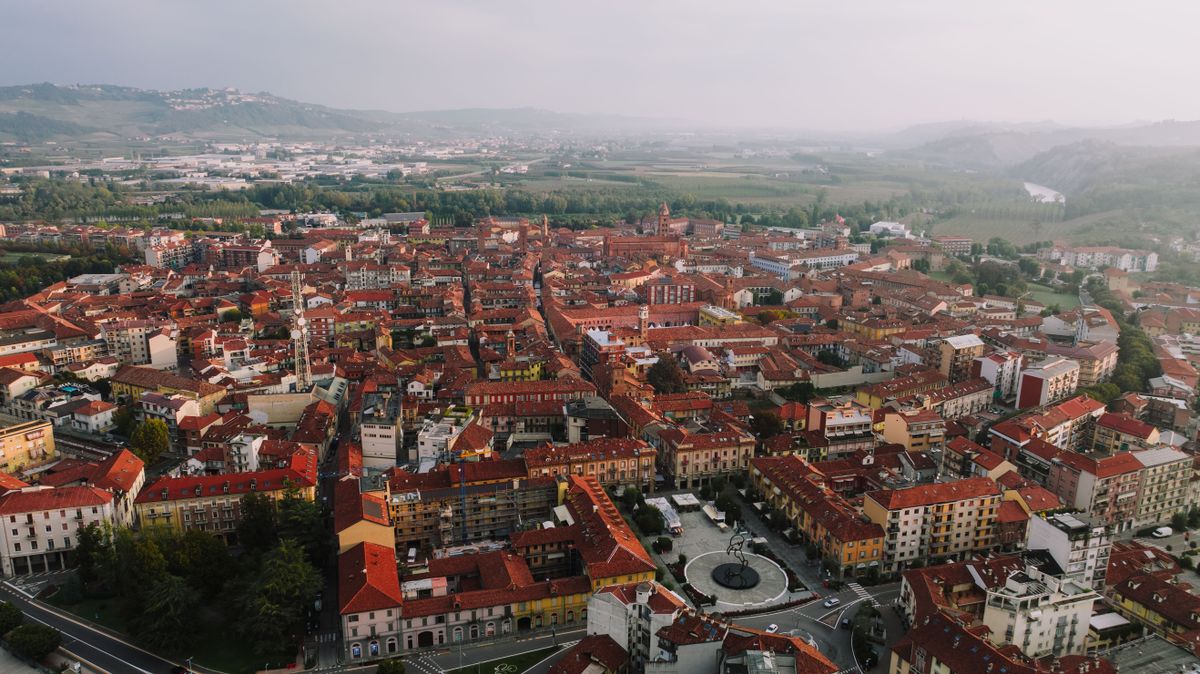
Alba’s medieval centre is compact enough to cover on foot in a couple of hours, though it rewards slower exploration. The main pedestrian axis runs along Via Vittorio Emanuele II and its continuation, lined with medieval tower-houses and arcaded porticos. Several Romanesque brick towers survive from the original medieval skyline when the town had over a hundred — Torre Civica (on Piazza Risorgimento) is the most photogenic.
Cathedral of San Lorenzo (Piazza Risorgimento) — a Gothic cathedral rebuilt between the 14th and 16th centuries over an earlier Romanesque structure. The interior contains Flemish-influenced carved choir stalls from the early 16th century, notably detailed. Open daily, free entry.
Piazza Risorgimento is the town’s main square, site of the weekly Saturday market (general merchandise) and the weekend truffle market during the fair season. The fountain in the centre marks the old Roman town of Alba Pompeia.
Museo Civico Federico Eusebio (Via Vittorio Emanuele 19) — local archaeology covering the Roman and medieval periods, including finds from the Roman town. Entry approximately €4. Closed Monday.
The main stretch for shopping and cafés is Via Cavour, which connects Piazza Savona to the upper town. Wine bars here serve Barolo, Barbaresco, and the local Dolcetto d’Alba by the glass — typically from €4.
Truffles and the fair
The Fiera Internazionale del Tartufo Bianco d’Alba (International White Truffle Fair) runs on weekends from early October to early December in the Cortile della Maddalena — a 16th-century courtyard behind Palazzo Banca d’Alba. Entry to the market costs approximately €5 at weekends. This is the primary white truffle market in the world. Prices for white truffles vary significantly by season and size: in a good year (wet autumn), expect €2,500–4,000 per kilogram for medium tubers; in a dry year, prices have reached €7,000–8,000/kg. The fair also runs cooking demonstrations, wine events, and the Palio degli Asini — a donkey race parodying Siena’s Palio, held on the second Sunday of October.
Outside market hours, several specialist shops sell truffle products year-round: Tartufi Morra (Piazza Pertinace 3) is the most established name, founded in 1930.
Wine and the Langhe
The Langhe hills surround Alba with some of Italy’s most sought-after vineyards. Key destinations within 20–30 minutes by car:
Barolo village (18km south-west) — the village itself has a wine museum (WiMu) inside the medieval castle, with good context on how Barolo DOCG works. Entry approximately €12. Many estates here accept walk-in visits: Marchesi di Barolo (Via Roma 1, Barolo) is one of the larger, more accessible cellars.
La Morra (12km south) — arguably the best viewpoint over the Langhe, with a panorama taking in the Apennines and, on clear days, the Alps. Several enotece in the piazza for tasting by the glass. Dolcetto d’Alba and Barbera d’Alba tend to cost €4–8/glass; Barolo €8–15/glass.
Barbaresco village (7km north-east) — quieter than Barolo and easily reached by bicycle from Alba on flat back roads. The co-operative Produttori del Barbaresco is an essential stop — one of Italy’s benchmark wine producers, with a shop for direct sales.
For a structured experience, book a wine tour from Alba which combines cellar visits with tasting menus and transport between estates.
Where to stay
Hotel Giacomo Morra Alba — Handwritten Collection (Via Roma 1 — doubles from approximately €130/night) is the best-located option in Alba, set on the main pedestrian street right in the historic centre. Named after the Giacomo Morra, who popularised white truffles internationally in the 1950s by gifting them to heads of state. Good restaurant and wine bar on-site.
Budget options are limited within the historic centre itself — most affordable accommodation is in converted farmhouses (agriturismo) in the Langhe hills outside town, which suits visitors with a car. Prices from approximately €60–80/night for a double at agriturismo with breakfast.
During the truffle fair period (October weekends especially), prices across the region rise significantly and early booking — ideally 2–3 months ahead — is essential.
Food
Piedmontese cuisine is arguably Italy’s richest. Key dishes to seek out in Alba’s restaurants:
Tajarin al burro e tartufo — egg pasta cut in thin strips (the Langhe version of tagliolini), typically served simply with butter and grated truffle. The pasta should be bright yellow from egg yolks; good tajarin uses around 30 yolks per kilogram of flour.
Agnolotti del plin — pinched pasta parcels filled with braised meat, served in broth or with a meat jus. One of the signature dishes of the Langhe.
Vitello tonnato — sliced braised veal with a tuna and caper sauce, served cold as an antipasto. Ubiquitous throughout Piedmont.
Bagna cauda — a warm dipping sauce of garlic, anchovies, butter, and olive oil, served with raw and cooked vegetables for dipping. A winter social dish, typically eaten communally. Autumn and winter only.
Named restaurants: Piazza Duomo (Piazza Risorgimento 4 — three Michelin stars, the flagship, requires advance booking; tasting menus from approximately €200/person) is internationally renowned but needs booking months ahead. For more accessible dining: Osteria dell’Arco (Piazza Savona 5 — mains approximately €18–25) serves traditional Langhe cooking; Lalibera (Via Pertinace 24A — mains approximately €16–22) has a strong focus on local producers.
Getting there and around
Train: Alba has its own station, though connections are slower than the main Piedmont network. From Turin Porta Nuova: approximately 1h15–1h30 via Bra or Asti. From Milan: change at Asti (approximately 2 hours total). The train from Bra, on the Turin–Cuneo line, takes about 20 minutes.
Car: The A33 motorway connects Alba to the wider autostrada network. From Turin approximately 50 minutes. Most wine estates are accessible only by car — driving is strongly recommended for anyone planning cellar visits.
Bike: The Langhe hills are steep; e-bikes can be hired in Alba (from approximately €25/day) and make the estate circuit more manageable.
For detailed planning: see the Langhe wine region guide, the Piedmont wine guide, and the Alba White Truffle Fair event page. Alba pairs naturally with Turin as a two-destination Piedmont itinerary — see the northern Italy itinerary for a full route.
Upcoming Events in Alba
La Befana - Feast of the Epiphany 2027
La Befana 2027, January 6. Italy's Epiphany gift-giving day: children receive sweets or coal from the Befana witch, then decorations come down.
Book an experience
Top experiences in Alba
Explore the best tours and activities in Alba, with instant confirmation and free cancellation on most bookings.