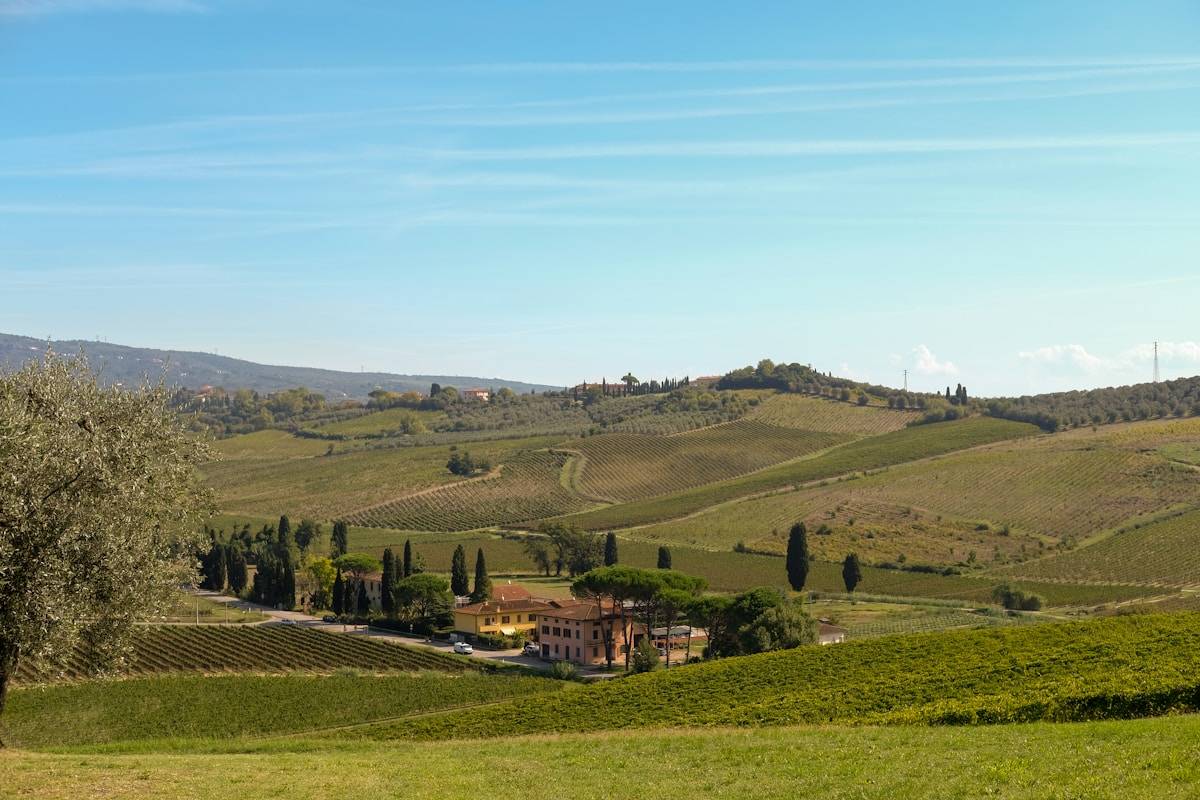
Alba is a small medieval city of approximately 35,000 people in the Cuneo province of Piedmont, positioned at the southern edge of the Langhe hills where the Tanaro river flows through the valley. It is the commercial and cultural capital of one of the richest wine and food zones in Europe: the Barolo and Barbaresco DOCG wine areas begin within 15km of the city, and Alba itself is the centre of the white truffle trade. For food and wine visitors, it punches far above its size.
The city repays one to two full days of exploration. The surrounding Langhe hills and wine villages — covered in our day trips from Alba article — can occupy several more days.
Alba Old Town: Towers and the Medieval Corso
Alba’s old town is well-preserved and compact enough to explore entirely on foot. The main axis runs along Via Cavour and Via Vittorio Emanuele II — a sequence of narrow streets lined with 15th and 16th-century buildings and the occasional surviving medieval tower.
In the Middle Ages, Alba had over 100 towers — private family towers built as displays of wealth and defensive position, common to medieval northern Italian cities. Today approximately seven survive to significant height, and their brick upper portions are visible above the roofline as you walk the old town. Unlike the famous tower clusters of San Gimignano in Tuscany, Alba’s towers are scattered through the street plan rather than grouped, which makes them easier to miss if you are not looking up.
Piazza Risorgimento is the central square and the social hub of the city. The main cafes are here, including Caffe Calissano and similar establishments that serve breakfast, coffee, and the Piedmontese ritual of an afternoon vermouth (Punt e Mes or Barolo Chinato are the local choices). The piazza is busier on Saturday mornings when the weekly market occupies the adjacent streets.
Cattedrale di San Lorenzo
The Cathedral of San Lorenzo on Piazza Risorgimento is Alba’s principal monument. Construction began in 1486 and continued through 1517 on an earlier Romanesque foundation; the current facade is 19th-century neo-Gothic, added when the original medieval face was deemed insufficiently grand. The interior is more interesting than the exterior: a three-aisled Gothic structure with good natural light and a notable early 16th-century polyptych in one of the side chapels attributed to Macrino d’Alba, a local painter of the period. Entry is free and the cathedral is open daily.
The adjacent bell tower predates the current cathedral and is one of the older structures in the centre.
Fiera Internazionale del Tartufo Bianco d’Alba
The White Truffle Fair is the reason many visitors time their trip to October or November. It runs from the first Saturday of October to the first Sunday of December each year — the precise end date varies with the year’s calendar. The main market takes place in the Cortile della Maddalena, a historic courtyard near the cathedral, where truffle vendors display and sell fresh white truffles (Tuber magnatum pico) under controlled conditions.
White truffle prices fluctuate significantly year to year depending on autumn rainfall and harvest conditions. In a good year (adequate October rain) prices average approximately €2,500–3,500 per kilogram; in a dry year, €4,000–5,000 or higher. At this scale, even a single truffle weighing 30–50 grams is a substantial purchase. Entry to the fair is approximately €5.
The fair is not only a trading event — it includes tastings, demonstrations, and cultural events throughout the October–December period. The atmosphere on weekends (when the fair is at its liveliest) is genuinely impressive. The piazzas around the cathedral fill with stalls selling truffle-based products, Langhe wines, and local produce.
A separate and prestigious event during the fair period is the Asta Mondiale del Tartufo Bianco d’Alba — the international truffle auction held at Castello Grinzane Cavour in November, where exceptional single truffles are sold to bidders in Tokyo, Moscow, Hong Kong, and New York simultaneously. This is attended as a spectacle rather than a buying event for most visitors.
Enoteca Regionale Piemontese Cavour at Grinzane Cavour
The Castello di Grinzane Cavour is 5km south of Alba, set on a hill above the first Barolo vineyards. The castle dates to the 13th century and takes its name from Count Camillo di Cavour — the key political architect of Italian unification — who was governor of Grinzane in the 1830s. It now functions as a wine museum and regional enoteca.
Entry to the castle and WiMu-adjacent exhibits is approximately €8. The tasting room on the ground floor sells Barolo, Barbaresco, Dolcetto d’Alba, and Barbera d’Alba wines at cellar-door prices, with knowledgeable staff. For a visitor arriving in the area without a specific cantina reservation, this is an excellent place to taste a range of the region’s wines in an accessible format. The cellar also stocks older vintages — Barolo from 10 or 15 years back is available at prices you will not see in restaurants.
The castle terrace has good views over the Barolo and Grinzane vineyards.
Wine Tasting in Alba
Alba’s centre has several wine shops and enoteca offering flights of Piedmontese wines without requiring a drive to a specific vineyard. Vineria dei Colori (Via XX Settembre) is well-regarded for its flights of Nebbiolo-based wines — a typical tasting of three wines (Barolo, Barbaresco, and Roero Arneis or Langhe Nebbiolo) costs approximately €20–25. This is an efficient way to compare the styles before visiting individual cantina in the villages.
The main wine categories to understand in Alba:
Barolo DOCG: made from 100% Nebbiolo grapes in the Barolo municipality and surrounding villages (Castiglione Falletto, Serralunga d’Alba, La Morra, Verduno, Novello). Full-bodied, high tannin, high acidity. Requires minimum 38 months ageing before release (62 months for Riserva). Prices from approximately €25–40 for a village-level wine at an enoteca, rising sharply for single-vineyard and aged bottles.
Barbaresco DOCG: also 100% Nebbiolo, from the Barbaresco village area. Slightly lighter structure than Barolo, requiring minimum 26 months ageing. More approachable in youth. From approximately €20–35 at an enoteca.
Dolcetto d’Alba DOC: soft, fruity, lower tannin. The everyday red drunk locally — more approachable than Barolo and considerably cheaper (from approximately €10–15).
The Palio degli Asini
During the truffle fair period, Alba holds a Palio degli Asini — a donkey race through the city streets with riders representing the city’s historical districts, accompanied by a medieval pageant with period costumes. The event is partly a parody of Siena’s serious Palio (Alba and Asti historically competed and occasionally mocked each other), and the atmosphere is cheerful rather than solemn. Held in October — exact date varies by year. Free to watch from the street; viewing areas near the finish are allocated in advance.
Cycling the Langhe Hills
The Langhe is some of the best road cycling terrain in northern Italy, with quiet farm roads winding between vineyards, hilltop villages, and cantina. Spring (April–May) and autumn (September–October) are the best seasons — warm but not hot, with dry roads. Bike rental in Alba is available from approximately €20–30 per day for a road bike, €35–50 for an e-bike. Most of the Barolo villages are within 15–25km of the city centre. The Langhe hills are genuine hills — the roads between vineyards include significant climbs, so fitness matters for road bikes; e-bikes make the terrain accessible to all levels.
Where to Stay in Alba
Alba has a small selection of hotels in the historic centre and several agriturismo properties in the surrounding Langhe hills. Staying in the city centre puts you within walking distance of the truffle fair, restaurants, and the Piazza Risorgimento. Browse hotels in Alba and filter by dates — rates rise significantly during the truffle fair in October and November.