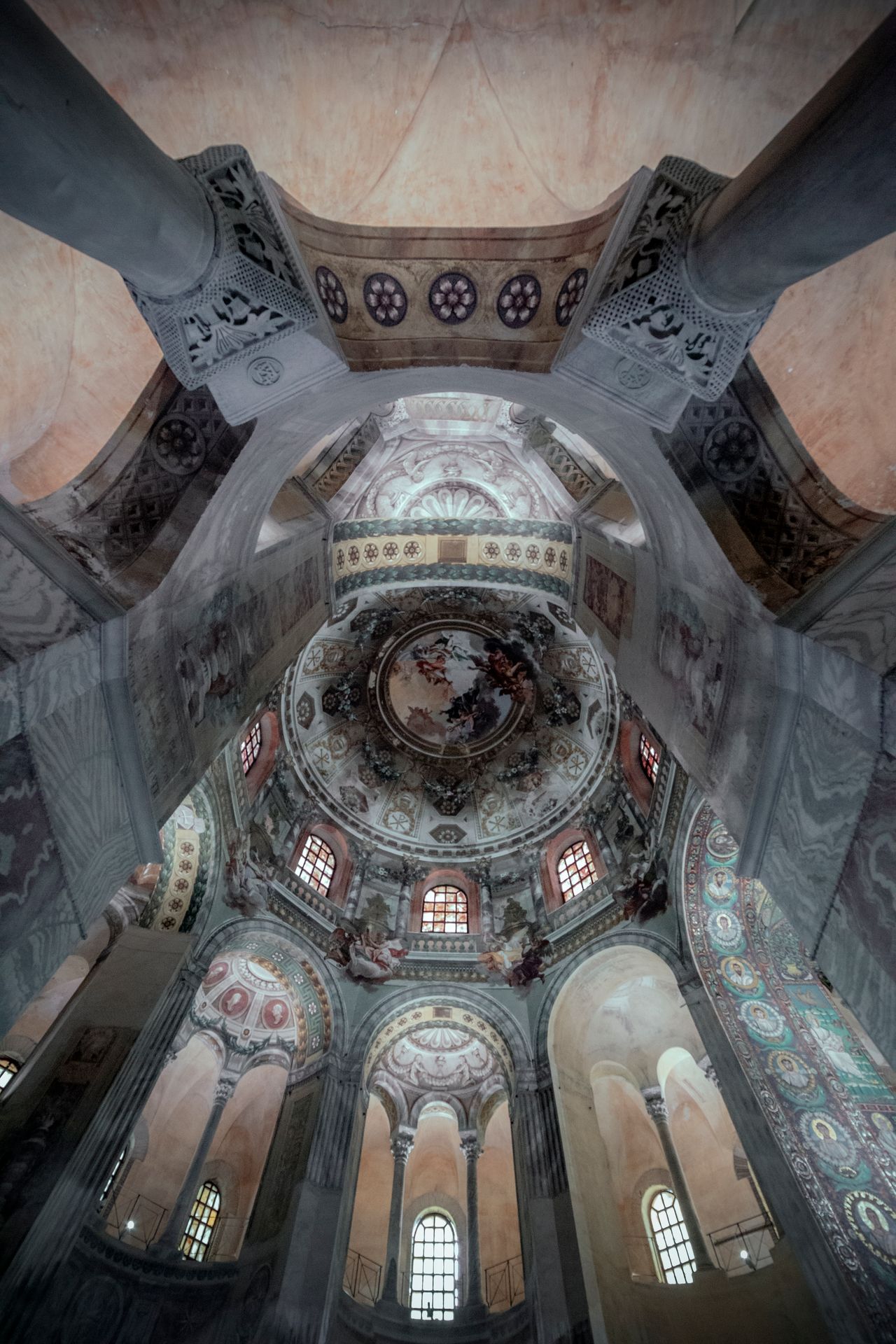
Ravenna holds one of the most concentrated collections of late-antique art anywhere in the world, and most of it is hidden inside buildings that look unremarkable from the street. That is precisely why a guided tour pays dividends here more than in almost any other Italian city. Step through the door of the Mausoleum of Galla Placidia and the interior explodes in deep cobalt blue and gold; without knowing what to look for — the starry ceiling, the lunette mosaics, the symbolism of every dove and deer — visitors can pass through in ten minutes and miss the full weight of what they are seeing.
The city served as capital of the Western Roman Empire from 402 to 476 AD, then of the Ostrogothic Kingdom under Theodoric from 493 to 540, and finally of the Byzantine Exarchate from 540 to 751. Three successive imperial powers, each with reasons to build ambitiously and to import the finest mosaic craftsmen from Constantinople, left their mark on the same small city. The result is eight UNESCO World Heritage Sites within walking distance of each other — the highest density of World Heritage monuments of any city in Italy.
Then there is Dante. The poet died in Ravenna in 1321 while in exile from Florence, and his tomb has stood here since 1780. Florence has been requesting the return of his remains for more than 600 years, so far without success. A tour that combines the mosaic circuit with a stop at the Danteum gives visitors a second, entirely different layer of history to work with.
Plan your visit and find accommodation before you book.
Quick Comparison: Top Ravenna Tours at a Glance
| Tour | Duration | Price (approx) | Best For |
|---|---|---|---|
| UNESCO Mosaic Circuit Walking Tour | 3 hrs | from €25 | First-time visitors |
| San Vitale and Galla Placidia Private Tour | 2 hrs | from €45 | In-depth mosaic study |
| Dante’s Ravenna Walking Tour | 2.5 hrs | from €20 | Literature and history |
| City + Sant’Apollinare in Classe Half-Day | 4 hrs | from €35 | Full UNESCO coverage |
| Po Delta Birdwatching Day Trip | 7 hrs | from €55 | Nature and landscape |
| Ravenna by Night Mosaic Tour | 2 hrs | from €30 | Atmosphere, smaller crowds |
| Bologna to Ravenna Day Trip | Full day | from €60 | Visitors based in Bologna |
| Mosaic Craft Workshop | 3 hrs | from €40 | Hands-on experience |
UNESCO Mosaic Circuit Walking Tour
Duration: 3 hours | From: approximately €25 per person
This is the standard introduction to Ravenna and the right starting point for any first visit. A licensed local guide leads a small group through the five monuments that make up the core of the city’s UNESCO sites: Basilica di San Vitale (548 AD), Mausoleum of Galla Placidia (5th century), Neonian Baptistery (5th century), Archbishop’s Chapel (6th century), and Basilica di Sant’Apollinare Nuovo (6th century).
The sequence matters. Most guides start with San Vitale, where the famous apse mosaics of Emperor Justinian and Empress Theodora stand as the best-preserved imperial portraits of late antiquity. The empress’s mosaic, depicting her and her court at the Offertory, is remarkable for its depth: the faces are individual, the silk robes reflect light differently depending on the angle, and the gold tesserae shift tone as clouds pass the windows. From there the group moves to Galla Placidia, a tiny mausoleum where the scale suddenly drops but the intensity increases — the starry barrel vault and the mosaic lunettes compress centuries of Christian iconography into a space roughly the size of a single room.
Entrance fees to all five monuments are typically included in the tour price, which saves the €12 combined Danteum ticket cost. Groups are capped at around twelve people, which means the guide can stop inside San Vitale’s apse rather than marshalling everyone through in under two minutes.
Book the UNESCO Mosaic Circuit tour
San Vitale and Galla Placidia Private Tour
Duration: 2 hours | From: approximately €45 per person
For visitors who want a slower, more analytical read of the two most important monuments, a private tour covering only San Vitale and the Mausoleum of Galla Placidia offers the depth that a group circuit cannot. The octagonal structure of San Vitale is itself a subject — it was directly modelled on Hagia Sophia’s San Sergio e Bacco in Constantinople, and the decision to build in that form in a western city in the 6th century was a political statement about Ravenna’s place within the Byzantine world.
A private guide can spend forty minutes in Galla Placidia without the pressure of keeping a group moving. The Good Shepherd lunette over the entrance, the Apostles in the barrel vault, and the deer at the fountain on the side walls each reward sustained attention. This tour suits art historians, architecture students, and anyone who has already done the full circuit and wants to return to the two monuments that deserved longer.
Book a private San Vitale tour
Dante’s Ravenna Walking Tour
Duration: 2.5 hours | From: approximately €20 per person
Ravenna’s connection to Dante is less well known than Florence’s, but arguably more intimate — this is the city where he spent his final years and where he is buried. A Dante-focused walking tour covers the Danteum (the 1780 tomb structure and small museum), the church of San Francesco where his funeral was held in 1321, and a series of sites connected to the Polenta family who gave him refuge during his Florentine exile.
The tour typically includes discussion of the political circumstances that brought Dante to Ravenna — the White Guelf and Black Guelf conflict, his relationship with Can Grande della Scala of Verona, and the writing of the Paradiso during his years in the city. The guide usually ends at the adjacent small museum where Dante’s original bones are held in a neoclassical urn, alongside a brief account of the 600-year dispute with Florence over their return. Entry to the Danteum is approximately €3.50 as of 2026.
City and Sant’Apollinare in Classe Half-Day Tour
Duration: 4 hours | From: approximately €35 per person
Sant’Apollinare in Classe sits 8km south of Ravenna, where the ancient port of Classis once served as the naval base for Rome’s Adriatic fleet. The basilica was consecrated in 549 AD, one year after San Vitale, and contains a single apse mosaic that operates on a completely different visual logic from anything in the city itself: a vast golden sky with a symbolic representation of the Transfiguration, twelve sheep processing in procession, and the figure of Sant’Apollinare standing in a stylised paradise garden below.
Because it requires transport out of the city centre, Sant’Apollinare in Classe is often skipped by visitors who underestimate its significance. A combined tour that takes in the main city monuments in the morning and transfers by minibus to Classe in the afternoon covers the full range of Ravenna’s Byzantine heritage in a single day. The basilica sees far fewer visitors than San Vitale, which means guides can take their time inside the apse without the crowd pressure typical of the city sites.
Book the city and Classe half-day tour
Po Delta Day Trip from Ravenna
Duration: 7 hours | From: approximately €55 per person
The Po Delta extends north and east of Ravenna across a wide flat landscape of lagoons, marshes, reed beds, and pine forests — the Comacchio valleys and Valli di Comacchio form the largest protected wetland in Italy. Day trips from Ravenna combine a boat tour of the delta with a stop in Comacchio, a small canal town built on islands in the middle of the lagoon, sometimes called the “little Venice of the Po Delta” for its network of bridges and waterways.
The delta is an important migration staging point, and over 300 bird species have been recorded in the area, including flamingos, herons, cormorants, spoonbills, and avocets. Autumn (September–November) is the best period for birdwatching, with large flamingo flocks present in the Valli di Comacchio from late summer through early winter. The tours include a boat ride through the canals and a guide who narrates the ecology and history of the delta, including the traditional eel fishing industry that Comacchio has been built around for centuries.
Bologna to Ravenna Day Trip
Duration: Full day | From: approximately €60 per person
Ravenna is 74km from Bologna and well-served by direct trains (approximately 1 hour 20 minutes). Day trips from Bologna typically include return transport, a guided tour of the main mosaic sites, and a stop for lunch in the city centre. This option suits visitors based in Bologna who want full coverage of the UNESCO sites without the logistics of self-navigation.
Group day trips from Bologna pick up at Bologna Centrale and arrive in time to cover San Vitale, Galla Placidia, and Sant’Apollinare Nuovo before a midday break. Afternoon itineraries vary — some return to Bologna directly, while others include a visit to the Danteum or a short stop in Comacchio. Private day trips allow a more flexible schedule and can include Sant’Apollinare in Classe.
Book the Bologna day trip to Ravenna
Practical Information
Getting to Ravenna: Direct trains from Bologna (approximately 1 hour 20 minutes, approximately €8–12 as of 2026) and Ferrara (approximately 1 hour). From Florence, change at Bologna; total journey approximately 2 hours.
When to visit: April to June and September to October offer the most comfortable temperatures and smaller crowds than July and August. The Ravenna Festival (June–July) brings outdoor classical performances that align well with evening mosaic tours.
Combined monument ticket: The Ravenna Mosaic Card covers the five main UNESCO sites for approximately €12 as of 2026. The Danteum combination ticket covering Dante’s Tomb and five sites costs approximately €12 separately.
San Vitale hours: Daily 9:00–17:00 (shorter hours November–February). Galla Placidia requires timed entry tickets purchased in advance in summer due to conservation limits — the mosaic’s moisture is sensitive to the breath of large groups.
Group size: Most guided tours cap at twelve to fourteen people. San Vitale and Galla Placidia impose additional limits; private tours guarantee entry regardless of the daily visitor quota.