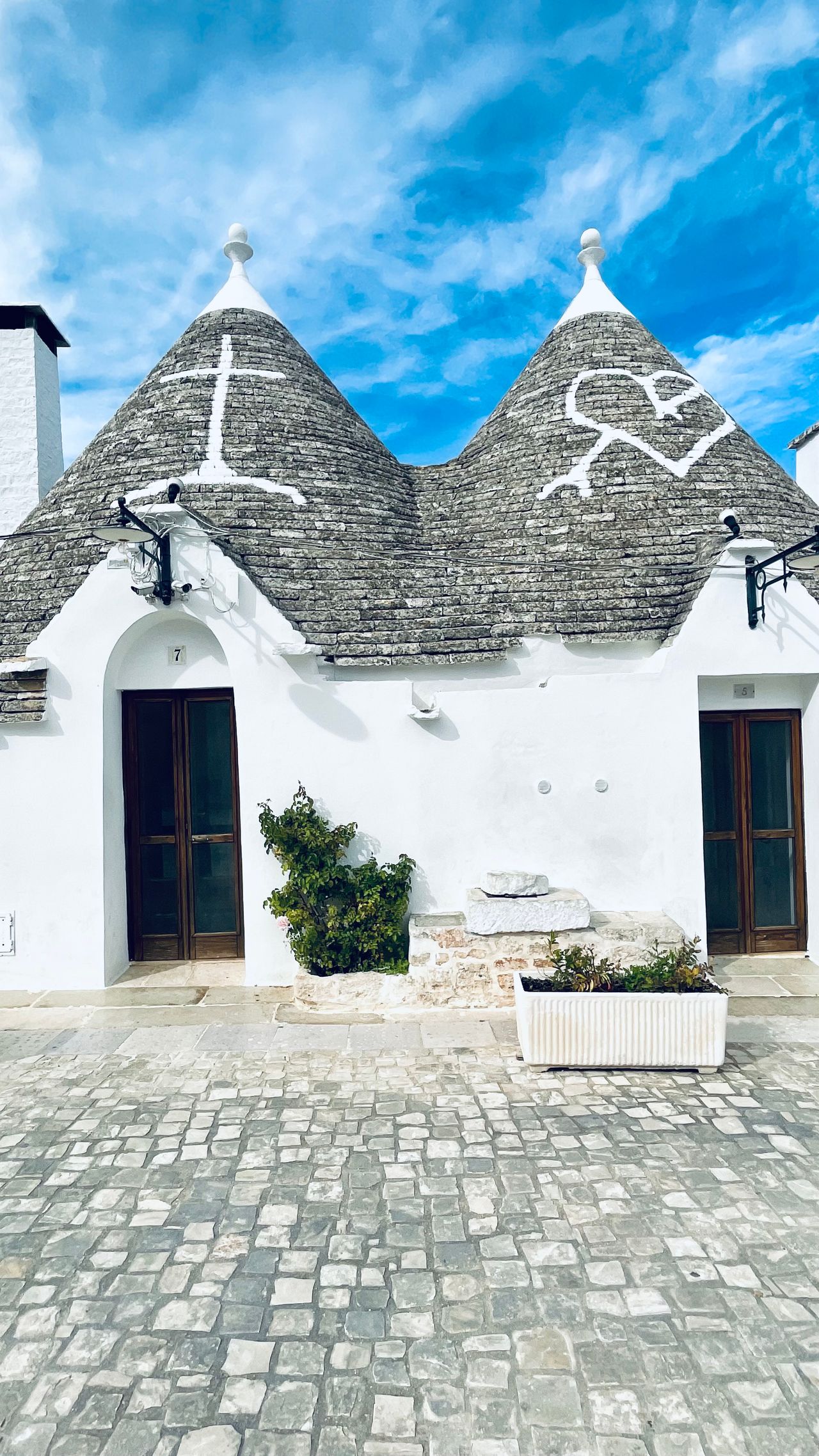
Alberobello is a small Puglian town of around 10,000 people that contains the highest concentration of trulli — the circular dry-stone limestone houses with conical roofs — found anywhere in Italy. The trulli of Alberobello’s Rione Monti and Aia Piccola districts were designated a UNESCO World Heritage Site in 1996, recognised as an outstanding example of vernacular architecture in which the building tradition, materials, and methods remained essentially unchanged from the medieval period into the twentieth century.
The trullo construction method is distinctive in two respects. First, the walls are built without mortar — each limestone block is placed dry, relying on weight and precision alone for structural integrity. Second, the conical roof is constructed using corbelling, with each successive ring of stone slightly overhanging the one below until the cone closes. The pointed pinnacolo (finial) at the apex of each cone is unique to the individual building, and many carry painted or carved symbols — Christian symbols such as the IHS monogram or the Chi-Rho, older apotropaic marks, and symbols whose meaning has been lost.
A widely-repeated legend holds that trulli were designed to be dismantled quickly to evade property tax during the Aragonese period, with residents able to pull out a keystone and collapse the roof before inspectors arrived. Historians have found no documentary evidence for this story, and the structural reality of how trulli are built makes rapid dismantling implausible. The more likely explanation for the mortar-free construction is simply that it was the local tradition using available materials — limestone flags are plentiful on the Murgia plateau.
The two main districts have different characters. Rione Monti (also called the Zona Monumentale) is the larger and better-known, with around 1,000 trulli lining steep lanes — this is where most shops and restaurants operate. Aia Piccola, across the valley, is smaller and less commercial, with many trulli still inhabited as private homes.
This guide covers the best-rated tours in Alberobello, from basic orientation walks to full Itria Valley excursions.
Quick Comparison: Top Alberobello Tours at a Glance
| Tour | Duration | From | Best For |
|---|---|---|---|
| Alberobello: Trulli Walking Tour | 2 hrs | €12 | First-timers, orientation |
| Alberobello: Trulli & Aia Piccola Guided Walk | 2.5 hrs | €18 | Architecture enthusiasts |
| Alberobello: Trulli, Olive Mill & Tasting | 3 hrs | €35 | Food lovers |
| Alberobello: Private Trullo History Tour | 2.5 hrs | €65 | Couples, private groups |
| Alberobello: Orecchiette & Trulli Food Experience | 3.5 hrs | €55 | Cooking enthusiasts |
| Bari: Day Trip to Alberobello & Itria Valley | 8 hrs | €45 | Day trippers from Bari |
| Bari: Alberobello, Locorotondo & Cisternino Day Trip | 9 hrs | €55 | Itria Valley overview |
| Alberobello: Sunset E-Bike Tour of the Trulli | 3 hrs | €40 | Active travellers |
For First-Timers
Alberobello: Trulli Walking Tour
Duration: 2 hours | From: approximately €12 per person
The standard introduction to Alberobello, meeting at the entrance to the Rione Monti and covering both main districts with a local guide who explains the construction method, the history of the town, and the significance of the pinnacoli symbols decorating the rooftops. The guide walks through the Rione Monti lanes — where the density of trulli is greatest and the lanes narrow to little more than a metre — and across to the quieter Aia Piccola on the opposite hillside.
The tour includes a visit to the Trullo Sovrano, the only two-storey trullo in existence, built by a wealthy priest’s family in the 18th century and now preserved as a museum. Its interior shows how a prosperous trullo dwelling was organised — the ground floor had a main room and storage chambers; an internal staircase, unusual in trullo construction, leads to the upper level. The building’s scale (it has 14 conical roofs rather than the usual one or two) gives a sense of the ambition involved in expanding within the constraint of the construction system.
For travellers who have only a few hours in Alberobello, this two-hour format covers the essential geography and history without overloading. It pairs well with an independent lunch at one of the restaurants in the Rione Monti afterwards.
Book the Alberobello Trulli Walking Tour
Alberobello: Trulli and Aia Piccola Guided Walk
Duration: 2.5 hours | From: approximately €18 per person
A slightly longer version of the standard walking tour that spends more time in Aia Piccola — the less-visited of the two trulli districts, where around 400 trulli are spread across a hillside that feels considerably quieter than the Rione Monti. Because Aia Piccola is still a lived-in neighbourhood with many privately owned trulli, it gives a more accurate impression of what the town looked like before the commercial souvenir trade transformed the Rione Monti. Several trulli here retain their original painted symbols on the cones in better condition than the more heavily trafficked buildings opposite.
The extended format also allows time to stop at the belvedere viewpoint looking across the valley between the two districts — the point from which the unusual density of conical roofs is most clearly visible — and to discuss the relationship between Alberobello’s architecture and the wider Murgia plateau landscape of which it is a part.
Book the Alberobello Trulli and Aia Piccola Guided Walk
For History and Architecture Lovers
Alberobello: Private Trullo History Tour
Duration: 2.5 hours | From: approximately €65 per person
A private tour with an archaeologist or architectural historian that goes beyond the standard walking narrative to examine the structural logic of trullo construction in detail — how the corbelled cone distributes load, why the mortar-free technique works in limestone but would not in softer stone, and how the building type relates to similar corbelled dry-stone structures found in other parts of the Mediterranean. The guide compares Alberobello’s trulli to the bories of Provence, the clochans of Ireland, and the navetas of Menorca, placing the local tradition in a European context.
The private format allows access to one or two trullo interiors that are not on the standard tour circuit, where the guide can examine the original cistern systems cut into the rock beneath the houses (trulli often had a rainwater cistern under the floor, fed by a channel in the limestone pavement outside) and the small secondary cones that served as sleeping chambers or storage spaces. Entry fees to the Trullo Sovrano are included.
Book the Alberobello Private Trullo History Tour
For Food Lovers
Alberobello: Trulli, Underground Olive Mill and Tasting
Duration: 3 hours | From: approximately €35 per person
Many of the limestone caves beneath the Rione Monti served historically as olive mills — the constant cool temperature of the underground space was ideal for cold-pressing, and several mills were carved directly into the bedrock beneath the trulli. This tour combines a walking tour of the main trulli districts with a visit to one of the surviving underground olive mills (palmento), where the guide explains the pressing process and the history of Puglia’s olive oil production, which accounts for around 40% of Italy’s total olive oil output. A tasting of local olive oil, paired with Puglian bread and vegetables, follows.
Puglia’s food character is tightly bound to its landscape — the extraordinary density of ancient olive trees on the plateau (some are thousands of years old and protected by law), the specific flavour profile of the Coratina and Ogliarola Barese cultivars, and the frugal, intensely flavoured cooking tradition that uses very little meat. This tour addresses that context without requiring a full cooking class commitment.
Book the Alberobello Trulli, Olive Mill and Tasting Tour
Alberobello: Orecchiette and Trulli Food Experience
Duration: 3.5 hours | From: approximately €55 per person
Combines a guided walk through the trulli districts with a hands-on pasta-making class focused on orecchiette — the small ear-shaped pasta that is Puglia’s most distinctive contribution to Italian cuisine and that requires a specific rolling-and-dragging technique with the thumb that takes practice to replicate. The class is held in a traditional kitchen and covers orecchiette with cime di rapa (the bitter turnip greens that are the classic pairing), a local primo using lampascioni (wild hyacinth bulbs, a Puglian specialty with a slightly bitter, earthy flavour quite unlike any other allium), and a dessert using local almonds.
The food experience runs for approximately two hours after the walking section. Participants eat what they cook, with Primitivo or Negroamaro wine included. The tour takes a maximum of eight participants, which keeps the cooking instruction genuinely instructive rather than a demonstration watched from a distance.
Book the Alberobello Orecchiette and Trulli Food Experience
For Day Trippers
Bari: Day Trip to Alberobello and the Itria Valley
Duration: 8 hours | From: approximately €45 per person
Alberobello sits 55km south of Bari in the Itria Valley — a limestone plateau covered in olive groves, vineyards, and dry-stone walls, dotted with masserie (fortified farm estates) and trulli. This full-day excursion from Bari Centrale covers Alberobello with a guide, then continues to one or two other Itria Valley towns — typically Locorotondo (a circular hilltop town of whitewashed houses 8km from Alberobello, with an excellent DOC white wine) or Cisternino (a small, largely unvisited historic centre 12km further). Lunch is at a local masseria or town restaurant.
The advantage of the combined format over visiting Alberobello alone is context: the trulli of Alberobello make more architectural sense when you have driven through the landscape that produced them — the same limestone flags underfoot, the same dry-stone walls dividing the fields, the same building logic applied at every scale from field boundaries to houses.
Book the Bari Day Trip to Alberobello and Itria Valley
Alberobello: Sunset E-Bike Tour of the Trulli
Duration: 3 hours | From: approximately €40 per person
An e-bike circuit that begins in central Alberobello, loops through the countryside south of the town (where isolated trulli and masserie sit among ancient olive trees), and returns via the Aia Piccola viewpoint in time for the late afternoon light on the conical roofs. The e-bike format makes the gradients of the Murgia plateau manageable regardless of fitness level and allows the tour to reach landscapes — the silvery olive groves, the dry-stone-walled smallholdings, the isolated trulli that have no tourist function at all — that are inaccessible on foot in the available time.
The sunset timing is genuinely worthwhile in Alberobello: the low light catches the grey limestone of the cones and the whitewashed walls in a way that differs markedly from midday. The tour meets at a rental point near the town centre and includes e-bike hire and a helmet. No previous cycling experience with e-bikes is required.
Book the Alberobello Sunset E-Bike Tour
Practical Information
Getting to Alberobello: Alberobello has a direct train connection from Bari on the Ferrovie del Sud Est regional line (FSE) — journey time approximately 1 hour 20 minutes, with departures roughly every hour. Trains are slow but reliable. By car from Bari: 55km, approximately 1 hour via the SS100 and SS172. From Lecce: approximately 120km, 1.5 hours. From Matera: 65km, under 1 hour.
When to visit: April through June and September through October offer the most comfortable temperatures and the smallest crowds. July and August bring significant visitor numbers and heat — the Rione Monti in peak summer can feel heavily commercialised. The trulli are photogenic in winter light and the town is quiet from November through March, though some tour operators reduce their schedule outside peak season.
Terrain: Alberobello’s trulli districts involve uneven stone paving, some steep lanes, and steps. The Rione Monti is more level than Aia Piccola. The town is not suitable for wheelchairs throughout, though the main viewpoint terraces are accessible.
Entry fees: The Trullo Sovrano museum charges approximately €3. Entry to the Rione Monti and Aia Piccola districts themselves is free. Individual trullo shops sometimes charge a small fee to enter their cone interiors.