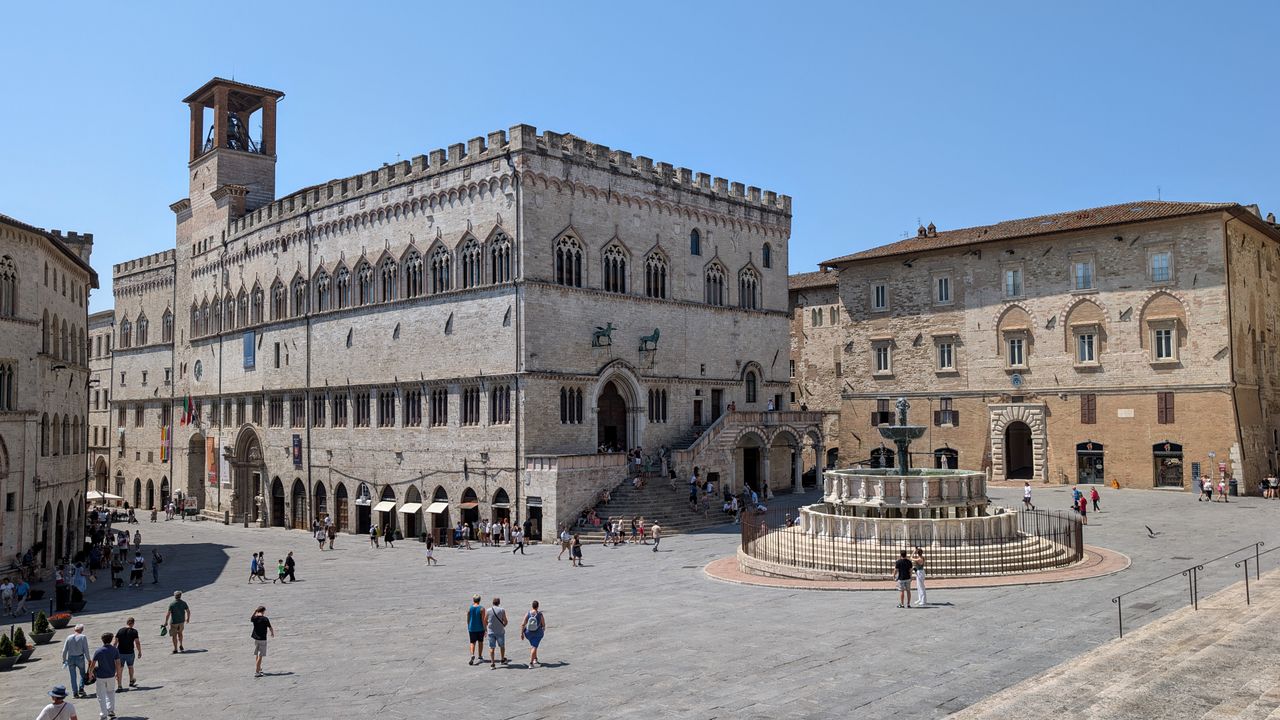
Perugia occupies one of the best defensive positions in central Italy: a broad ridge 493 metres above sea level, overlooking the Tiber valley to the east and the hills of Umbria in all other directions. The city was an Etruscan stronghold — ancient Perusia was one of the twelve cities of the Etruscan federation — and the massive sandstone walls visible in several places around the city’s edge date in part to the 3rd and 4th centuries BC, making them among the best-preserved Etruscan fortifications in the peninsula.
The Romans took Perugia in 40 BC after a bitter siege, burning much of the upper city. Medieval Perugia rebuilt on the same ridge, and the city that visitors walk through today is largely the product of the 13th and 14th centuries: the Palazzo dei Priori (begun 1293), the Fontana Maggiore (completed 1278), the Gothic cathedral, and a network of towers and civic palaces that reflect the wealth and competitive ambition of a commune at the height of its independence. Perugia’s university was founded in 1308 and remains one of the oldest in Italy; the University for Foreigners of Perugia, established in 1925, draws language students from around the world and gives the city a lively, internationally mixed atmosphere.
The Palazzo dei Priori is one of the finest examples of Italian Gothic civic architecture anywhere in the country. Its long facade runs the length of the Corso Vannucci — the main pedestrian street — and the interior houses the Galleria Nazionale dell’Umbria, which holds the most important collection of Umbrian painting in Italy. Pietro Perugino (1446–1523), who was born near Città della Pieve 40 kilometres west of Perugia and spent much of his career in the city, is represented here extensively. Perugino was Raphael’s teacher in Perugia in the early 1500s, and the influence of his clean, luminous figure style on his pupil is visible in the gallery’s holdings.
Underground Perugia — specifically the remains of the Rocca Paolina, a 16th-century papal fortress built over an entire medieval neighbourhood by Pope Paul III after he crushed a revolt in 1540 — provides one of the most unusual architectural experiences in central Italy. Sections of medieval streets, arches, and house facades survive intact beneath the fortress foundations and are accessible via guided tour. After Italian unification in 1860, Perugians demolished the above-ground sections of the hated Rocca as one of their first acts of self-determination; the underground streets were rediscovered gradually and are now one of the city’s most visited sites.
Quick Comparison: Top Perugia Tours at a Glance
| Tour | Duration | Price (approx) | Best For |
|---|---|---|---|
| Perugia old city walking tour | 2 hrs | from €18 | History, architecture |
| Underground Perugia (Rocca Paolina) | 1 hr | from €20 | Medieval archaeology |
| Assisi day trip from Perugia | Full day | from €45 | Basilica, Franciscan history |
| Galleria Nazionale dell’Umbria guided visit | 1.5 hrs | from €22 | Umbrian painting, Perugino |
| Umbrian wine and olive oil tasting | 2–3 hrs | from €40 | Food and wine |
| Assisi + Spello combination day tour | Full day | from €60 | Umbrian valley overview |
| Lake Trasimeno boat and shore tour | Half day | from €35 | Landscape, history |
| Perugia Chocolate tour + Eurochocolate context | 2 hrs | from €30 | Gastronomy |
Perugia Old City Walking Tours
Duration: 2 hours | From: approx €18 per person
The natural starting point for any guided walk in Perugia is Piazza IV Novembre, one of the most architecturally coherent medieval piazzas in central Italy. The space is anchored by the Fontana Maggiore at its centre, the Palazzo dei Priori along its south side, and the cathedral of San Lorenzo on the north. Completed between 1275 and 1278, the Fontana Maggiore was designed by Fra Bevignate and sculpted by Nicola and Giovanni Pisano. It consists of two marble basins: the lower decorated with relief panels depicting the labors of the twelve months and the seven liberal arts; the upper with figures of saints, biblical characters, and allegorical personifications, topped by three bronze female figures supporting a central bronze basin. The iconographic programme was deliberate civic messaging — a statement about the city’s cultural and political self-image.
From the piazza, a guided walk typically moves up the Corso Vannucci, through the Porta Marzia (an Etruscan gateway incorporated into Sangallo’s Rocca Paolina in the 16th century and surviving today on Via Baglioni), and into the network of medieval lanes east of the main street. The guide will usually cover the arched Via dell’Acquedotto — a medieval aqueduct that carries water across a gap between two hills, with houses built on top of the arches — and the Arco Etrusco (2nd–3rd century BC), one of the best-preserved Etruscan gateways in Italy, with its characteristic curved stone blocks and later Roman additions.
Browse walking tours and all Perugia activities
Underground Perugia: The Rocca Paolina
Duration: 1 hour | From: approx €20 per person
When Pope Paul III imposed a salt tax on Perugia in 1540, the city revolted. The Pope’s response was to build a fortress — the Rocca Paolina — on top of the Baglioni family’s noble quarter, effectively burying an entire neighbourhood of medieval Perugia beneath tonnes of fill and new fortification. The architect Antonio da Sangallo the Younger designed the project; the construction required demolishing or burying dozens of towers, churches, and palaces that had formed one of the city’s wealthiest districts.
When Perugians demolished the above-ground sections of the Rocca in 1860, they discovered that the underground streets, arches, and house facades beneath it were largely intact — preserved by the fill used to level the construction site four centuries earlier. Today a section of this buried neighbourhood is accessible through the Rocca Paolina complex, entered via escalators at Piazza Italia. The guided tour passes through Via Baglioni Sotterranea, where medieval house facades still show doorways, windows, and carved stone details at street level, and through a series of chambers and corridors that follow the original medieval street layout.
The experience is genuinely unusual: walking through a functioning 14th-century street that has been sealed underground for nearly 500 years and is now part of the city’s pedestrian circulation system. The escalators that connect the upper and lower city pass through the underground complex, so many visitors use them without realising they are walking through a preserved medieval neighbourhood.
Browse underground Perugia tours and all activities
Assisi Day Trips from Perugia
Duration: Full day | From: approx €45 per person
Assisi, 25 kilometres east of Perugia in the Subasio hills, is one of the most visited destinations in Umbria — and with reason. The Basilica di San Francesco, built above the tomb of St Francis between 1228 and 1253, contains two complete fresco cycles of extraordinary quality: the Lower Church with works attributed to Cimabue and the Sienese school, and the Upper Church with the celebrated cycle of 28 scenes from the life of St Francis, traditionally attributed to Giotto (c. 1296–1304) though the attribution remains debated among art historians.
Organised day tours from Perugia typically include transport (coach or minivan), a guided visit to both churches with a licensed guide who explains the iconographic programme and the art-historical context, and free time in the medieval centre. Some tours include the Rocca Maggiore fortress above the town, which offers the best panoramic view of the Spoleto valley and the surrounding olive country.
The drive from Perugia to Assisi passes through the Umbrian plain and is itself visually rewarding — the approach to Assisi from the west, with the pink stone basilica visible from the valley floor, gives a sense of the medieval pilgrimage experience that arriving by train to the lower town does not reproduce. Combination tours adding Spello (decorated with Pinturicchio frescoes in the Baglioni chapel) or Bevagna (a perfectly preserved Roman and medieval walled town) extend the day productively.
Browse Assisi day tours and all Perugia activities
Umbrian Wine and Olive Oil Tours
Duration: 2–3 hours | From: approx €40 per person
Umbria produces several DOC and DOCG wines of genuine distinction within easy reach of Perugia. Sagrantino di Montefalco DOCG — made from the Sagrantino grape, found almost nowhere else in the world — is produced in the hills around Montefalco, 45 kilometres southeast of Perugia. It is one of Italy’s most tannic red wines, typically requiring extended ageing. Torgiano Rosso Riserva DOCG, produced around the town of Torgiano (15km south of Perugia), is more approachable and pairs naturally with the Umbrian olive oil that is produced alongside it.
Wine tours from Perugia visit one or two producers in the surrounding hills, combining a cellar tour with a structured tasting of the estate’s wines accompanied by local bread, pecorino, and norcineria (Umbrian cured pork, for which Norcia 100km east is the historic centre). Olive oil tastings are often incorporated, particularly in autumn: Umbrian extra-virgin olive oil, produced largely from Moraiolo, Frantoio, and Leccino varieties, has a characteristic green-gold colour and pronounced bitter-peppery finish that distinguishes it from Ligurian or Sicilian oils.
Browse wine tours and all Perugia activities
Lake Trasimeno Excursions
Duration: Half day | From: approx €35 per person
Lake Trasimeno, 20 kilometres west of Perugia, is the largest lake in central Italy and one of the least developed major Italian lakes. The low hills surrounding the shore are dotted with medieval fortified towns — Castiglione del Lago on the western promontory, Passignano sul Trasimeno on the north shore, the island of Polvese (uninhabited, now a nature reserve), and the island of Maggiore, which has a small permanent population and a medieval Franciscan friary.
Boat tours from Castiglione del Lago or Passignano reach the islands in approximately 20–30 minutes. A half-day excursion from Perugia combines a coach transfer to the lake, a boat crossing to Isola Maggiore (the only island with public access), a walk through the village and friary, and return to Perugia. Trasimeno is also famous historically as the site of Hannibal’s ambush of a Roman army in 217 BC — one of the largest military defeats in Roman history — and some tours incorporate this context into the lakeside visit.
Browse lake tours and all Perugia activities
Practical Information
Getting to Perugia: Perugia has two rail connections. The Ferrovia Centrale Umbra connects to Foligno (for Florence and Rome connections) and Terni. The main intercity connections use Terontola station (50km, connected by regional train in approximately 50 minutes) on the Florence–Rome main line. Buses (FlixBus and Sulga coaches) connect directly to Rome, Florence, and Milan. Within the city, escalators connect the lower modern city to the historic centre; the MiniMetro funicular links Pian di Massiano (with a large car park) to Piazza Matteotti in the historic centre.
When to visit: April to June and September to October are the best months. July brings Umbria Jazz (usually the second and third week of July), when the city fills with visitors and prices rise — book accommodation and tours well ahead. October is the Eurochocolate festival (held over a long weekend, usually the third week of October): the streets of the historic centre become a tasting venue for dozens of chocolate producers.
Where to stay: See our Perugia hotels guide for accommodation options in and around the historic centre.
City overview: Read our full Perugia city guide for restaurant recommendations, neighbourhood orientation, and further detail on the Galleria Nazionale dell’Umbria.