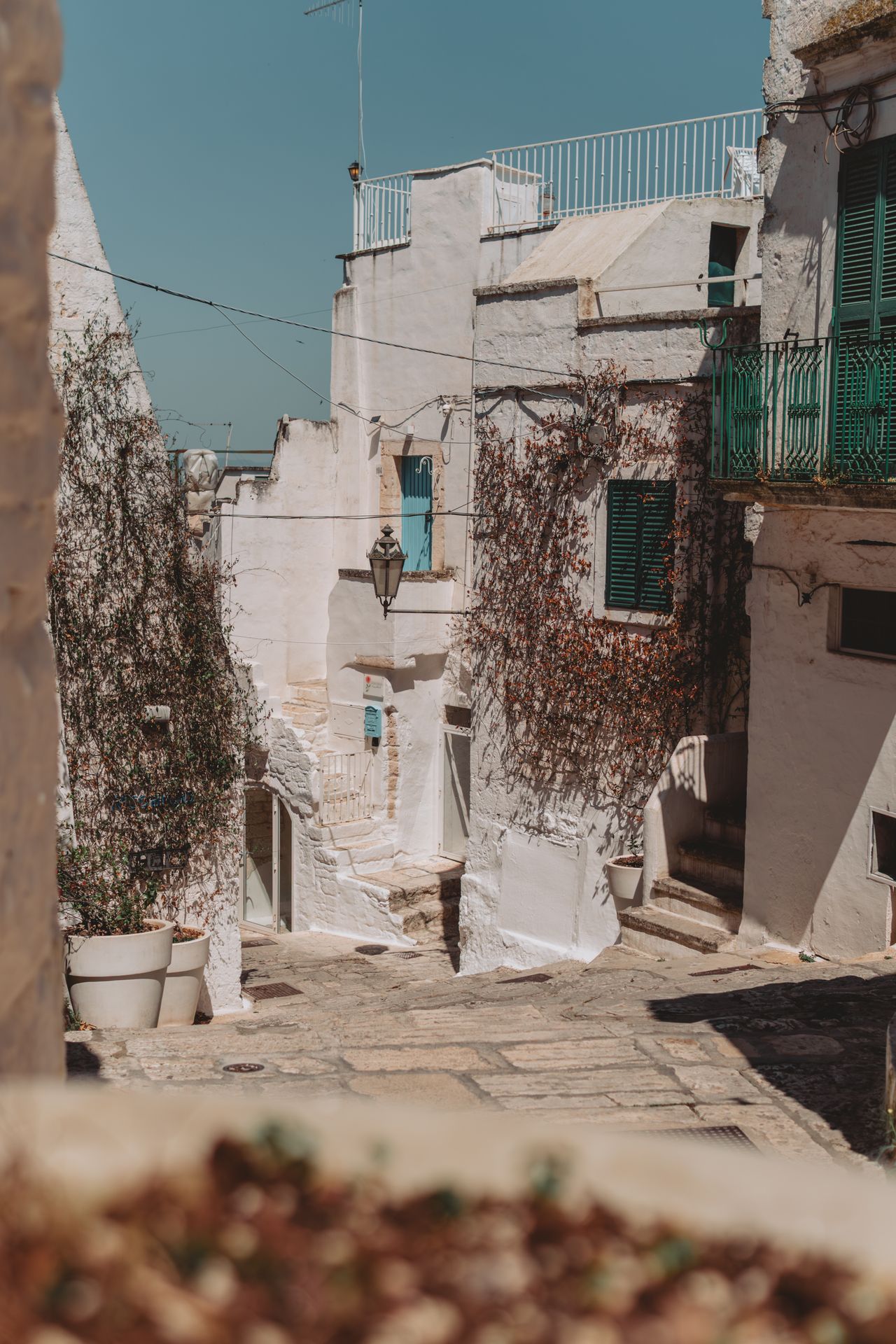
Ostuni stands 200 metres above the surrounding plain on a limestone ridge, its whitewashed houses and cathedral visible from the Adriatic coast on clear days. The name La Città Bianca — the White City — reflects a practical history: the lime wash applied to buildings for centuries served as disinfectant and insect repellent as much as decoration. The result is one of the most photogenic towns in Puglia, a tightly packed maze of arches, stepped lanes, and terracotta roof tiles above an endless sea of ancient olive trees.
Those olive trees matter as much as the architecture. The territory around Ostuni contains some of the oldest cultivated olive groves in Italy, with individual trees estimated at between 1,000 and 3,000 years old. Many of the massive, gnarled trunks in the countryside between Ostuni and Fasano predate the Norman arrival in Puglia by several centuries. The groves are part of the reason this region looks the way it does: the flat plain is broken not by roads or development but by trees, dry-stone walls, and the occasional masseria — fortified farmhouse — built when Puglia was frontier territory exposed to raids from the Adriatic.
The cathedral (Cattedrale di Santa Maria Assunta), completed between 1469 and 1495, crowns the old town with a facade that mixes Late Gothic tracery with early Baroque detail. The large rose window on the main facade is the most distinctive element, and the position of the building at the summit of the hill means it catches the afternoon light from the west in a way that makes the stonework glow. The views from the cathedral terrace over the olive plain to the sea are among the best in the Salento region.
Ostuni also has an unexpected archaeological distinction: the Municipal Museum houses the skeleton of “Delia,” a woman who died approximately 25,000 years ago in the late Palaeolithic period. She was buried in an advanced stage of pregnancy — making this one of the earliest known deliberate human burials in southern Europe, and a find that entirely redefined our understanding of pre-agricultural life in this part of Italy.
Quick Comparison: Top Ostuni Tours at a Glance
| Tour | Duration | Price (approx) | Best For |
|---|---|---|---|
| Old town walking tour | 1.5–2 hrs | from €18 | History, architecture |
| Masseria farm visit + olive oil tasting | 2–3 hrs | from €35 | Food, rural culture |
| E-bike tour: olive groves to the coast | 3–4 hrs | from €45 | Active, countryside |
| Cooking class in a masseria | Half day | from €65 | Gastronomy |
| Coast day trip: Rosa Marina and Adriatic beaches | Full day | from €40 | Sea, scenery |
| Itria Valley day tour (Alberobello + Locorotondo) | Full day | from €60 | Trulli, Puglia overview |
| Sunset aperitivo tour with local guide | 2 hrs | from €30 | Culture, photography |
| Private driving tour: Ostuni + Fasano + Selva di Fasano | Full day | from €120 | Flexibility, depth |
Old Town Walking Tours
Duration: 1.5–2 hours | From: approx €18 per person
Ostuni’s historic centre is small enough to cover on foot but complex enough to get genuinely lost in — the lanes spiral inward from Piazza della Libertà toward the cathedral in a pattern that was never planned but simply accumulated over centuries of construction and reconstruction. A guided walk removes the disorientation and adds the context that makes the architecture legible.
Starting at Piazza della Libertà, a good guide will explain the Baroque column of St Oronzo (erected in 1771 following a plague outbreak, with the statue of Ostuni’s patron saint set on top) before leading you through the arched gateway and into the old town proper. The route typically passes through the neighbourhood of Piazzetta Petrarolo, across the Largo Luce with its views over the olive plain, and up to the cathedral level for the panorama of the coast.
The cathedral interior contains a carved wooden ceiling from the 17th century and several notable Baroque altars, but the exterior architectural detail — particularly the rose window tracery and the articulated cornice line — is what most guides focus on for the first visit. On the return descent, the itinerary usually includes the Arco di San Domenico and some of the older residential lanes where the whitewash is applied directly to the medieval limestone beneath, giving the walls a texture quite different from more recently treated surfaces.
Browse old town walking tours and all Ostuni activities
Masseria Farm Visits and Olive Oil Tastings
Duration: 2–3 hours | From: approx €35 per person
A masseria is a fortified farmhouse — a building type that developed across Puglia during the medieval and early modern periods when coastal and inland farms needed to be defensible. Many of the masserie around Ostuni have been converted to agriturismo accommodation or tourism experiences, but a good number remain working farms producing olive oil, wine, vegetables, and almonds.
A guided masseria visit typically begins with a walk through the olive grove, where the guide identifies the different varieties (Ogliarola Salentina and Cellina di Nardò are the most common around Ostuni), explains the grafting and pruning methods used to maintain century-old trees, and demonstrates the difference in oil character between early-harvest fruit (intensely green, peppery) and fully ripe olives pressed in November. The tour continues to the frantoio — the olive press — where the guide explains the cold-pressing process that distinguishes extra-virgin oil from lesser grades.
Tasting follows: typically three or four oils at different harvest dates and ripeness levels, with local bread for dipping and sometimes a plate of preserved vegetables from the estate. Autumn visits during the olive harvest (October to November) include the option to participate in hand-picking, which most visitors find unexpectedly satisfying. Year-round visits focus on the grove, press, and tasting without the harvest participation.
Browse masseria tours and all Ostuni activities
E-Bike Tours: Olive Groves and the Adriatic Coast
Duration: 3–4 hours | From: approx €45 per person
The coastal plain between Ostuni and the Adriatic is flat, shaded by ancient olives, and crossed by quiet farm tracks that see almost no vehicle traffic. An e-bike tour is one of the best ways to experience the scale and character of this landscape without covering the same ground on foot. Routes typically descend from the town toward the coast via unpaved masseria tracks, reach the Adriatic near Rosa Marina or Torre Canne, and follow the coastal road for a section before looping back through the olive groves.
The total distance is usually 25–40 kilometres depending on the operator and the pace of the group. E-bikes make the return uphill section to Ostuni manageable without significant effort — the old town sits well above the plain, and the last kilometre or two involves a noticeable climb that traditional bikes would make harder in summer heat. Most operators provide helmets, water, and a small snack stop at a masseria or beach bar en route.
Photography stops are a feature of most guided routes: the combination of silver-leafed olive trees, red soil, limestone walls, and the distant blue of the Adriatic produces images that are specific to this part of Puglia. Groups are typically limited to 8–10 people to maintain a manageable pace on the narrower farm tracks.
Browse cycling tours and all Ostuni activities
Itria Valley Day Tours: Alberobello and Beyond
Duration: Full day | From: approx €60 per person
Ostuni is well placed for day trips into the Itria Valley, the trulli district northwest of the city. The most visited destination is Alberobello (47 kilometres), where the UNESCO-listed Rione Monti neighbourhood contains more than 1,000 trulli — conical limestone dwellings built using dry-stone construction without mortar. The technique, specific to this part of Puglia, produced buildings that could technically be dismantled at short notice — originally used to avoid property taxes on permanent structures.
A full-day Itria Valley tour from Ostuni typically combines Alberobello with one or two smaller towns: Locorotondo (known for its circular layout and white-wine production), Cisternino (a quieter hilltop town with a well-preserved centro storico), or Martina Franca (Baroque architecture and the largest town in the valley). Transport between sites is included; the guide explains the trulli construction method, the social history of the valley, and the differences between the tourist-facing Rione Monti and the still-inhabited Rione Aia Piccola in Alberobello.
Browse Itria Valley tours and all Ostuni activities
Practical Information
Getting to Ostuni: The nearest train station is Ostuni on the Bari–Lecce main line, served by Trenitalia regional trains. Bari is approximately 75 minutes away; Lecce approximately 50 minutes. Taxis from the station to the old town cost around €10–€15. A car is useful for reaching the surrounding masserie and coast independently, but not required for tours based in the old town.
When to visit: May to June and September to October offer the best balance of weather and manageable visitor numbers. July and August are the busiest months; the old town lanes become congested in the early afternoon, though mornings and evenings are pleasant. October and November bring olive harvest season, which is the best time for masseria and food-focused tours.
Getting around: The old town is compact and entirely walkable. Most tours meet centrally and require no transport between sites. Coastal and valley day tours provide transport from a central pickup point.
Where to stay: See our Ostuni hotels guide for accommodation in the historic centre and surrounding countryside, including masseria agriturismo options.
City overview: Read our full Ostuni city guide for more on the cathedral, beaches, local restaurants, and how to structure your time in the area.