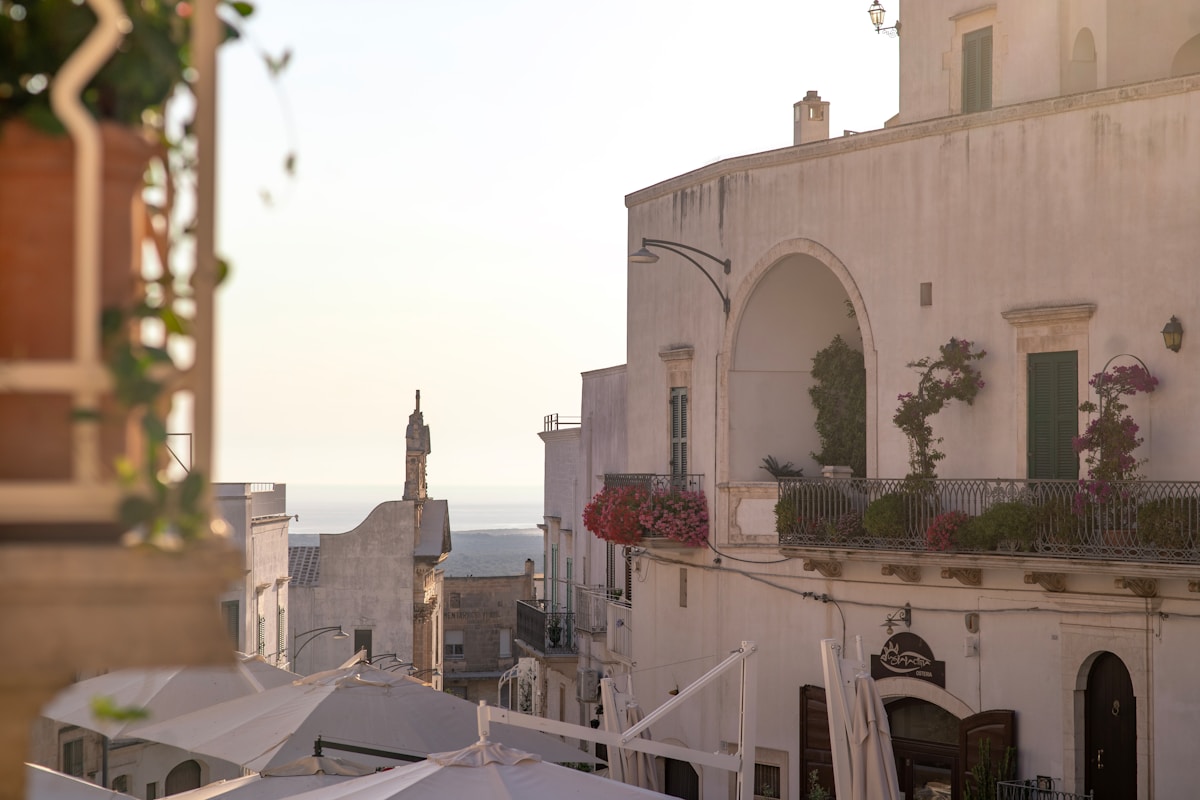
Ostuni is the White City — one of the most immediately striking towns in all of Italy, where the entire hilltop centro storico is painted brilliant white, creating a bleached mass of alleys, arches, and domed churches visible from miles across the olive groves of the Murge. Staying in the centro bianco is the point of a visit: the narrow staircase alleys (le chianche), the cathedral with its unusual late-Gothic rose window, and the views from the town’s terraces over the Adriatic are all best experienced from inside, early in the morning and in the evening, when the day-trip crowds from Bari and Brindisi have gone.
Search Ostuni hotels on Booking.com to compare prices and check availability across all areas in this guide.
Centro Bianco — The White Old Town
The hilltop old town of Ostuni is built in layers ascending to the cathedral. The alleys are narrow — some barely shoulder-width — and everything is whitewashed. Hotels and guesthouses here are in converted traditional buildings, usually with the characteristic white-rendered stone walls and Mediterranean small-window architecture.
Budget (€80–115/night): B&Bs and small guesthouses in the white alleys. Several family-run options along Via degli Archi, Via Pirro Guaceto, and the streets below the cathedral offer simple rooms in characterful buildings from approximately €80–100/night in shoulder season as of 2026. Self-catering apartments in the old town are also available and often offer the best value for 3+ night stays — cooking in a whitewashed Ostuni kitchen is part of the experience.
Mid-range (€120–200/night): Ostuni Palace Hotel (on the edge of the centro bianco) is the most conventional mid-range option with reliable services; doubles from approximately €120–165/night as of 2026. Boutique guesthouses in the white town — typically 5–12 rooms in carefully restored buildings with terraces — command approximately €140–200/night for the best options in season.
Boutique/Luxury in the white city (€180–300/night): La Sommità Relais (Via Scipione Petrarolo 7) is Ostuni’s most refined address within the old town — a converted 16th-century noble residence with 16 suites, a rooftop pool with panoramic views, and a spa; doubles from approximately €200–320/night in peak summer as of 2026. The rooftop views over the olive groves toward the Adriatic are exceptional.
New Town and Below the Hill
The modern commercial town below Ostuni’s hilltop has standard two- and three-star hotels, chain accommodation, and more accessible parking. It’s the practical choice for budget-conscious visitors or those with mobility considerations — the old town involves significant staircase walking.
Budget options: From approximately €65–90/night. Simple and functional. The walk up to the white city takes 10–15 minutes on a steep path or road.
Masseria Countryside — Between Ostuni and the Sea
The olive grove landscape between Ostuni, Fasano, and the Adriatic coast has the highest concentration of quality masseria accommodation in Puglia.
Top-end masseria: Masseria San Domenico (near Fasano, 15 km north of Ostuni) is one of the region’s landmark luxury masserias — a converted 15th-century working farm with a thalassotherapy pool, Mediterranean gardens, and a restaurant using estate olive oil; doubles from approximately €300–600/night in peak season. Masseria Il Frantoio and Masseria Torre Coccaro are comparable options in the same price tier. These are destinations in themselves as much as bases for the region.
Plan your trip:
- Browse tours in Ostuni and Puglia
- Book an airport transfer
- Get travel insurance for Italy
- Pick up an eSIM for Italy
- Search hotels in Ostuni on Booking.com
Practical notes
- Summer in the white city. July and August in Ostuni are very hot (35°C+) and the old town alleys compress the heat. White renders the buildings more comfortable than stone (reflective rather than absorptive), but midday in the centro bianco in August is challenging. Evening and early morning are the times to experience it. Early June and September are significantly more pleasant.
- Brindisi airport. The nearest airport is Brindisi (40 km southeast) — smaller and easier than Bari. Multiple carriers fly direct from northern Europe in summer. Car hire at the airport is strongly recommended for Ostuni and the surrounding region.
- Olive oil. Ostuni is in the heart of one of Italy’s most productive olive oil regions — the Murge produces a significant percentage of Italy’s olive oil output. Several estates near Ostuni offer tastings and sell direct.
- ZTL. The centro bianco has restricted vehicle access. Hotels inside the white city will advise on permits and the nearest accessible car parks. Most visitors park in the lower town and walk.
The Ostuni travel guide covers the white city in detail, the cathedral, the views over the Adriatic, and the best things to do in the surrounding region.