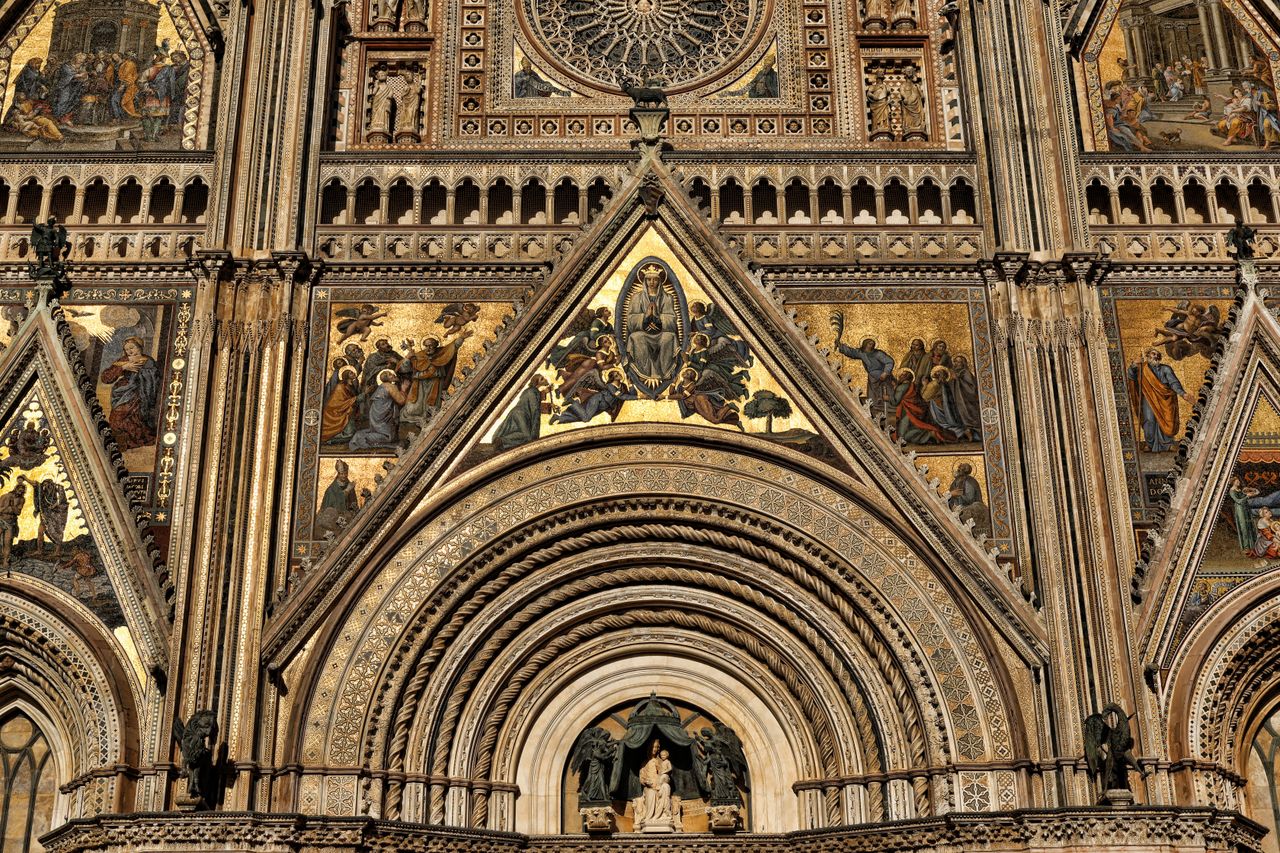
Orvieto is one of the most physically dramatic cities in central Italy. The town sits on a plateau of volcanic tufa rock roughly 400 metres above the valley floor, its sheer cliff faces carved over millennia by the Paglia and Chiani rivers. When you arrive by train at Orvieto Scalo and look up, the cathedral’s golden facade catches the light long before the funicular delivers you to the top. That combination of geology, history, and spectacle makes Orvieto a place that rewards proper guided exploration rather than a quick self-guided walk.
The city’s roots are Etruscan. The ancient settlement known as Velzna — one of the most powerful of the twelve Etruscan city-states — occupied this plateau from at least the 9th century BC. The Romans destroyed it in 264 BC, but the population rebuilt, and the medieval town that stands today is layered directly on top of that earlier civilisation. Much of the Etruscan legacy is literally underground: more than 1,200 caves, wells, tunnels, and chambers have been identified beneath the streets, carved into the same soft tufa on which the city stands.
Above ground, the cathedral (Duomo di Orvieto) is among the finest Gothic churches in Italy. Construction began in 1290 and continued for over three hundred years, with the signature four-panel gold mosaic facade largely the work of Lorenzo Maitani. Inside, the Cappella di San Brizio contains Luca Signorelli’s frescoes of the Last Judgment (1499–1504), which Michelangelo is known to have studied before beginning the Sistine Chapel ceiling. A good guide makes the difference between noticing the individual panels and understanding how radically Signorelli broke with the conventions of his time.
Beyond the cathedral, the Pozzo di San Patrizio (St Patrick’s Well) offers one of the most architecturally inventive underground experiences in Italy, while the surrounding countryside produces Orvieto Classico DOC white wine — worth tasting with context from a local producer. We cover all of these below.
Quick Comparison: Top Orvieto Tours at a Glance
| Tour | Duration | Price (approx) | Best For |
|---|---|---|---|
| Cathedral + Cappella di San Brizio guided tour | 1.5–2 hrs | from €25 | Art history, fresco detail |
| Orvieto Underground (tufa caves) | 1 hr | from €15 | History, geology |
| Pozzo di San Patrizio entry + guide | 45 min | from €15 | Architecture, engineering |
| Combination: Cathedral + Underground + Well | 3–4 hrs | from €35 | Full Orvieto day |
| Orvieto wine tasting + vineyard tour | 2–3 hrs | from €40 | Food and wine |
| Day trip from Rome (Orvieto + Civita di Bagnoregio) | Full day | from €65 | Visitors based in Rome |
| Private walking tour of the historic centre | 2 hrs | from €50 | Tailored pace and interests |
| Truffle hunting + lunch, Umbrian hills | Half day | from €80 | Gastronomy |
Cathedral and Cappella di San Brizio Tours
Duration: 1.5–2 hours | From: approx €25 per person
The Duomo di Orvieto is not a building you can fully absorb without guidance. The facade alone — four vertical bands of mosaic alternating with carved stone reliefs by Lorenzo Maitani — depicts scenes from the Old and New Testaments in extraordinary detail. Maitani’s work on the lower pillar reliefs, particularly the scenes of the damned, shows a psychological intensity unusual for the early 14th century.
Inside, the cathedral divides into a striped Romanesque nave and the famous Cappella di San Brizio on the right transept. Luca Signorelli began his frescoes here in 1499 and completed them by 1504. The cycle — covering the end of the world, the resurrection of the flesh, the damned cast into hell, and the Elect rising to heaven — represents a turning point in Italian Renaissance painting. The foreshortened figures, the anatomical confidence, and the dramatic composition all anticipate Michelangelo’s Sistine ceiling, which was begun just three years after Signorelli finished here. Vasari records that Michelangelo came to Orvieto specifically to study these frescoes.
Skip-the-line entry is worth booking in advance during peak season. Queue times at the ticket office regularly exceed 40 minutes on summer mornings. A licensed guide adds essential context to the iconography and the technical innovations Signorelli introduced.
Browse Cathedral and all Orvieto tours and activities
Orvieto Underground: The Tufa Cave Network
Duration: 1 hour | From: approx €15 per person
Beneath Orvieto’s streets lies an entirely separate city. Over roughly 2,500 years, Etruscans, Romans, and medieval inhabitants carved more than 1,200 chambers, tunnels, cisterns, and passageways into the soft volcanic tufa. The Orvieto Underground guided tour (Città Sotterranea) takes you through a section of this network: medieval olive presses still partially intact, pigeon coops cut into the tufa walls (colombaie — a source of food and fertiliser), wells that descend to the water table, and sections of Etruscan tunnelling that predate Roman occupation entirely.
The tufa maintains a near-constant temperature of approximately 14°C year-round, which made it ideal for food storage and for keeping animals. The guided tour lasts around 45–55 minutes and is the only way to access the caves — independent entry is not permitted. Tours depart from Piazza del Duomo several times daily. The guide explains both the geological formation of the plateau and the layered history of who carved what and why, which is far richer than it sounds.
This is also the most accessible of the underground sites in Orvieto: paths are level and lit throughout. If you have limited time, the underground tour and the cathedral together make a natural morning pairing before lunch on the piazza.
Browse underground cave tours and all Orvieto activities
Pozzo di San Patrizio: The Double-Helix Well
Duration: 45 minutes–1 hour | From: approx €15 per person
Commissioned in 1527 by Pope Clement VII following the Sack of Rome — which left him briefly besieged in Castel Sant’Angelo — the Pozzo di San Patrizio is a feat of Renaissance engineering that has been earning admiration ever since. The problem Clement needed solved was straightforward but urgent: if Orvieto were besieged, the city needed a water supply that could not be cut off. The solution was a well 53 metres deep with 248 steps arranged on two separate spiral ramps, descending and ascending without ever crossing, so that donkeys carrying water barrels could move up and down simultaneously without colliding.
The architect Antonio da Sangallo the Younger designed the double-helix structure. Each ramp has 72 windows opening onto the central shaft, which floods the staircase with natural light at the top and fades gradually to near-darkness at the bottom. The well was named for its resemblance to the cave where St Patrick spent his years of purgatory in Irish legend — the idea being that it descended to another world entirely.
A guide adds value here by explaining the engineering logic of the two-ramp system, the political context of the commission, and the hydraulic mechanism at the base. The descent itself takes about 10 minutes and the view back up the central shaft, with its rings of windows receding into light, is one of the most photogenic moments in any Orvieto itinerary.
Browse Pozzo di San Patrizio tours and all Orvieto activities
Day Trips: Civita di Bagnoregio and the Surrounding Area
Duration: Full day | From: approx €65 per person (from Rome)
Orvieto makes an excellent base for the surrounding Umbrian and Lazio countryside. The most popular day excursion is Civita di Bagnoregio, 15 kilometres to the south: a medieval hilltop village accessible only by a single pedestrian bridge, perched on eroding tufa cliffs that have been slowly collapsing for centuries. The village has fewer than a dozen permanent residents today, and the sight of it at dawn or late afternoon — isolated against the canyon landscape — is genuinely unlike anything else in central Italy.
Organised full-day tours from Rome combining Orvieto and Civita di Bagnoregio are a practical option for visitors without a car. The alternative is to travel to Orvieto independently by train and then hire a taxi or join a small-group shuttle to Civita. Note that Civita charges a pedestrian bridge entry fee (approximately €5 per person).
Orvieto is also within easy reach of Florence (approximately 1.5 hours by train), making it a viable stop on a Florence–Rome journey. Wine tours in the surrounding DOC vineyards can be arranged through local operators and typically include visits to two or three producers with tasting and lunch.
Browse Orvieto day tours and all activities
Orvieto Classico Wine Tours
Duration: 2–3 hours | From: approx €40 per person
Orvieto Classico DOC is one of central Italy’s oldest documented wine appellations. The white wine — made primarily from Grechetto and Trebbiano Toscano grapes grown on the volcanic hillsides around the city — has been produced here since at least the Etruscan period, though the DOC classification dates to 1971. The tufa soil drains quickly and retains heat, producing a wine with relatively high acidity and mineral character. Most versions are dry (secco), though the traditional abboccato (slightly sweet) style still exists at some smaller estates.
Wine tours based in Orvieto typically visit two or three producers, including a cellar walk through underground barrel rooms carved into the tufa, followed by a comparative tasting with local charcuterie and bread. Some tours include a stop at one of the city’s enoteca (wine shops) for a broader overview of regional Umbrian producers — Sagrantino di Montefalco and Torgiano Rosso Riserva are both worth trying if you are spending more than a day in the area.
Transport to the vineyards is usually included when booking through an organised tour operator; the estates are scattered across the hills south and east of the city and are not easily accessible on foot or by public transport.
Browse wine tours and all Orvieto activities
Practical Information
Getting to Orvieto: Orvieto train station (Orvieto Scalo) is on the main Rome–Florence line. Direct Intercity trains from Roma Termini take approximately 1 hour 20 minutes; from Florence around 1 hour 45 minutes. The funicular from the station to the historic centre runs every 10 minutes and costs approximately €1.30 each way. A combined funicular + bus ticket covers onward travel within the town for roughly €2.
When to visit: April to June and September to October offer the best weather and manageable crowds. July and August are hot (temperatures regularly exceed 33°C) and the cathedral queues are at their longest. November to February is quiet and cool; many smaller tour operators reduce their schedules outside peak season.
Tour booking: Most guided tours should be booked 3–5 days ahead in high season. The Cappella di San Brizio has limited daily entry numbers and sells out faster than the rest of the cathedral. The Orvieto Underground tours run several times daily and rarely sell out more than a day ahead, but advance booking guarantees your preferred time slot.
Combining sites: The Carta Unica Orvieto combination ticket covers the cathedral, underground, Pozzo di San Patrizio, and the Museo Nazionale Etrusco and is available at the tourist office on Piazza del Duomo. It costs approximately €25 and is worth it for a full day visit.
Where to stay: See our Orvieto hotels guide for accommodation options in and around the historic centre, including agriturismi in the surrounding vineyards.
City overview: Read our full Orvieto city guide for restaurants, neighbourhoods, and the best approach to planning your time.