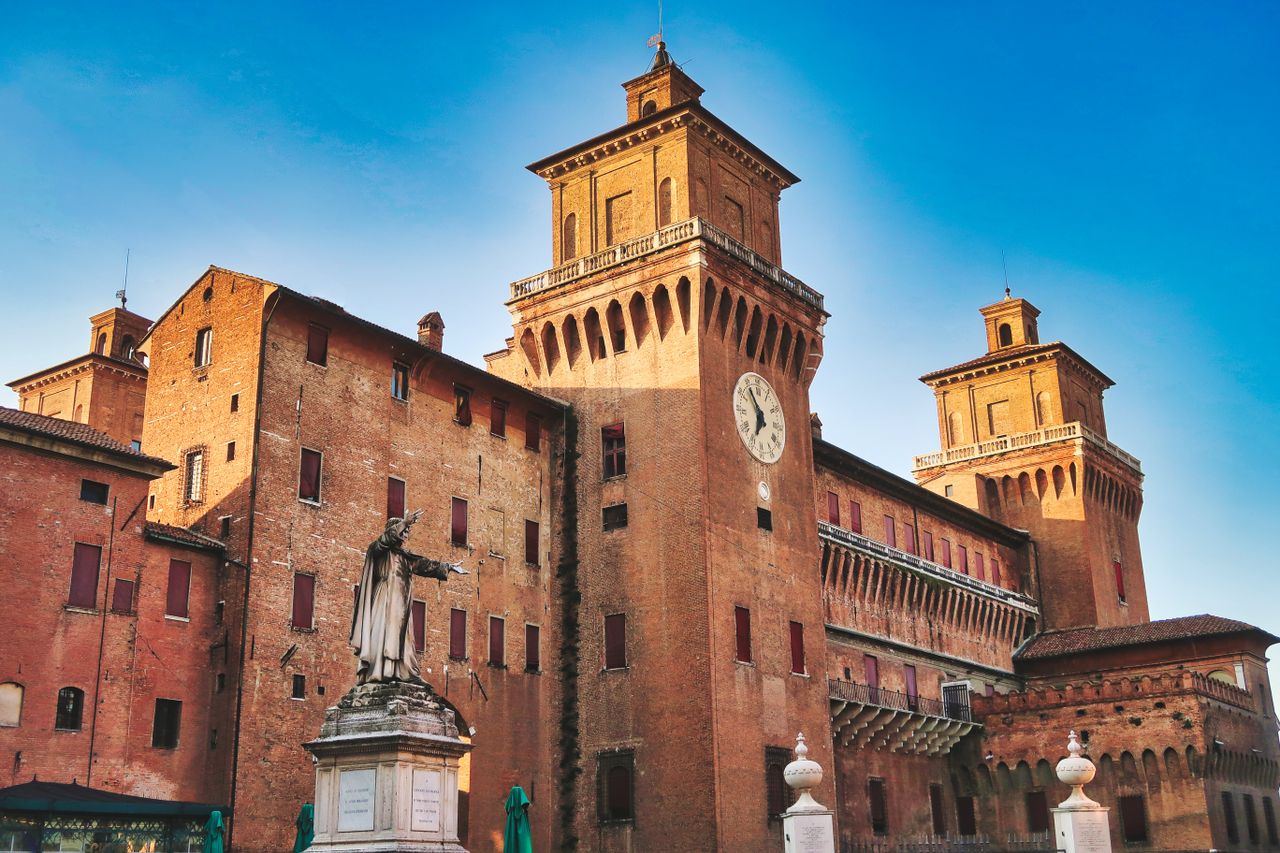
Ferrara sits in the flat Po plain of Emilia-Romagna, 47km north of Bologna and roughly 100km from Venice. Unlike most Italian cities, which grew organically around medieval cores, Ferrara was deliberately expanded in the late 15th century according to a plan by the architect Biagio Rossetti. The northern addition to the city — the Addizione Erculea, commissioned by Duke Ercole I d’Este — is considered one of the earliest examples of Renaissance urban planning in Europe, laid out with straight avenues, regular blocks, and open spaces designed to be legible from above.
Ferrara was the capital of the Este duchy from 1264 to 1598, and the city bears the marks of that dynasty throughout. The Castello Estense, a four-towered moated fortress completed in its main form in 1385, still dominates the city centre. The Palazzo dei Diamanti on the Addizione Erculea — named for its 8,500 diamond-shaped marble blocks cut to catch light at multiple angles — houses the Pinacoteca Nazionale and has one of the most recognisable facades in Italian Renaissance architecture. UNESCO inscribed the historic centre in 1995 and extended the designation to include the Po Delta in 1999.
The literary and artistic connections run deep. Ludovico Ariosto, whose Orlando Furioso (1516) became one of the defining texts of Renaissance literature, worked here at the Este court. Torquato Tasso, author of Jerusalem Delivered, spent time in Ferrara. The Impressionist painter Giovanni Boldini was born here in 1842. The city is also known for its bicycle culture — more bikes per capita than almost anywhere else in Italy — which makes it unusually pleasant to explore on two wheels.
The Po Delta Park begins roughly 30km to the east: 80,000 hectares of wetland, lagoon, and river channels that host flamingos, herons, cormorants, and dozens of migratory species. It is one of the most significant bird habitats in all of Italy and largely unknown outside specialist circles.
Quick Comparison: Top Ferrara Tours at a Glance
| Tour | Duration | From | Best For |
|---|---|---|---|
| Ferrara city walking tour | 2–3 hours | €20 | First-time visitors |
| Castello Estense guided visit | 1.5 hours | €15 | Este dynasty history |
| Ferrara bike tour | 3 hours | €25 | Exploring the full city |
| Renaissance Ferrara private tour | 3–4 hours | €50 | Architecture and art |
| Po Delta birdwatching boat tour | 4–5 hours | €40 | Nature and wildlife |
| Ferrara food tour and tasting | 3 hours | €55 | Local cuisine |
| Bologna and Ferrara combined day trip | Full day | €75 | Visitors based in Venice |
Ferrara City Walking Tour
Duration: 2–3 hours | From: approximately €20 per person
A standard walking tour covers the core of the UNESCO heritage zone: Piazza della Repubblica and the Castello Estense, the Cathedral of San Giorgio (the Duomo), the Palazzo dei Diamanti, and sections of the medieval and Renaissance street network. The contrast between the two halves of the city — the dense medieval streets south of the castle and the planned Renaissance avenues of the Addizione Erculea — is most clearly understood with a guide who can explain what was built when and why.
The Duomo on Piazza della Cattedrale deserves particular attention. The west facade is Romanesque-Gothic, built progressively from the 12th to the 15th centuries, with an unusual arcade of shops built into the base. The tympanum above the central portal depicts the Last Judgement in carved relief. Inside, the standout works are the reliefs depicting the months of the year and a polyptych by Cosmè Tura. A good guide will spend time on these details rather than moving the group too quickly through.
Tours typically last 2 to 3 hours on foot and cover 3 to 4km. The city is almost entirely flat, which makes it accessible regardless of fitness level.
Castello Estense Guided Visit
Duration: 1.5 hours | From: approximately €15 per person
The Castello Estense was built in response to a popular uprising in 1385, when Tommaso da Tortona led a revolt and was killed by the Este lords — the castle was as much a statement of power as it was a defensive structure. Over the following two centuries it was expanded and refined into a court residence without losing its fortress character: the four towers, the moat, and the drawbridges remain intact.
The interior includes the apartments of Lucrezia Borgia (wife of Alfonso I d’Este from 1502), the rooms of Renée of France (daughter of Louis XII, wife of Ercole II), and the dungeons where two family members — Ugo d’Este and his stepmother Parisina Malatesta — were executed in 1425 after an affair was discovered. The story was the basis for literary works by Byron and Donizetti. A guided visit brings this chronology alive in a way that self-guided audio tours rarely match. The rooftop terraces are also accessible and give excellent views across the city’s roofscape.
Book the Castello Estense Tour
Ferrara Bike Tour
Duration: 3 hours | From: approximately €25 per person
Ferrara’s flatness and its well-maintained cycle path network — approximately 100km within the urban area — make a guided bike tour the most efficient way to cover the full city. A typical route links the Castello Estense, the Duomo, the Palazzo dei Diamanti, the broad avenues of the Addizione Erculea, the city walls (a 9km perimeter circuit dating from the 13th to 16th centuries, almost entirely preserved), and the Jewish Ghetto, which was established in 1627 and preserves several synagogues and a museum.
The city walls are a particular highlight on two wheels. The full circuit takes roughly 45 minutes to cycle at an easy pace, with views across the surrounding flat farmland and the bastions visible at regular intervals. Bike tours include bicycle and helmet hire and an English-speaking guide. Group sizes are typically small — 8 to 12 people — which allows the guide to stop and talk at each major site rather than herding the group past. This is a good option even for visitors who have already done a walking tour, as the bike circuit covers different ground.
Po Delta Birdwatching Boat Tour
Duration: 4–5 hours | From: approximately €40 per person
The Po Delta is one of the most overlooked natural sites in northern Italy. The river fans out across roughly 380km² of lagoon, wetland, and channel before reaching the Adriatic, forming a mosaic of habitat types that supports an extraordinary diversity of birds. Flamingos have bred here since the 1990s — colonies of several hundred birds are reliably present at the Sacca di Goro lagoon from spring through autumn. Grey herons, great white egrets, marsh harriers, spoonbills, and numerous wader species use the delta during migration.
Guided boat tours depart from Gorino or Comacchio (approximately 30km from Ferrara) and spend 4 to 5 hours on the water channels with a naturalist guide. The best season is April to May for migrating waders and breeding flamingos, and October to November for wintering wildfowl. Tours include binoculars for hire and field guides. This is a very different experience from the Renaissance city tours and appeals to visitors who want to see the natural side of the Po plain alongside the cultural heritage.
Ferrara Food Tour and Tasting
Duration: 3 hours | From: approximately €55 per person
Ferrara has a distinct local cuisine that owes as much to the Jewish community — one of the oldest in Italy, established here from at least the 13th century — as to the Emilian culinary tradition. Cappellacci di zucca are the signature pasta: large, hat-shaped pockets filled with pumpkin, butter, and nutmeg, served with butter and sage or ragù. Salama da sugo is a cured sausage of pig offal and red wine, compressed and aged for at least a year, then braised and served with mashed potato — a flavour unique to Ferrara. Pampepato is a dense spiced chocolate cake with pepper, candied fruit, and almonds.
Food tours visit the Mercato Comunale, a covered market in the historic centre selling local produce, aged cheeses, and cured meats, then move to a sequence of tasting stops at traditional shops and small restaurants. Guides explain the historical context — particularly the Jewish community’s contributions to the cuisine — and facilitate tastings at each location. This is a good introductory tour for visitors arriving in Ferrara for the first time who want to understand the city through its food before exploring on their own.
Practical Information
Getting there: Ferrara has direct train connections from Bologna (approximately 35 minutes), Venice (approximately 1.5 hours), and Padua (approximately 55 minutes). The train station is approximately 15 minutes’ walk from the Castello Estense, or a short taxi ride.
Getting around: The historic centre is compact and flat. A bike is the most enjoyable way to move between sites. The full city circuit including the walls is approximately 12km — manageable in 3 to 4 hours at a leisurely pace. Walking tours of the core cover roughly 3 to 4km.
When to visit: Ferrara is pleasant year-round. Spring and early autumn are ideal. The Ferrara Buskers Festival in late August is one of the largest street music events in Italy — the city fills considerably, and accommodation prices rise. The Palio di Ferrara (horse race) takes place in late May.
Recommended time: A half day is enough for the main sites. A full day allows the bike circuit, Castello Estense, and a meal. Add a second day for the Po Delta or a cooking class.
See our Ferrara city guide and Ferrara hotels guide for more on planning your visit.