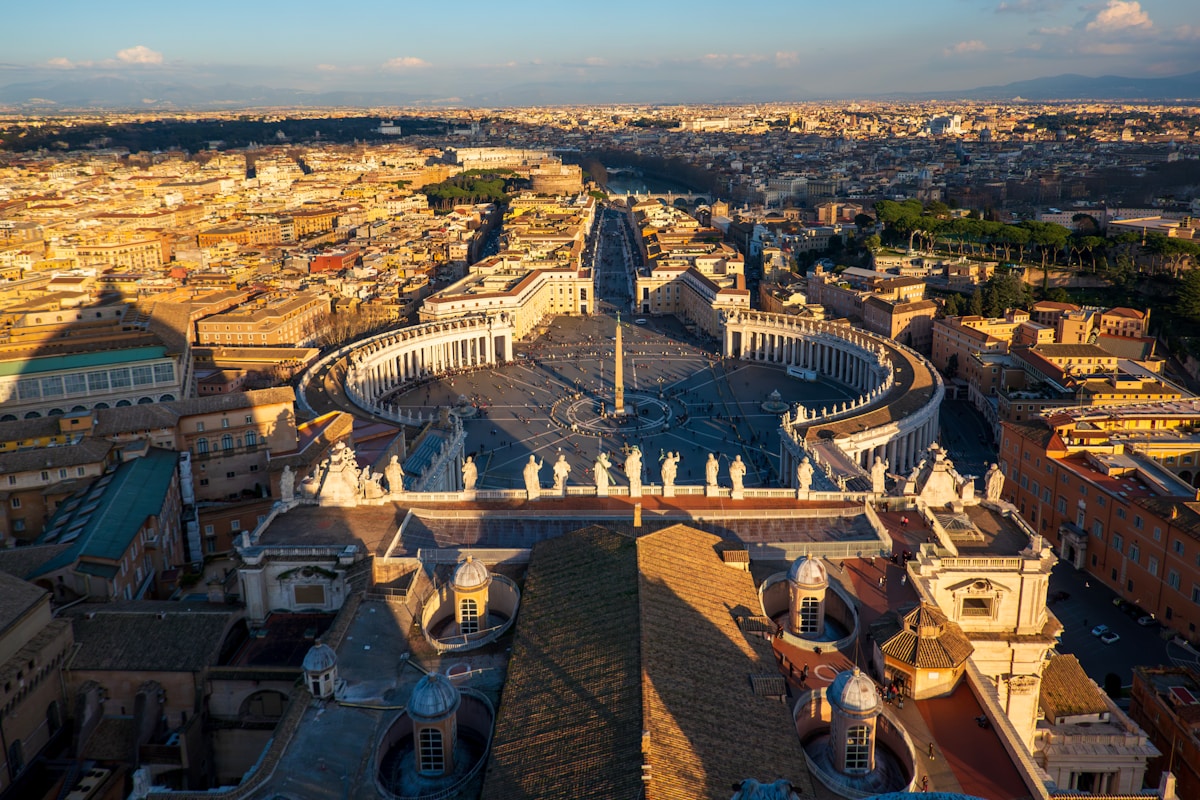
Italy is one of the most accessible destinations in Europe. Multiple international hub airports, extensive rail connections from neighbouring countries, and easy entry for most nationalities make logistics straightforward.
Major airports
Rome Fiumicino (FCO) - Italy’s largest international hub with direct flights from North America (New York, Chicago, Los Angeles, Toronto, Montreal), Asia (Tokyo, Beijing, Dubai), the Middle East, and all major European cities. The Leonardo Express train runs to Roma Termini station every 15 minutes (approximately €14, 32 minutes, as of 2026). The cheaper FL1 regional train runs to Trastevere and Ostiense stations (approximately €8, 30 minutes). Fixed-rate taxis to central Rome cost approximately €50. For a pre-booked private transfer with driver meet-and-greet, Welcome Pickups covers Fiumicino and Ciampino. A second terminal (T3) handles intercontinental flights.
Milan Malpensa (MXP) - The second major international hub with direct flights from North America and Asia. The Malpensa Express train runs to Milano Cadorna (approximately 35 minutes, approximately €13) and Milano Centrale (approximately 50 minutes, approximately €13), as of 2026. The Autostradale bus to Centrale costs approximately €10 (1 hour). Located 45km northwest of Milan.
Milan Linate (LIN) - Smaller, closer to the city. Primarily European and domestic routes. Connected to the city centre by metro M4 (approximately 15 minutes, approximately €2.20).
Venice Marco Polo (VCE) - Serves Venice with European and some intercontinental connections. The Alilaguna water bus runs to the Venice island (approximately €15, 1–1.5 hours depending on route). The ATVO bus to Piazzale Roma costs approximately €10 (30 minutes). Private water taxis to the island cost approximately €110–130.
Naples Capodichino (NAP) - European routes and some seasonal intercontinental flights. The Alibus shuttle runs to Piazza Garibaldi (central station) and the port (approximately €5, 20 minutes, as of 2026). Fixed-rate taxis approximately €16–23 depending on destination.
Pisa Galileo Galilei (PSA) - Major budget airline hub for Tuscany. Ryanair and easyJet operate extensive European networks. The PisaMover automated train connects to Pisa Centrale station (approximately €5, 5 minutes), then trains to Florence (approximately 1 hour, €9). The quickest gateway to Tuscany on a budget.
Bologna Guglielmo Marconi (BLQ) - Efficient small hub with growing European connections. The Marconi Express monorail runs to Bologna Centrale station (approximately €10, 7 minutes). Good entry point for Emilia-Romagna and central Italy.
Bergamo Orio al Serio (BGY) - The main Ryanair hub for the Milan region. Budget flights across Europe. The Autostradale bus to Milano Centrale costs approximately €7 (1 hour). Bergamo’s medieval upper city is worth visiting before continuing to Milan.
Budget airlines serving Italy
Ryanair - The largest budget carrier serving Italy, with bases at Bergamo, Rome Ciampino, Pisa, Bari, Brindisi, Palermo, Catania, Cagliari, and many smaller airports. European flights from approximately €20–50 one-way.
easyJet - Serves Milan Malpensa, Naples, Venice, Pisa, Palermo, and Catania. European flights from approximately €25–60 one-way.
Wizz Air - Serves Milan Malpensa, Rome Fiumicino, Naples, Catania, and Bari. Central and Eastern European connections. Flights from approximately €15–40 one-way.
Vueling - Spanish low-cost carrier serving Rome, Florence, Venice, Milan, Palermo, and Catania. Connections via Barcelona.
Budget airline fares make the south and islands (Puglia, Sicily, Sardinia) directly accessible without premium prices - Bari, Brindisi, Palermo, Catania, and Cagliari all have low-cost services.
By train from Europe
Paris to Milan: Approximately 7 hours by TGV/Frecciarossa (no change needed). Two services daily. Tickets from approximately €30 booked well in advance at trenitalia.com or oui.sncf.
Paris to Turin: Approximately 5.5 hours direct by TGV. Tickets from approximately €25 booked ahead.
Zurich to Milan: Approximately 3.5 hours direct by EuroCity. Tickets from approximately €20 at sbb.ch. Scenic route through the Gotthard Base Tunnel.
Munich to Verona/Milan: Approximately 5–6 hours to Verona, 7–8 hours to Milan via the Brenner Pass. EuroCity services. The alpine scenery through Innsbruck is outstanding.
Vienna to Venice: Approximately 6 hours via Innsbruck and the Brenner Pass. ÖBB EuroCity services.
Overnight trains (ÖBB Nightjet): Munich/Vienna to Rome (approximately 12–15 hours), Milan (approximately 8 hours), and Venice. Couchettes from approximately €40, private cabins from approximately €90. A practical way to save a night’s accommodation while covering long distances.
Barcelona to Milan: Trenitalia/Renfe service via the French Riviera; approximately 11 hours with changes. Better suited as an overnight journey.
By car
Driving to Italy from northern Europe is straightforward via the motorway network. The main Alpine crossings: the Brenner Pass (Austria–Italy via the A22, toll approximately €10), the Gotthard Tunnel (Switzerland–Italy, vignette required for Swiss motorways - approximately CHF 40/year), and the Mont Blanc Tunnel (France–Italy, toll approximately €50 one-way, approximately €60 return). The Frejus Tunnel (France–Italy to Turin) costs approximately €50 one-way.
Italian motorways (autostrade) charge tolls calculated by distance. A toll card (Telepass or Viacard) speeds up payment at toll booths. Expect to pay approximately €20–30 in tolls for a Milan–Florence drive and approximately €40–50 for Milan–Rome.
Visa and entry requirements
EU/EEA citizens: No visa, no border controls under Schengen. Stay as long as you like. National ID card or passport sufficient.
US, UK, Canada, Australia, New Zealand, Japan, South Korea: Visa-free for up to 90 days within any 180-day period (Schengen rules). No registration required for short stays. Passport must be valid for at least 3 months beyond your planned departure date.
ETIAS (EU Travel Information and Authorisation System): An electronic pre-travel authorisation for visa-exempt third-country nationals (US, UK, Canadian, Australian, etc.). Expected to be operational from 2026. Cost approximately €7, valid for 3 years. Check current status at etias.com before travelling.
Digital Nomad Visa: For non-EU nationals wanting to stay beyond 90 days for remote work. Apply through the Italian consulate in your home country. Requires proof of income (minimum approximately €28,000/year), health insurance, and accommodation. Processing takes approximately 30–60 days.
COVID requirements: As of 2026, Italy has no COVID-related entry restrictions. Check the Italian Ministry of Health website for current status before travelling.
For detailed visa information by nationality: Italy visa requirements guide. For flights - best booking strategy, airlines, and airport connections: flights to Italy guide and compare flights to Italy. Once in Italy, for getting between cities: getting around Italy guide — or compare intercity train fares on Omio to book Trenitalia and Italo in one search. For longer stays with a digital nomad visa: Italy Digital Nomad Visa guide. For travel insurance that covers your entry requirements and medical costs: Italy travel insurance guide. For airport-to-city transfers on arrival: private transfers cover all major Italian airports.
Ready to Plan Your Trip?
See our itineraries for inspiration:
- One Week in Italy - seven days through Rome, Florence, and Venice
- 10 Days in Italy - the classic grand tour of Italy’s highlights
- 2 Weeks in Italy - the ultimate two-week Italian itinerary
- 3 Weeks in Italy - the north-to-south grand tour from Milan to Sicily
Plan Your Trip
✈️ Book your flights to Italy 🛡️ Get travel insurance 📱 Stay connected with an eSIM 🚗 Rent a car