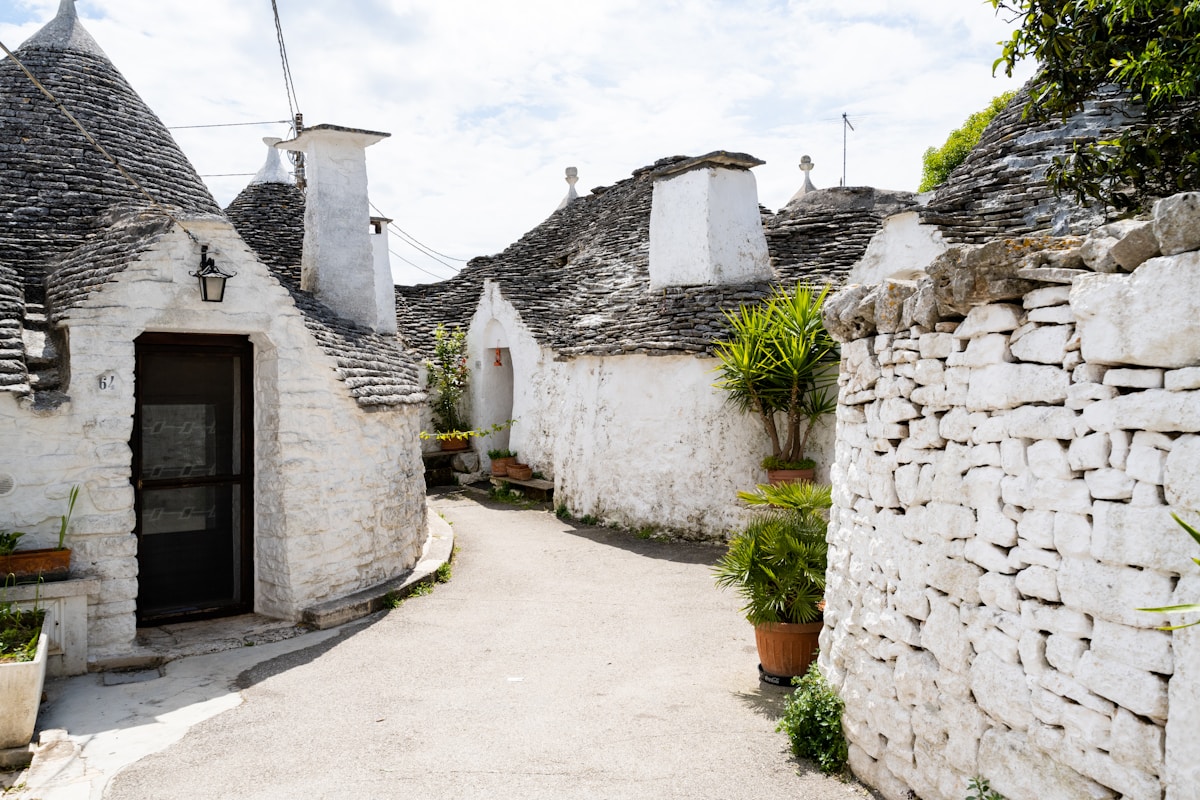
Puglia has the most distinctive accommodation landscape in Italy. Staying in a trullo (a traditional conical-roofed stone house) or a masseria (a converted fortified farmhouse) is as specific to Puglia as staying in a ryokan is to Japan. The combination of the landscape, the food, and these building types creates a completely distinctive travel experience.
Search Puglia hotels on Booking.com to compare prices and check availability across all areas in this guide.
Trulli accommodation (Alberobello and Valle d’Itria)
The trulli - conical stone houses built with dry stone without mortar - are concentrated in the Valle d’Itria (Valley of the Itria river) around Alberobello, Locorotondo, and Cisternino. UNESCO World Heritage Site since 1996.
Alberobello: The most trullo-dense town, with the Rione Monti quarter of over 1,000 trulli. Many of the trulli in this district are rental accommodation. Staying in a trullo in Alberobello gives the most immediate experience of the architecture, though the tourist density in summer is high.
Prices: Trullo rental (self-catering): €80–200/night for a small unit; €150–400/night for a larger complex with pool. Most are rented as complete units rather than individual rooms.
The surrounding Valle d’Itria: Trulli accommodation scattered across the countryside between Alberobello, Locorotondo, and Martina Franca. More private than the Alberobello tourist core. The Airbnb platform has a large selection; specialist agencies including Puglia at Home and Andare in Puglia specialise in this area.
Masseria stays
A masseria is a traditional Pugliese fortified farmhouse - the working farm of the feudal era, with tower, chapel, stone buildings, and walls for protection. The conversion of masserie into agriturismo or boutique hotel properties is Puglia’s distinctive luxury offer.
What to expect: Stone buildings, olive groves, a pool, and usually a kitchen producing local food. The best masserie serve dinner from their own production - olive oil, vegetables, cheese, meat. Many are isolated in the countryside; a car is essential.
Prices: €150–600/night depending on property and season. Half-board is often offered and usually worthwhile.
Notable areas: The Salento (south-east), the Fasano/Monopoli countryside (near Alberobello), and the Gargano promontory (north).
Lecce
The baroque capital of the south - a city stay rather than countryside.
Historic centre: €80–200/night. Several converted baroque palazzos serving as boutique hotels, often with pietra leccese (local limestone) architecture visible throughout. B&Bs in the historic streets are good value.
Top-end (€200–400/night): Patria Palace (one of the finest hotels in Lecce, facing the Santa Croce Basilica), Risorgimento Resort.
Ostuni
The “white city” on a hill above the olive grove plain - 60km north-west of Lecce.
In town (€80–180/night): B&Bs and small hotels in the whitewashed historic centre. Good base for the southern Salento coast.
Masserie around Ostuni: Several well-regarded masserie in the olive grove landscape around the city.
Bari and the Adriatic coast
Bari is the practical hub; the adjacent Adriatic coast towns of Monopoli, Polignano a Mare, and Trani have resort accommodation.
Polignano a Mare: A town built on limestone cliffs above the sea - several boutique hotels in the old city. Famous for the coves accessible from the beach below the cliffs.
Monopoli: A smaller port town with good mid-range options.
Booking tips
- Masserie are often booked directly through their own websites - the major booking platforms don’t carry all of them.
- July–August: All accommodation fills up; book 3–4 months ahead for trulli and masserie.
- May–June and September–October: The best time for Puglia. Temperatures suitable for walking, sea warm in September, prices 25–40% lower than summer.
- A car is essential for the Valle d’Itria, masseria stays, and the smaller coast towns. Bari and Lecce are walkable cities; elsewhere requires wheels.
Named accommodation recommendations
Trulli stays
Trullidea (Alberobello) - A collection of restored trulli in the historic Rione Monti zone. Doubles from approximately €90/night as of 2026. Each unit is a separate trullo with original stone walls and cone ceiling. Kitchen facilities in some units. The best way to experience trullo architecture from inside.
Trulli Holiday (Alberobello) - Several restored trulli with modern amenities in the historic centre. Doubles from approximately €80/night. Pool available at some properties. Book directly for the best rates.
Masserie
Masseria Torre Maizza (near Fasano) - A Rocco Forte property in a fortified 16th-century masseria surrounded by olive groves. Doubles from approximately €350/night as of 2026. Pool, spa, private beach access, golf course. One of the most prestigious addresses in Puglia.
Masseria Il Frantoio (near Ostuni) - A working olive farm with guest rooms in a restored masseria. Doubles from approximately €180/night. The on-site restaurant uses produce from the farm. Olive oil tastings included. A genuine agriturismo experience at a high standard.
Masseria Moroseta (near Ostuni) - A contemporary design masseria - minimalist white architecture set among ancient olive trees. Doubles from approximately €250/night. Pool, organic farm-to-table breakfast. One of the best-designed properties in Puglia.
City hotels
Patria Palace Hotel (Lecce, Piazzetta Riccardi) - A five-star in a 17th-century palazzo in the heart of baroque Lecce. Doubles from approximately €150/night. Rooftop terrace with views over the Basilica of Santa Croce. Excellent location for walking the old city.
Palazzo Ferraioli (Lecce, Via Palmieri 66) - A boutique hotel in a restored palazzo. Doubles from approximately €100/night. High ceilings, original stone, and a courtyard garden. Central location near Piazza del Duomo.
Hotel Oriente (Bari, Corso Cavour 32) - A well-located four-star between Bari Vecchia (old town) and the Lungomare seafront. Doubles from approximately €90/night. Good base for exploring Bari’s old town and the focaccia bakeries.
Coastal stays
Grotta Palazzese (Polignano a Mare, Via Narciso 59) - Famous for its restaurant built into a natural cave above the sea. The hotel rooms are more conventional but well-maintained. Doubles from approximately €200/night. The cave restaurant (dinner only, approximately €100+ per person) is a once-in-a-lifetime experience.
Covo dei Saraceni (Polignano a Mare, Via Conversano 1) - A four-star on the cliff edge with direct sea views. Doubles from approximately €150/night. Pool and terrace overlooking the Adriatic.
Plan your trip:
- Browse tours and day trips from Bari across Puglia
- Book a hire car - essential for Puglia’s hilltowns
- Get travel insurance before you book
- Pick up an eSIM for Italy
- Search hotels in Puglia on Booking.com
For a zone-by-zone breakdown with specific properties and practical booking timing advice: where to stay in Puglia.
Getting to Puglia
Bari Karol Wojtyla Airport (BRI) has direct flights from most European cities via Ryanair, easyJet, and Wizz Air. The Alibus shuttle runs to Bari Centrale station (approximately €5, 20 minutes). Brindisi Airport (BDS) serves the southern Salento area. Both airports have car rental desks. Alternatively, the Frecciarossa from Rome reaches Bari in approximately 4 hours (from approximately €30 booked ahead).
For city-specific accommodation: Bari hotels and Lecce hotels cover options in each city. For planning a full Puglia circuit: Puglia itinerary maps 7 days from Bari to Lecce with day-by-day hotel recommendations. For the food to pair with your stay: Pugliese food guide covers orecchiette, burrata, and where to eat well across the region. For comparing Puglia with Sicily: Puglia vs Sicily guide.
Ready to Plan Your Trip?
See our itineraries for inspiration:
- Puglia Itinerary - seven days through Italy’s heel
- Southern Italy Itinerary - ten days from Naples to Sicily
- 3 Weeks in Italy - the north-to-south grand tour from Milan to Sicily
- 2 Weeks in Italy - the ultimate two-week Italian itinerary