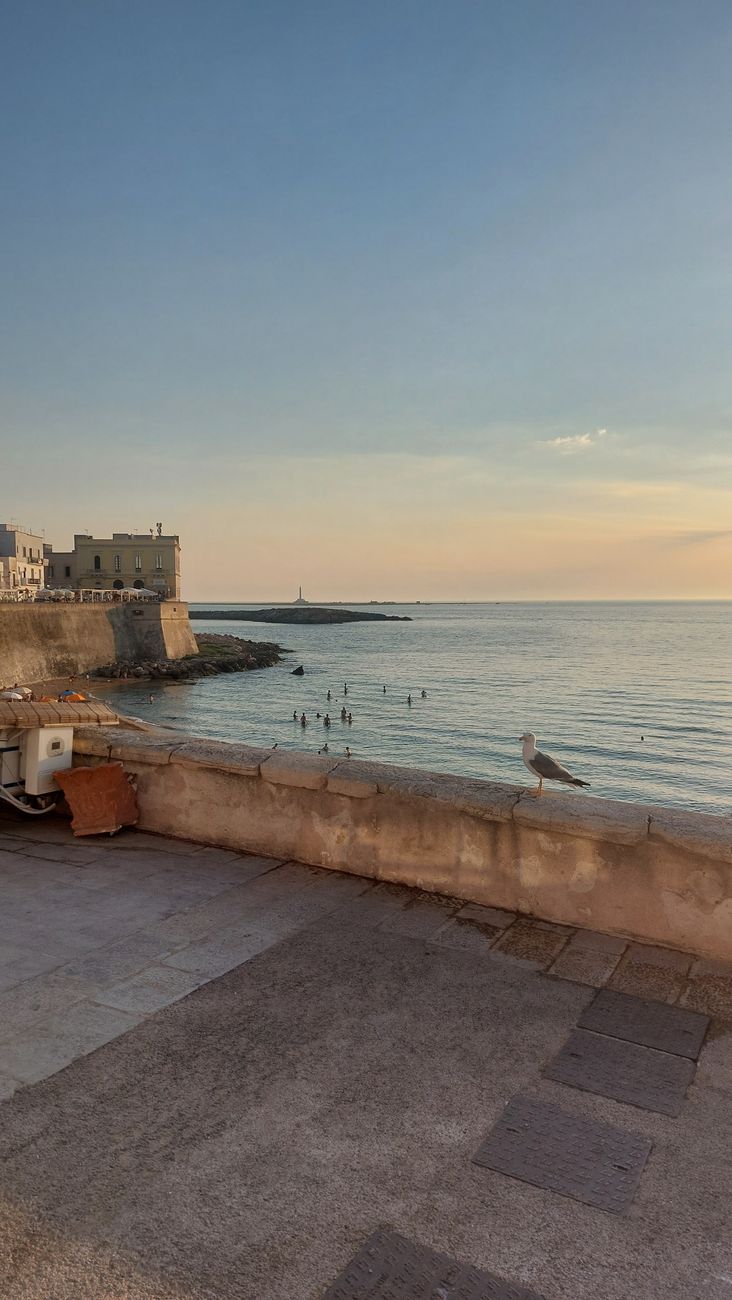
Gallipoli — not to be confused with the Dardanelles campaign — is one of Puglia’s most striking coastal towns: a medieval island connected to the mainland by a narrow bridge and virtually surrounded by the Ionian Sea. The old town’s whitewashed baroque buildings, the 17th-century cathedral, the fish market on the seafront, and the Greek fountain (one of the oldest in Italy) are the reasons to visit. The surrounding Salento coast — the turquoise Ionian with pale sand beaches extending in both directions — is among the finest in southern Italy. The combination of historic island and beach access makes Gallipoli one of Salento’s most complete bases.
Search Gallipoli hotels on Booking.com to compare prices and check availability across all areas in this guide.
Old Town Island — The Medieval Centre
The island old town is a self-contained world: one bridge connects it to the mainland, and the streets inside are narrow, whitewashed, and largely pedestrianised. It’s the most distinctive part of Gallipoli and the most rewarding for a slow stay.
Pros: Wake up inside the medieval island. The morning fish market is on your doorstep. The evening — after the day-trippers from Lecce leave — is quiet and atmospheric. The sea is visible from many streets. The cathedral baroque facade is one of the best in Salento.
Cons: Limited parking (the island is pedestrian-only inside the walls; you park on the bridge or in the new town). Accommodation options are fewer in number than the new town. In high season the streets are crowded during the day.
Budget (€70–110/night): B&Bs in the island’s lanes offer basic rooms in historic buildings. Several family-run guesthouses operate in the streets around the cathedral and the seafront. Check recent reviews on platforms — quality varies considerably in this segment, but the best budget options in the old town offer excellent value for the location.
Mid-range (€110–200/night): Palazzo del Corso (Corso Roma 145, the old town’s main street) is the island’s most polished mid-range option — a boutique property in a converted historic palazzo with contemporary-styled rooms and a small rooftop area; doubles from approximately €120–190/night as of 2026. Relais Corte Palmieri (Corte Palmieri 2) is a restored historic palazzo with courtyard; doubles from approximately €100–160/night as of 2026.
Boutique/Luxury (€200–350/night): Several refined B&B-style guesthouses in the island’s best buildings have recently upgraded to a higher standard; look for properties with rooftop terraces or sea-facing rooms. The best command prices from €200–280/night in peak summer.
New Town — The Peninsula
The new town extends south of the bridge across a peninsula and along the coast toward Baia Verde. It has more hotels, better car parking, and direct beach access — the tradeoff is a more ordinary atmosphere.
Beach hotels and resorts: A strip of hotels and residences lines the coast from Lido San Giovanni (just north of the old town) south through Baia Verde to Rivabella. These range from basic two-stars to well-equipped four-star beach resorts with pools. Rates in peak August reach €200–300/night at the better properties; considerably less in June and September.
Budget/chain hotels: Several guesthouses and small hotels in the new town from approximately €60–90/night offer straightforward accommodation with the advantage of easier parking.
Plan your trip:
- Browse tours in Gallipoli and the Salento
- Book an airport transfer
- Get travel insurance for Italy
- Pick up an eSIM for Italy
- Search hotels in Gallipoli on Booking.com
Practical notes
- Book summer well ahead. Gallipoli in August is one of the most visited resort towns in southern Italy. Old town B&Bs with limited inventory fill in May/June for summer dates.
- Car parking. The island is pedestrian-only inside. Parking on the approach bridge (Via Antonietta De Pace) or in the new town is the normal arrangement. Your hotel will advise on the nearest car park.
- Lecce as a dual base. Lecce is 37 km east of Gallipoli — an easy drive or bus ride. Some visitors base themselves in Lecce (better restaurant options) and day-trip to Gallipoli and the Salento coast. Both arrangements work well.
- September is the best month. The sea is at its warmest (around 25°C), the crowds have thinned, prices drop, and the old town is at its most atmospheric. Anyone with flexibility should target this window.
The Gallipoli travel guide covers the island old town, the Salento beaches, and the fish market. For day trips: day trips from Gallipoli covers Otranto, Santa Maria di Leuca, and the Adriatic coast.