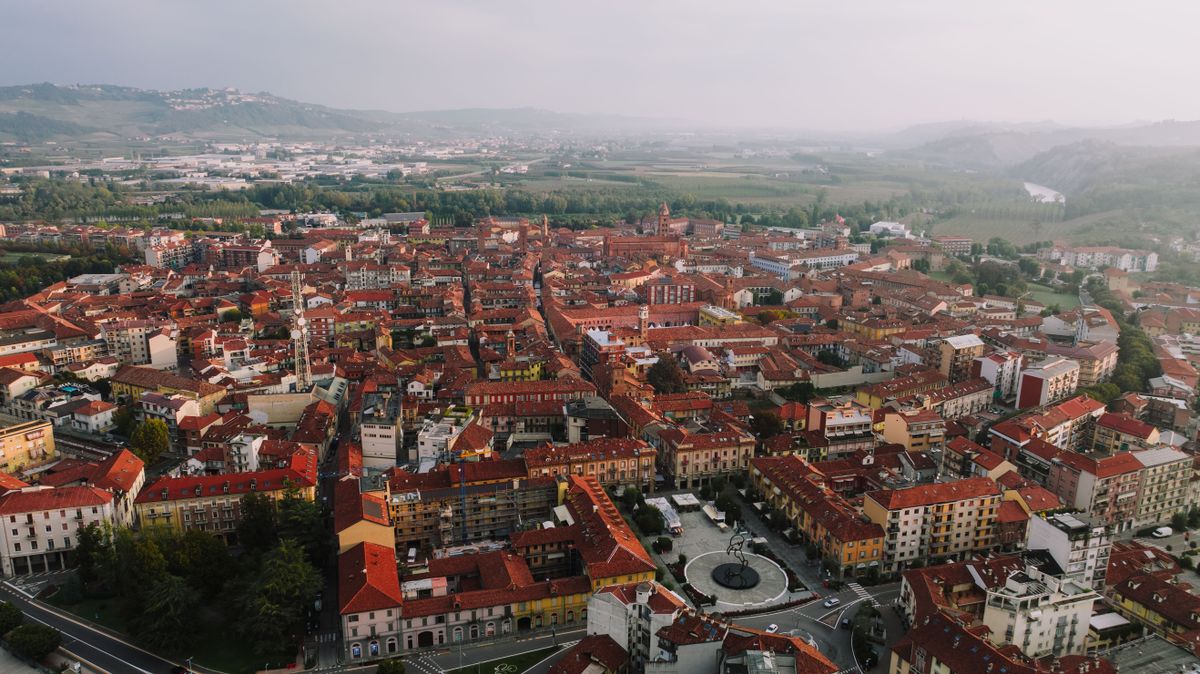
Alba is Piedmont’s gastronomic capital — a compact medieval city of towers, cobbled streets, and an outsized concentration of serious restaurants and wine bars. The centro storico, enclosed within its old walls, has a scale that rewards slow exploration: the Cattedrale di San Lorenzo, the Renaissance church of San Giovanni, and a main piazza that serves as the town’s living room at aperitivo hour. The real draw, though, is the landscape surrounding it: the Langhe hills are among the most beautiful in Italy, and Barolo, Barbaresco, and the white truffle are all produced within easy reach of the city.
Search Alba hotels on Booking.com to compare prices and check availability across all areas in this guide.
Centro Storico — Inside the Old Walls
Alba’s historic centre is compact — roughly 600 metres across — and almost entirely pedestrianised. Via Vittorio Emanuele II runs as the main spine from Piazza Savona south through the medieval core to Piazza Risorgimento, passing most of the principal churches, the truffle fair site, and the best restaurants. Hotels here are in converted historic buildings: old merchant houses, tower buildings, and palazzo structures that have been adapted with modern amenities.
Pros: Everything in Alba is within walking distance. The truffle market and main restaurants are steps away. The medieval towers and Duomo are central landmarks. The general atmosphere of a prosperous Piedmontese market town — good food, good wine, unhurried pace — is strongest here.
Cons: Limited parking inside the walls (your hotel can advise on ZTL permits and designated car parks just outside). Room availability is tightly constrained, especially in October.
Budget (€65–100/night): B&Bs and small guesthouses operate in the side streets off the main pedestrian spine. Locanda del Pilone and similar family-run options offer clean, simple accommodation with the benefit of central location. Expect basic rooms, sometimes with shared facilities, at approximately €65–85/night as of 2026. For self-catering, several apartments in the historic centre offer flexibility at similar prices.
Mid-range (€100–170/night): Hotel Savona (Via Roma 1, directly on Piazza Savona) is Alba’s most centrally positioned three-star, with well-maintained rooms, professional staff, and a location that puts you at the edge of the pedestrian zone. Doubles from approximately €110–150/night as of 2026. Hotel Langhe (Via Nino Bixio 10, just outside the historic walls) offers comfortable four-star facilities at competitive rates; doubles from approximately €100–145/night as of 2026; good for guests with a car.
Luxury (€180–300/night): Hotel Palazzo Finati (Via Vernazza 8, in the heart of the centro storico) is a boutique property occupying a restored 19th-century palazzo — 10 individually decorated rooms, exposed stone and brick, and the finest location in the city for exploring on foot; doubles from approximately €180–260/night as of 2026. This is the address for truffle season celebrations and special occasions.
Langhe Hills — Agriturismo and Vineyard Hotels
The hills surrounding Alba — the Langhe DOC zone — have a concentration of agriturismo and wine-estate accommodation that ranges from simple farmhouse B&Bs to five-star properties with panoramic vineyard terraces.
What to expect: Most are 10–25 minutes from Alba by car. You get views, quiet, and the experience of sleeping among the vines. The trade-off is that you need a car for everything, including dinner in Alba. Most agriturismo offer meals, but restaurant quality varies significantly.
Budget end (€80–120/night): Simple agriturismo in working farms — clean rooms, local breakfast (wine sometimes included), and views that would cost three times as much in Tuscany. The roads between La Morra, Castiglione Falletto, and Neive have the highest concentration.
Mid-range (€130–220/night): Wine estates with properly designed rooms, a pool, and access to estate tastings. The area around Barbaresco village and the slopes below La Morra have established options with consistently strong reviews.
Luxury (€220–400+/night): The top tier includes properties with Michelin-affiliated restaurants, extensive wine cellars, and spa facilities — places where the landscape and the food are as much the point as the room. Relais San Maurizio (near Santo Stefano Belbo) and Boscareto Resort (Serralunga d’Alba) are among the most celebrated options in this category as of 2026.
Plan your trip:
- Browse tours and experiences in Alba
- Book an airport transfer
- Get travel insurance for Italy
- Pick up an eSIM for Italy
- Search hotels in Alba on Booking.com
Practical booking notes
- Truffle season (October–November) is a different market. Book early, accept that prices are non-negotiable, and plan multiple nights — the fair circuit, the surrounding villages, and the culinary calendar are worth lingering for.
- Car essential for Langhe exploration. Alba itself is walkable, but the wine villages, viewpoint roads, and countryside restaurants require a car or organised tour.
- Wine tour base value. Alba is better placed than Turin or Milan for intensive Barolo and Barbaresco itineraries — the drive is shorter, the evening returns are more practical, and the local restaurant scene after a day in the vineyards is excellent.
- Parking. Large car parks are located just outside the historic walls (Piazza Medford, Largo Bra). Most hotels can advise; those inside the walls arrange ZTL permits for check-in/check-out.
The Alba travel guide covers the truffle fair, the wine estate circuit, and the best restaurants. For day trips into the Langhe: day trips from Alba covers Barolo village, Neive, and the Barbaresco tower walk.