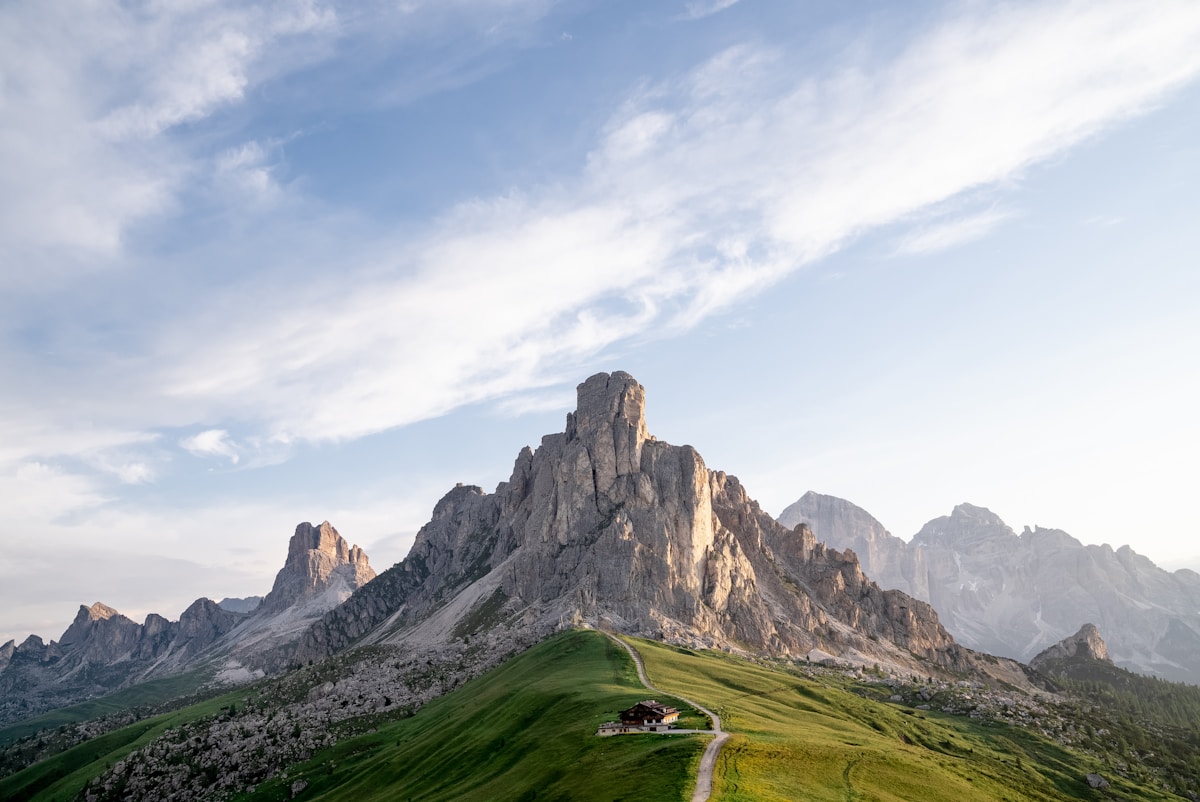
Cortina d’Ampezzo is Italy’s highest-profile mountain resort, set in a wide valley at 1,224m in the Dolomites of Belluno province, Veneto. It hosted the 1956 Winter Olympics and parts of the 2026 Winter Olympics. What makes it stand out from other alpine resorts is the quality of the surrounding mountain scenery — the Dolomite rock formations are a UNESCO World Heritage site, and several of the most iconic formations in the range are within 30 minutes of the town.
Activities divide cleanly by season, and the two versions of Cortina — summer hiking destination and winter ski resort — attract different types of visitor.
Summer Activities (June to September)
Summer is arguably the better season for first-time visitors who want to understand the Dolomites’ landscape. The cable cars still run, the rifugi (mountain huts) are open, and the hiking trails are clear from late June through to early October.
Cinque Torri: The Most Accessible Viewpoint
The Cinque Torri (Five Towers) at 2,361m is the easiest way to reach dramatic Dolomite scenery from Cortina without serious hiking. A chairlift departs from the SP48 road near Bai de Dones, approximately 7km from the town centre, and reaches the base of the five rock towers. The return fare is approximately €16 as of 2026.
From the chairlift top, a short walk reaches the rock towers themselves — freestanding vertical columns of dolomite that photographers and climbers favour. Trails from the summit connect to an unexpected attraction: the preserved WWI trench warfare ruins from when Cortina sat on the Italian-Austrian front (1915–17). The trenches, tunnels, and artillery positions are maintained as an open-air museum with interpretation boards. A full circuit of the towers and war ruins takes 3–4 hours at a comfortable pace. The rifugio at the base serves hot food and drinks.
Tre Cime di Lavaredo: The Dolomites’ Signature Hike
The Tre Cime di Lavaredo — three near-vertical rock towers rising above 2,900m — are the most photographed formation in the entire Dolomite range, and they are 30 minutes from Cortina by car. Take the SS48bis road towards Misurina (11km east), then the toll road from Misurina to Rifugio Auronzo at 2,333m. The toll is approximately €30 per car in summer 2026.
The classic loop trail (5.5km, approximately 2 hours walking) circles the three peaks, passing the north face — the steepest and most dramatic side — as well as the Rifugio Lavaredo and Rifugio Locatelli, both serving simple mountain food. We recommend arriving before 8am: by 10am the car park is full and the trail becomes crowded with day visitors. Summer buses from Cortina run to Misurina and some continue to Rifugio Auronzo — check Bus Dolomiti schedules seasonally.
Lake Misurina itself (1,754m, 11km from Cortina) is worth a stop on the way back: a high-altitude lake with reflections of the Sorapiss and Cadini di Misurina peaks.
Freccia nel Cielo: Highest Viewpoint by Cable Car
The Freccia nel Cielo (Arrow in the Sky) is a three-stage cable car rising from the edge of Cortina to 3,244m on Tofana di Rozes — the dominant peak above the town. The return ticket is approximately €38 as of 2026, and the car runs mid-July to mid-September depending on conditions.
The summit panorama extends in clear conditions to the Marmolada glacier (the Dolomites’ only true glacier, currently retreating significantly) and across multiple mountain groups. Layers are essential: the temperature difference between town and summit is typically 15–20°C.
Lake Ghedina and the Town
Lake Ghedina, 2km west of the centre, is a small glacial lake accessible on foot or by car — free to visit, good for reflection photography of the surrounding peaks. Allow 30 minutes.
The town centre merits a walking circuit of 1–2 hours. Corso Italia, the main pedestrian street, is lined with high-end outdoor and fashion shops and has good cafes. The church of Santi Filippo e Giacomo has a baroque interior worth a 15-minute visit (free entry). The town’s sport shops — several are on or near the corso — rent bikes, hiking poles, and climbing equipment.
Winter Activities (December to March)
Skiing: Dolomiti Superski
Cortina’s ski area is part of the Dolomiti Superski pass network, the world’s largest connected ski circuit with 1,200km of pistes across 12 Dolomite valleys. Three ski areas directly adjoin the town: Tofana (largest), Faloria, and Cristallo. The areas are not all ski-connected to each other — some require a ski bus or car between sectors.
A day pass for Cortina’s local ski area costs approximately €55–65 in high season (Christmas, February). A 7-day Dolomiti Superski pass, giving access to all 12 areas, runs approximately €310–380 in peak season. Equipment rental from the many ski hire shops in town costs approximately €35–50 per day for a standard ski set.
The 2026 Winter Olympics brought upgrades to some lifts and runs, improving capacity on the busiest sectors.
Ice Skating at the Olympic Ice Rink
The Pista Olimpica di ghiaccio — the Olympic ice rink in the town centre, originally built for the 1956 Games — is open to public skaters during periods between competitions and events. Admission is approximately €8; skate hire approximately €10. Check the seasonal schedule via the Cortina sports consortium (Cortina Funivie) website before visiting, as competition bookings reduce public sessions.
Sledging and Snow Activities
Sports shops in Cortina rent sleds for approximately €20 per day. Several marked sledging runs operate near the resort’s lower slopes. The historic bobsled run (used for 2026 Olympic bobsled events) is a competition venue and is not open to the public.
Snowshoeing is possible on several marked trails — hire snowshoes from sports shops (approximately €15/day) and the tourist office has maps of recommended routes in the valley.
Getting to the Starting Points
Most summer trailheads and cable car stations require a car or summer shuttle. Cortina is 166km from Venice (approximately 2 hours by car via the A27 motorway and SS51), 98km from Bolzano (approximately 1h45), and 157km from Verona (2h30). From Cortina town, it is 7km to the Cinque Torri chairlift, 30km to Rifugio Auronzo for the Tre Cime di Lavaredo, and 6km to the Falzarego pass.
Where to stay in Cortina d’Ampezzo: Find hotels in Cortina d’Ampezzo — search accommodation across all budgets.