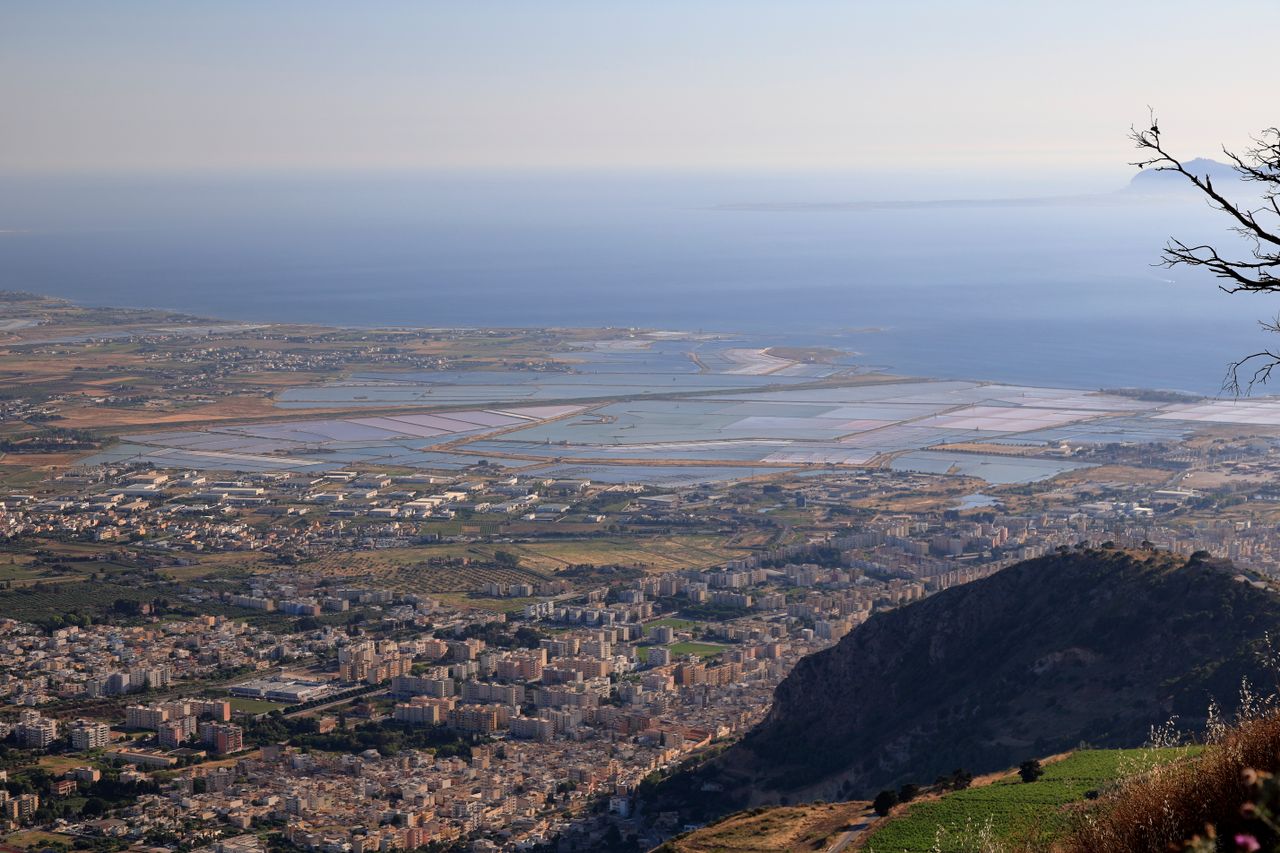
Trapani sits at the extreme western tip of Sicily on a narrow sickle-shaped promontory that points toward Tunisia, not Rome. The city faces Africa — Tunis is closer than Palermo — and that geographical fact explains almost everything about its food, its salt trade, and the layered history that makes it one of the most distinctive places to explore in the entire island. The salt pans stretching south toward Marsala have been worked continuously since Phoenician times. The Egadi Islands, visible on clear days from the waterfront, were the site of the 241 BC Battle of the Egadi, the naval engagement that ended the First Punic War and established Rome’s dominance in the western Mediterranean. The hilltop town of Erice, perched at 750 metres above the plain and connected to Trapani by cable car, preserves a medieval street plan, a Norman castle, and a reputation for almond pastries so established it borders on civic identity.
We have put together this guide to help you decide which tours actually make the most of Trapani’s geography and heritage. The city rewards visitors who reach beyond its handsome Baroque centre: the salt pans at golden hour, a boat that threads between the Egadi Islands’ sea caves, a cellar in Marsala where you taste wine made to a recipe unchanged since 1796. The tours below cover all of that, with practical detail on duration, price, and where they meet.
Quick Comparison: Top Trapani Tours at a Glance
| Tour | Duration | From | Best For |
|---|---|---|---|
| Salt Pans and Windmills Sunset Walk | 3 hours | approx €18 | First-timers, photographers |
| Erice Cable Car and Old Town Tour | 5 hours | approx €38 | History, views, pastry lovers |
| Egadi Islands Full-Day Boat Trip | 8–9 hours | approx €65 | Swimming, island-hopping |
| Favignana and Levanzo Snorkel Tour | 7 hours | approx €55 | Snorkelling, marine history |
| Marsala Wine and Motya Phoenician Island | 6 hours | approx €50 | Wine, archaeology |
| Trapani Old Town Walking Tour | 2.5 hours | approx €22 | Orientation, city architecture |
| Sicilian Couscous Cooking Class | 3.5 hours | approx €65 | Food culture, hands-on |
| Selinunte and Segesta Greek Temples Day Trip | 9 hours | approx €45 | Ancient history |
For First-Timers
Salt Pans and Windmills Sunset Walk
Duration: 3 hours | From: approx €18 per person
The salt pans of the Saline di Trapani e Paceco Nature Reserve extend in a broad, shallow plain between Trapani and Marsala, punctuated by restored windmills that were used for centuries to pump seawater between the evaporation basins. In the right light — and at sunset in particular — the pans turn deep rose and orange, a reflection of the salt crystals and the brine algae that colour the water. This tour walks through the reserve with a guide who explains the harvesting cycle, which still runs from May through September. The salt is raked by hand and piled into small white pyramids, sometimes covered with terracotta tiles against the rain, a sight that looks more like coastal Tunisia than anywhere else in Europe.
The route passes the Museo del Sale at Nubia, a small museum inside an old salt mill that traces the history of salt production from Phoenician times to the present. In season — typically March through November — pink flamingos feed in the shallow pans alongside other wading birds. The walk is level throughout and suitable for all fitness levels. Most tours depart from Piazza Saturno and include transport to the reserve. Binoculars are worth bringing.
Trapani Old Town Walking Tour
Duration: 2.5 hours | From: approx €22 per person
Trapani’s historic centre is compact — barely 700 metres from the western tip of the promontory to the main piazza — but it contains a dense sequence of Baroque churches, Arab-Norman alleyways, and seafront bastions built under Spanish Habsburg rule. This walking tour covers the Cathedral of San Lorenzo (Piazza Saturno, 17th to 18th century Baroque), the church of Santa Maria del Gesù, and the seafront Bastione Conca. Guides explain why Trapani’s street names, its fish-based couscous, and its walled old medina-style quarter reflect eight centuries of Arab administration that lasted here long after the Norman conquest of 1071.
The tour typically ends at the daily fish market near the port, where swordfish, tuna offcuts, and fresh sardines are sold beside stalls offering arancine and sfincione. The guide can point you to the best spots for cuscus al pesce — the fish couscous that is Trapani’s most authentic dish — or granita made with almond milk pressed from locally grown almonds from the Agrigento interior.
For History and Culture Lovers
Marsala Wine and Motya Phoenician Island
Duration: 6 hours | From: approx €50 per person
Marsala, 30 kilometres south of Trapani, is two places in one: the birthplace of a fortified wine that changed British drinking habits in the 1790s, and the gateway to the most significant Phoenician site in Sicily. The wine came first — an English merchant named John Woodhouse arrived in 1796, discovered that adding grape spirit before fermentation preserved the wine for long sea voyages, and built a trade that made Marsala famous across the British Empire. Today producers including Florio, Pellegrino, and Marco De Bartoli continue the tradition; cellar visits typically include three to five tastings and an explanation of the solera-influenced aging process.
From the Marsala waterfront, a short boat ride crosses the Stagnone lagoon to the Isola di San Pantaleo, the ancient Phoenician city of Motya (also spelled Mozia). Founded around the 8th century BC, Motya was one of the western Mediterranean’s most powerful Phoenician trading posts until its destruction by Dionysius I of Syracuse in 397 BC. The archaeological museum on the island houses the Giovinetto di Mozia, a 5th-century BC marble youth in a fine pleated garment that may have been created by a Greek sculptor working to Phoenician commission — one of the most debated and visually striking ancient sculptures in Sicily. The Museo Regionale Lilibeo in central Marsala displays a remarkably preserved 3rd-century BC Punic warship, the only physical evidence of the fleet that fought at the Egadi Islands.
Erice Cable Car and Old Town Tour
Duration: 5 hours | From: approx €38 per person
Erice rises to 750 metres above the plain east of Trapani, a medieval hilltop town of Norman and Aragonese churches, cobbled alleys, and views that, on clear days, reach across to Tunisia and the Egadi Islands simultaneously. The Funivia dell’Erice cable car departs from the Trapani outskirts and reaches the summit in around 10 minutes; the journey itself, rising sharply above the salt plain and the coast, is part of the experience. Tours typically include the cable car, a guided walk through the old town, and time at the Castello di Venere — a Norman castle built over the ancient Temple of Venus (Aphrodite) that gave the mountain its sacred reputation across the Phoenician and Roman Mediterranean.
The Church of the Assumption (14th century, built by the Aragonese) and the Giardino del Balio gardens beside the castle are standard stops. The guide explains how Erice remained a semi-autonomous community with its own dialect and traditions throughout centuries of conquest — the pastry shops still sell the almond-filled genovesi pastries invented here, reportedly by the nuns of the local convent. Budget time for a coffee and a pastry at one of the old town cafés before the cable car descent.
For Sea and Islands
Egadi Islands Full-Day Boat Trip
Duration: 8–9 hours | From: approx €65 per person
The Egadi Islands — Favignana, Levanzo, and Marettimo — lie between 15 and 30 kilometres off the Trapani coast, and a full-day boat tour visits at least two of them with time for swimming in water that ranks among the clearest in the central Mediterranean. Favignana, the largest and closest, was for centuries the centre of the mattanza: a ritual communal bluefin tuna hunt using elaborate nets, a practice with roots in Arab and Phoenician fishing techniques that continued until its prohibition in the early 2000s as tuna stocks collapsed. The former tuna factory (Stabilimento Florio) is now a museum; the guide explains the mattanza in detail, including the complex social hierarchy of the tunnaroti fishermen and the almost ceremonial nature of the kill.
Levanzo, the smallest inhabited island, is worth visiting for the Grotta del Genovese, a sea cave that contains some of the finest Neolithic and Upper Palaeolithic rock art in Italy — engravings and paintings of deer, horses, oxen, and human figures dating from around 10,000 to 6,000 BC. Access to the cave requires a separate local guide booking in advance. Marettimo, the furthest island (30km), is the wildest, with walking trails through macchia and sea caves accessible only by boat.
For Food Lovers
Sicilian Couscous Cooking Class
Duration: 3.5 hours | From: approx €65 per person
Trapani’s claim to the most distinctively North African food tradition in Italy rests on cuscus al pesce — couscous steamed over a fish broth made with rockfish, prawn heads, and sea bass, then finished with a concentrated fish stew poured over the top. The dish arrived with the Arab population that administered western Sicily from the 9th century and never left; it appears on every traditional menu in the province. This cooking class, run in a domestic kitchen in the old town, teaches you to prepare the couscous by hand in the traditional manner — rubbing semolina with water and olive oil to form the tiny grains, then steaming it in a cuscusiera (a clay pot with a perforated lid) over the bubbling broth.
You also prepare tonno in agrodolce (sweet and sour tuna with capers, olives, and vinegar), a dish that appears across western Sicily and reflects both the Arab sweet-sour spice tradition and Trapani’s role as a major tuna fishing port. The class ends with the meal, which includes local wine. Group sizes are typically limited to eight people, giving you genuine access to the cooking process rather than a demonstration.
Practical Information
Getting to Trapani: Trapani Birgi Airport (TPS) receives seasonal flights from several northern European and Italian cities. Regular Trenitalia services connect Trapani to Palermo (approximately 2 hours). Buses serve Trapani from Palermo, Agrigento, and Marsala.
Best time for tours: April to June and September to October offer the most reliable weather with smaller crowds than July and August. The salt pans are most photogenic in late afternoon light between May and October. Boat trips to the Egadi Islands run from April to October; winter crossings are infrequent and weather-dependent.
What to bring on boat trips: Sun protection, swimming kit, a towel, and sea shoes are recommended. Some boats supply snorkelling equipment; confirm at booking.
Currency: Cash is useful for the fish market, small pastry shops, and some local guides. Card payment is accepted at most tour operators.