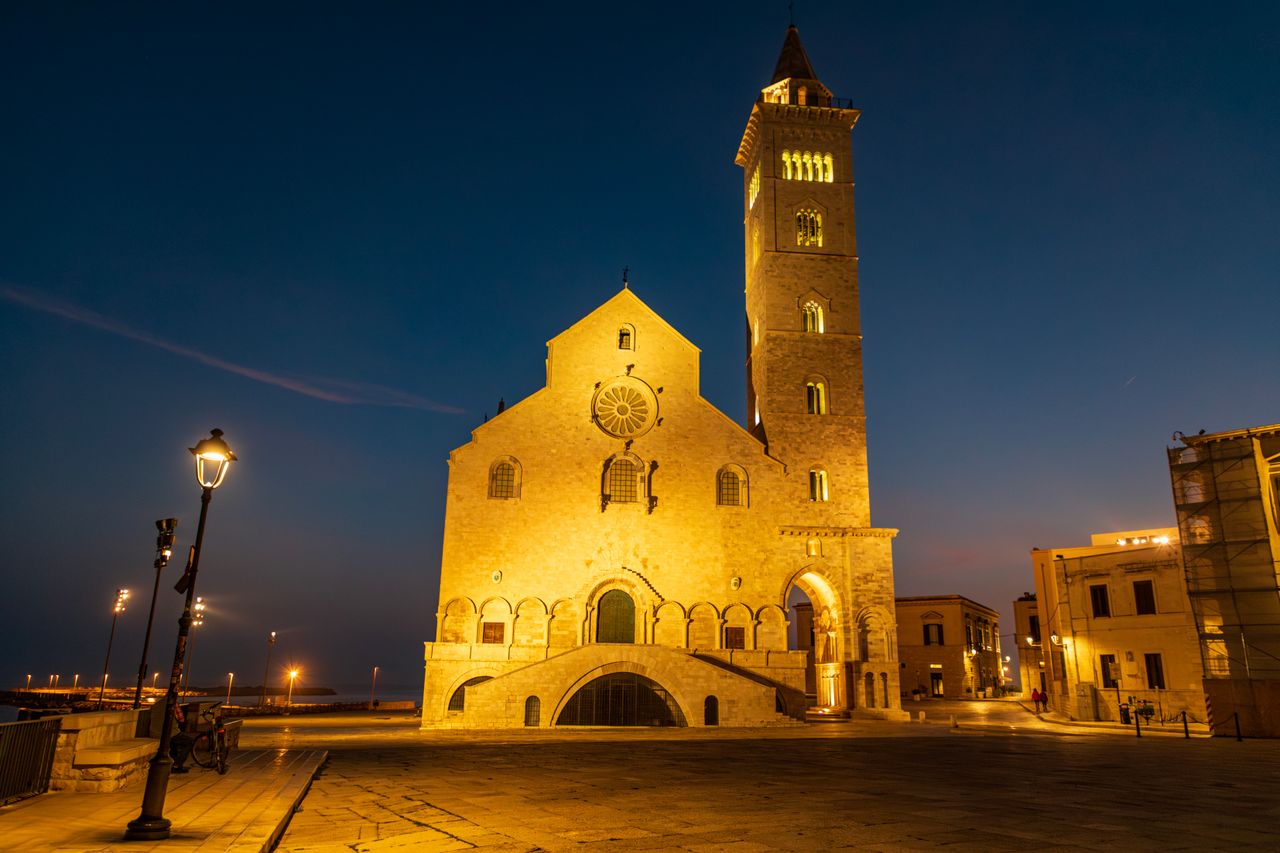
Trani earned its nickname — la Perla dell’Adriatico, the Pearl of the Adriatic — from the cathedral. Begun in 1099, the Cathedral of San Nicola Pellegrino stands on a platform of white limestone that extends directly into the sea, so that from the water the building appears to grow out of the Adriatic itself. The tall Romanesque campanile, the carved portal, the pale stone glowing against blue water: it is one of the genuinely arresting architectural compositions in southern Italy, and one that photographs cannot fully prepare you for in person. Trani is a small port city, 43 kilometres north of Bari on the Adriatic coast of Puglia, and it holds several other serious claims on a visitor’s attention beyond its cathedral. A medieval Jewish community left behind Italy’s oldest surviving synagogue building. The hinterland contains Castel del Monte, Emperor Frederick II’s geometrically perfect octagonal castle, a UNESCO World Heritage Site that raises more questions about its purpose than it answers. Local Puglia wine producers work with Nero di Troia and Primitivo grapes in the vineyards between the coast and the Murge plateau.
We have put together this guide to the best tours in Trani and the surrounding area, with enough detail on each to help you decide what fits your time and interests. The tours below range from a 2-hour cathedral walk to a full-day Puglia wine and castle combination — all making use of Trani’s position as a compact, well-connected base on the northern Puglia coast.
Quick Comparison: Top Trani Tours at a Glance
| Tour | Duration | From | Best For |
|---|---|---|---|
| Cathedral and Old Town Walking Tour | 2 hours | approx €15 | First-timers, architecture |
| Jewish Quarter and Scolanova Synagogue Tour | 2.5 hours | approx €18 | Medieval history, heritage |
| Castel del Monte Day Trip from Trani | 5–6 hours | approx €35 | UNESCO history, architecture |
| Puglia Wine Tasting Tour | 4 hours | approx €45 | Wine, local producers |
| Castel del Monte and Puglia Wine Combination | 8 hours | approx €75 | Full day, wine and castle |
| Trani and Barletta Coast Walking Tour | 3.5 hours | approx €22 | Coastal history |
| Private Romanesque Architecture Tour | 3 hours | approx €90 | Architectural depth, groups |
| Matera and Sassi Day Trip from Trani | 10 hours | approx €55 | UNESCO rock-cut city |
For First-Timers
Cathedral and Old Town Walking Tour
Duration: 2 hours | From: approx €15 per person
Every visit to Trani begins at the cathedral, and this walking tour gives it the time it deserves. The Cathedral of San Nicola Pellegrino was begun in 1099, shortly after the Norman conquest of Puglia, and completed over the following two centuries in successive phases that added the bell tower, the central portal sculptures, and the deep crypt beneath the main floor. What makes it unusual is the site: the entire structure sits on a raised limestone terrace that projects into the Adriatic, so the sea is visible on three sides from the cathedral platform. At dusk, the building turns gold, then amber, then a cool grey as the light drops — local photographers know that no other spot on the Puglia coast offers the same combination of Romanesque architecture and water.
The guide takes you inside to the three-layered crypt, which contains the remains of an early Christian church from the 5th or 6th century, a second Romanesque-era church from the 11th century, and the lower church dedicated to San Nicola Pellegrino himself — a Greek pilgrim who arrived in Trani around 1094, was initially dismissed as a madman, and died here at a young age before being canonised. The upper church is the full cathedral space, with its nave of marble columns and the carved ambones. From the cathedral, the walk continues along the port to the castello (a 12th-century Norman fortification now used for exhibitions), and into the tight medieval lanes of the old town.
Trani and Barletta Coast Walking Tour
Duration: 3.5 hours | From: approx €22 per person
This tour pairs Trani’s cathedral waterfront with a guided visit to Barletta, 15 kilometres north along the Adriatic coast. Barletta holds two unusual historical facts: it is home to the Colosso di Barletta, a bronze statue approximately 5 metres tall of a late-Roman emperor (identity debated, possibly Valentinian I or Theodosius II) that is one of the largest surviving ancient bronzes in existence, salvaged from a shipwreck in the medieval period and standing in front of the Basilica del Santo Sepolcro since at least the 13th century. Barletta is also the site of the Disfida di Barletta — the Challenge of Barletta — a celebrated duel from 1503 in which thirteen Italian knights fought thirteen French knights following a dispute over Italian courage; the Italian side won. The Cantina della Sfida museum in the city centre commemorates it.
The guide connects the two towns by explaining how this stretch of the northern Puglia coast functioned as a crusader staging post — both Barletta and Trani were major embarkation points for the Crusades, and both cities built or expanded their cathedral complexes using wealth generated by that traffic. Transport between Trani and Barletta is included in most tour prices; confirm at booking.
For History and Culture Lovers
Jewish Quarter and Scolanova Synagogue Tour
Duration: 2.5 hours | From: approx €18 per person
Trani had one of the most significant medieval Jewish communities in Italy. Between the 10th and 15th centuries, the Jewish quarter — the Giudecca — was a prosperous neighbourhood in the heart of the city, and its community produced important religious scholars. Four synagogues were built; two survive in transformed form. The Scolanova Synagogue, built in 1250, is the oldest surviving synagogue building in Italy still structurally intact. It was converted to a church (Sant’Anna) during the forced conversions of 1380 under Charles III of Naples, returned briefly to Jewish use in the early 16th century, then converted permanently to a church. In 2013 the Italian Jewish community undertook a restoration that returned the interior as closely as possible to its original form — the Hebrew inscriptions, the women’s gallery, and the Torah ark niche are visible again.
The tour also visits the church of Sant’Anna (a second former synagogue, its Romanesque exterior largely unchanged), and walks the narrow lanes of the Giudecca, where the guide explains the legal and social framework governing Jewish life in Norman and Angevin Puglia — a complex history of periodic royal protection, economic integration, and recurring pressures toward conversion. Entry to the Scolanova Synagogue costs approximately €3 as of 2026.
Castel del Monte Day Trip from Trani
Duration: 5–6 hours | From: approx €35 per person
Castel del Monte stands 35 kilometres southwest of Trani on a bare hilltop in the Murge plateau, visible from a considerable distance in every direction. Emperor Frederick II of Hohenstaufen had it built between approximately 1240 and 1250, and it is unlike any other medieval building in Europe. The plan is a perfect octagon. Eight octagonal towers of identical size stand at each corner of the octagon. The courtyard inside is octagonal. The rooms on each of the two floors — eight of them, each trapezoidal — are arranged around the courtyard with a mathematical precision that seems deliberately calculated. Frederick II was one of the most intellectually remarkable rulers of the Middle Ages, fluent in six languages, interested in mathematics, falconry, astronomy, and the science of the Arab world; the castle has been read as an astronomical instrument, a hunting lodge, a symbol of imperial power, and a palace with no practical military function. None of these readings is fully satisfactory, which is part of what makes the building so difficult to forget.
UNESCO inscribed Castel del Monte in 1996. Day trips from Trani typically include transport by minibus, a guided visit with entry (approximately €7 as of 2026), and the return journey — some include a stop for wine tasting at a Murge producer on the return route. The castle is unheated and can be cold in winter; dress accordingly.
For Wine Lovers
Puglia Wine Tasting Tour
Duration: 4 hours | From: approx €45 per person
The vineyards around Trani and across the northern Murge plateau grow Nero di Troia, a thick-skinned red grape variety grown almost nowhere else in the world, and the primary grape of the DOC Castel del Monte Nero di Troia Riserva. It produces wines of considerable tannic grip and dark fruit — structured, sometimes austere when young, and capable of real complexity with age. This tour visits two or three producers within 30 to 40 kilometres of Trani, with a guide who explains the difference between the coastal and plateau mesoclimates and why the Nero di Troia grape struggled commercially for decades before a generation of younger producers began treating it seriously.
Most tours also include a tasting of local Primitivo — a grape genetically identical to Zinfandel, producing full-bodied, high-alcohol reds that are easier to sell internationally and have funded the renovation of many estates that now also make Nero di Troia. Food accompaniments at tastings typically include taralli (ring-shaped savoury biscuits), local cheeses, and cured meats. Transport from Trani is included in most tour prices; group sizes are usually limited to twelve.
Castel del Monte and Puglia Wine Combination
Duration: 8 hours | From: approx €75 per person
This full-day tour combines the castle visit with two winery stops in the Castel del Monte DOC zone, making use of the fact that the vineyards are concentrated in the same plateau area. You visit the castle in the morning when light enters the upper-floor rooms from the east, then move to a winery for a cellar tour and seated tasting with a local lunch. An afternoon stop at a second producer, typically smaller and more artisanal, rounds out the day before the return to Trani.
The guide on this tour often has a background in both architecture and wine, which allows a satisfying connection: Frederick II’s castle gave its name to one of Puglia’s most important wine DOCs, and the landscape you drink in — limestone plateau, sparse macchia, the distant glint of the Adriatic — is the landscape that produced both the building and the grapes. This is the tour we would recommend for visitors spending two or more nights in Trani who want a single full day out of the city.
For Day Trippers
Matera and Sassi Day Trip from Trani
Duration: 10 hours | From: approx €55 per person
Matera is 115 kilometres southwest of Trani, a journey of around 90 minutes by coach. The Sassi di Matera — the ancient cave-dwelling districts of Sasso Caveoso and Sasso Barisano — are carved into the walls of a deep ravine, inhabited continuously from the Palaeolithic period until the 1950s, when the government forcibly relocated the residents to new housing on hygiene grounds. Since the 1990s the Sassi have been restored and partially repopulated; UNESCO inscribed them in 1993. Matera was European Capital of Culture in 2019 and now functions as one of southern Italy’s most visited cities.
Day trips from Trani include return coach transport and a guided walk through the Sassi with a licensed Matera guide. Entry fees to the rock-cut churches (rupestrian churches) are typically extra — approximately €3 to €5 per church as of 2026 — and a full visit to the Sassi takes at least three to four hours. Wear comfortable shoes with grip; the stone paths are steep and uneven. The combination of Trani’s Norman coast and Matera’s prehistoric caves in a single day is a significant historical range, and the tour works best if you have already seen Trani’s main sites on a previous day.
Practical Information
Getting to Trani: Regular Trenitalia regional trains run between Bari Centrale and Trani in approximately 30 to 40 minutes. The station is a short walk from the port and cathedral. Foggia, to the north, is about 45 minutes away by train. Driving from Bari takes around 35 minutes via the SS16 coastal road.
Best time for tours: April, May, September, and October are the best months. July and August bring heat and summer visitors; the cathedral terrace can become very crowded midday in August. The Jewish quarter tours run year-round and are particularly atmospheric in winter when crowds are minimal.
What to wear: The cathedral crypt and the Scolanova Synagogue require covered shoulders and knees. Castel del Monte is exposed to wind at all seasons; bring a layer even in summer.
Combined ticket options: Castel del Monte and several other Apulian castles are covered by a combined PoloMuseale ticket — ask your guide or check at the castle entrance on arrival.