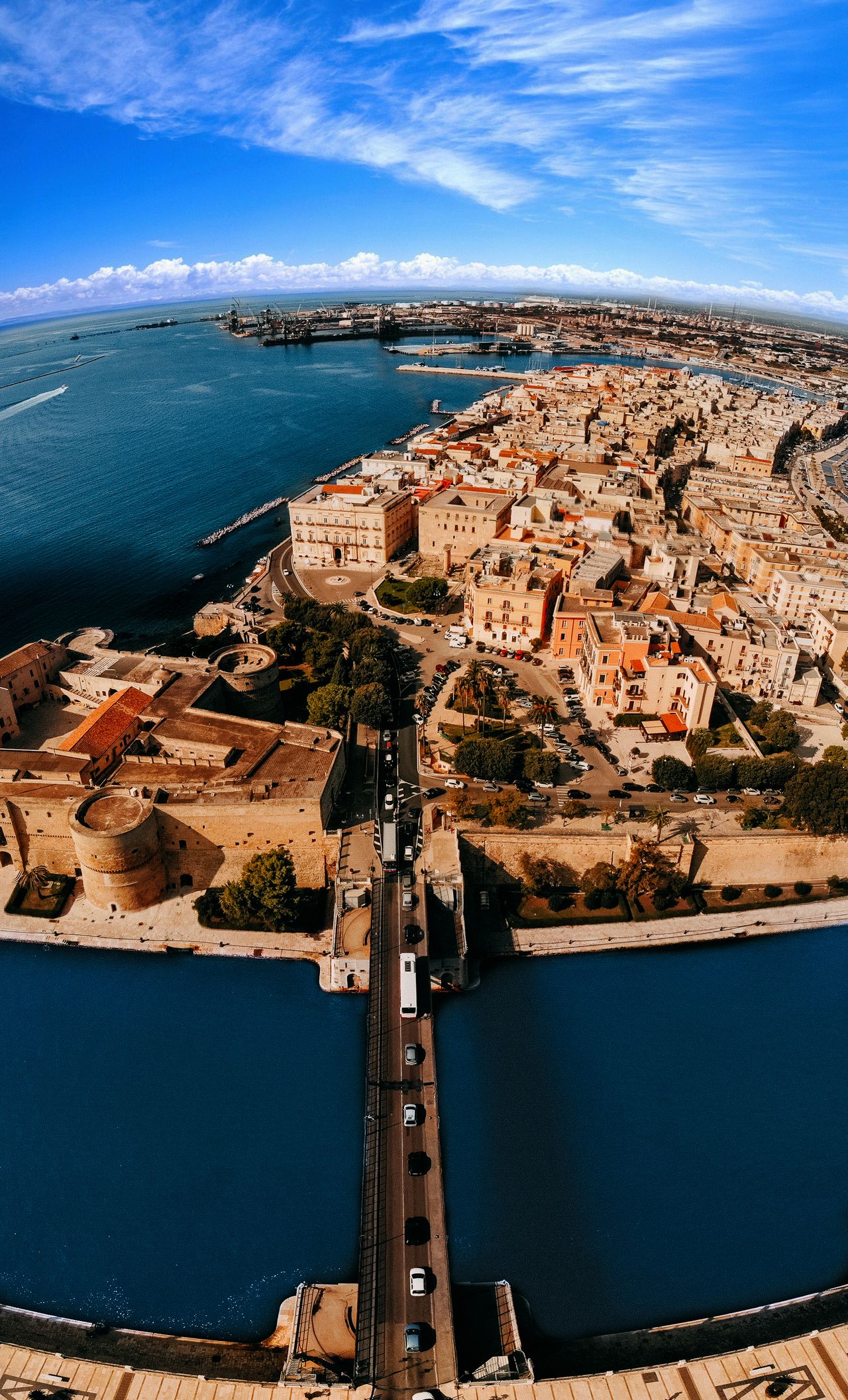
Taranto carries two identities that rarely appear in the same sentence. The first is ancient: Taras was founded by Spartan colonists in 706 BC, became the most powerful Greek city in southern Italy, and accumulated a treasury of Hellenistic gold jewellery and Magna Graecia artefacts now housed in one of the finest archaeological museums in the country. The second is modern: Taranto is home to the Ilva steelworks (now ArcelorMittal), one of the largest steel plants in Europe, which has dominated the city’s economy and its environmental politics for decades. The two identities coexist in a city that most visitors to Puglia skip entirely, which is their loss.
The MARTA (Museo Archeologico Nazionale di Taranto) is the reason to come. The Hellenistic gold jewellery collection on its own would justify the detour — intricate wreaths, earrings, necklaces, and diadems made by goldsmiths working in the 4th and 3rd centuries BC to standards that remained unsurpassed until the modern era. There are also terracotta figurines (Tarantine terracottas are among the finest in the Greek world), red-figure vases, bronze armour, and the foundations of the ancient city visible in the museum’s lower levels. A guided tour is strongly recommended because the collection is large and the English-language labelling is inconsistent.
The city’s geography is as unusual as its history. The old town (Città Vecchia) occupies an island between the Mar Grande (the outer Ionian Sea bay) and the Mar Piccolo (a sheltered inner lagoon). Two bridges connect the island to the modern city to the east: the historic Ponte Girevole (swing bridge, 1887) and a more recent fixed bridge. The swing bridge still opens periodically to allow naval and commercial vessels into the Mar Piccolo, and the moment when the bridge swings away from its moorings — holding back traffic on both sides while a warship or tanker passes through — is one of the more unexpected sights in southern Italy.
Holy Week in Taranto is a separate subject. The Processione dei Misteri on Good Friday runs from midnight Thursday to midday Friday — twelve continuous hours of procession through the old town, with the Addolorata confraternity moving in a slow, shuffling walk called the “nazzicata” (a controlled stumble-step), hooded and barefoot, since the 17th century. If your visit coincides with Holy Week, every other consideration becomes secondary to watching this.
Quick Comparison: Top Taranto Tours at a Glance
| Tour | Duration | Price (approx) | Best For |
|---|---|---|---|
| MARTA Museum Guided Tour | 2 hrs | from €15 | Archaeology, Hellenistic gold |
| Old Town Island Walking Tour | 2.5 hrs | from €18 | City history, architecture |
| Mar Piccolo Boat Tour | 2 hrs | from €25 | Lagoon ecology, city from water |
| Taranto Holy Week Experience | Variable | from €30 | Cultural immersion (Holy Week only) |
| Alberobello Trulli Day Trip | Full day | from €45 | UNESCO trulli, Itria Valley |
| Matera Day Trip from Taranto | Full day | from €50 | Sassi cave city, UNESCO |
| Lecce Baroque Day Trip | Full day | from €45 | Baroque architecture, Puglia |
| Combined MARTA and Old Town Tour | 4 hrs | from €28 | Full Taranto overview |
MARTA Museum Guided Tour
Duration: 2 hours | From: approximately €15 per person
The Museo Archeologico Nazionale di Taranto is arranged across multiple floors, with the collection sequenced chronologically from the earliest Bronze Age material through to late Roman finds. A guided tour focuses on the highlights: the Hellenistic gold jewellery on the upper floors, the red-figure ceramics, the terracotta figurines (the Tanagra-style figures made in Taranto between the 4th and 2nd centuries BC are among the finest in the Greek world), and the bronze armour.
The gold jewellery merits particular attention. Tarantine goldsmiths developed a filigree technique — twisting gold wire into intricate patterns and soldering it to a base — that appears in earrings, necklaces, and diadems of extraordinary delicacy. The pieces were grave goods, placed with wealthy burials in the necropoleis around the ancient city, and they represent the economic peak of Taras in the 4th century BC, when the city controlled a large territory and engaged in trade across the Mediterranean. The guide explains the iconographic programme of individual pieces: the Nike (Victory) figures on earrings, the Eros figures on diadems, the Gorgon heads on the finest necklaces.
Museum entry is approximately €8 as of 2026. The museum is closed on Mondays. Photography without flash is permitted in most galleries.
Old Town Island Walking Tour
Duration: 2.5 hours | From: approximately €18 per person
The Città Vecchia of Taranto is a peninsula-island roughly 700m by 350m, entered from the modern city via the Ponte Girevole or the fixed bridge on the opposite side. Its street plan is ancient and dense — narrow alleys called “vichetti” separate blocks of buildings that have been continuously inhabited, demolished, and rebuilt since the Greek period.
A walking tour covers the Aragonese Castle (1492, built by Ferdinand I of Aragon on the site of a Byzantine fortification), the Cathedral of San Cataldo (a composite of Norman, Baroque, and later modifications, housing the relics of the city’s patron saint), and the Piazza Fontana area where ancient Greek and Roman structures are visible in the street surfaces. The guide explains the two-bridge geography — the Ponte Girevole opens four to six times daily to allow vessels through to the Mar Piccolo, and timing a visit around one of these openings is worth planning. The swing bridge is an iron structure built in 1887 and still fully operational, and the mechanism of the swing, visible from the bridge itself, is impressive.
Book the old town walking tour
Mar Piccolo Boat Tour
Duration: 2 hours | From: approximately €25 per person
The Mar Piccolo is a sheltered inner lagoon, 26 square kilometres, separated from the outer Mar Grande by the old town island and a narrow isthmus. The lagoon is fed by underground freshwater springs (citri) that maintain a constant temperature and salinity gradient, creating conditions ideal for mussel and oyster farming. Taranto mussels (cozze tarantine) are farmed in the Mar Piccolo and are among the most prized in Italy — the restaurants in the old town serve them in every form.
A boat tour of the Mar Piccolo navigates the inner lagoon, passing the mussel farm structures (long ropes of submerged mussels hanging from wooden poles), the citri (fresh water springs visible as clear upwellings in the lagoon surface), and the naval base on the southern shore. Taranto has been an important Italian naval base since the late 19th century, and the Mar Piccolo — sheltered and with controlled access — serves as its main anchorage. The guide explains the lagoon’s ecology, the traditional mussel farming methods, and the history of the British Royal Navy’s torpedo attack on the Italian fleet in the Mar Piccolo in November 1940 (the Battle of Taranto), which destroyed three battleships and influenced Japanese planning for Pearl Harbor.
Book the Mar Piccolo boat tour
Alberobello Trulli Day Trip
Duration: Full day | From: approximately €45 per person
Alberobello is 70km northwest of Taranto in the Itria Valley, and it contains the highest concentration of trulli — the conical-roofed limestone dwellings unique to this part of Puglia — of any town in the region. The Rioni Monti and Aia Piccola districts are designated a UNESCO World Heritage Site (1996); together they contain approximately 1,500 trulli, many of them still inhabited.
A day trip from Taranto covers the drive through the Murge plateau landscape (a flat limestone plain dotted with trulli farmhouses and dry-stone walls), a guided walk through the Rioni Monti district with explanation of trulli construction (the walls and roof are built without mortar, using interlocking limestone slabs in a technique traceable to the 14th century), and free time to visit the interior of a trullo and the small museum. The guide usually explains the local legend that trulli were built without mortar so that they could be quickly demolished when tax collectors arrived — if there was no permanent structure, no tax was owed. The truth is more prosaic but the story has persisted for centuries.
Book the Alberobello day trip from Taranto
Matera Day Trip from Taranto
Duration: Full day | From: approximately €50 per person
Matera is 65km northwest of Taranto (approximately 1 hour by car), in the neighbouring region of Basilicata. The Sassi di Matera — two ravines of cave dwellings carved into the tufa rock, inhabited continuously for approximately 9,000 years — are among the most extraordinary urban environments in Europe. They were designated a UNESCO World Heritage Site in 1993 and served as European Capital of Culture in 2019. Mel Gibson filmed The Passion of the Christ here in 2004, using the ancient cave churches as first-century Jerusalem.
A guided day trip from Taranto includes the drive across the Murge plateau, a two-hour walking tour of the Sassi (the Sasso Caveoso and Sasso Barisano ravines) with explanation of the troglodytic settlement history, a visit to one of the cave churches (chiese rupestri) with their Byzantine frescoes, and time for lunch in the new town above the ravines. The guide explains the controversial history of the Sassi’s abandonment: approximately 15,000 people were forcibly relocated to new housing by the Italian government between 1952 and 1964, on the orders of Alcide De Gasperi who called the Sassi “a national disgrace.” Many of those families, or their descendants, have since returned to restore and inhabit the cave dwellings.
Book the Matera day trip from Taranto
Combined MARTA Museum and Old Town Tour
Duration: 4 hours | From: approximately €28 per person
A combined half-day tour covers the MARTA museum in the morning (before it becomes warm and crowded) followed by a guided walk of the old town island. The two elements complement each other: the museum provides the ancient Greek and Roman material culture that underlies the city’s history, and the old town walk provides the living urban landscape that has developed on top of it. The guide draws the thread between Taras, the Aragonese fortification, the 17th-century Baroque churches, and the present-day fishing and mussel-farming economy that continues in the Mar Piccolo.
This is the most efficient way to cover Taranto’s main attractions in a single morning. It leaves the afternoon free for a meal at one of the seafood restaurants in the old town (mussels, ricci di mare, raw oysters, and orecchiette alle cime di rapa are the local benchmarks) and an independent walk along the Lungomare Vittorio Emanuele III with views across to the Mar Grande.
Book the combined MARTA and old town tour
Practical Information
Getting to Taranto: Direct trains from Bari (approximately 1 hour 20 minutes, approximately €8 as of 2026) and from Lecce (approximately 1 hour 40 minutes). From Naples, change at Bari or Foggia; total approximately 4 hours. The train station (Taranto Centrale) is adjacent to the Mar Grande waterfront.
When to visit: April–June and September–October for comfortable temperatures and smaller crowds. Holy Week (the week before Easter) is the best time to experience the Processione dei Misteri, but accommodation books out months in advance. Avoid August if possible — the heat is extreme and much of the city slows.
MARTA museum: Open Tuesday to Sunday, 09:00–20:00. Closed Mondays. Entry approximately €8 as of 2026. The Hellenistic gold jewellery galleries require timed entry on busy days — arrive at opening or book in advance.
Taranto mussels: The Mar Piccolo mussel farms produce approximately 30,000 tonnes per year. Old town seafood restaurants along Via Cariati serve raw mussels (cozze crude) with lemon, grilled mussels (cozze gratinate), and mussels in tomato sauce (tiella di riso, patate e cozze — a layered rice, potato, and mussel bake considered the definitive local dish).