The Bronzi di Riace change visitors. Two full-size ancient Greek bronze warriors, cast in the 5th century BC and recovered from the seabed off the Calabrian coast in 1972, now stand in a climate-controlled room in the Museo Nazionale della Magna Grecia in Reggio Calabria. There is no other word for the encounter except confrontation — they are at full human scale, their eyes inlaid with bone and glass paste, their lips and nipples rendered in copper, every tendon and muscle resolved with an anatomical precision that took Greek sculptors generations to develop. Most ancient bronze statues were melted down for weapons; these two survived by sinking.
That survival is why Reggio Calabria receives visitors from across the world who might otherwise have no reason to stop in a city at the very tip of the Italian peninsula. The museum they anchor is one of the finest collections of Magna Graecia — Greek-colonial southern Italy — artefacts anywhere, but the Bronzi are the reason people make the journey. A guided tour of the museum adds context that transforms the experience: the guide explains the casting techniques, the probable identification of the figures (Achilles and Patroclus, or two Argive heroes, or Pheidias originals — scholars still disagree), and the extraordinary circumstance of their discovery by a diver on a shallow sandbank near Riace Marina.
Beyond the museum, Reggio Calabria sits at one of the most geographically dramatic points in Italy. On clear days the Lungomare Falcomatà — the palm-lined seafront promenade — frames Mount Etna rising from Sicily across the 3.2km of the Strait of Messina. The city has been destroyed by earthquakes and rebuilt multiple times; the current waterfront dates largely from the early 20th century reconstruction after the 1908 earthquake that killed over 80,000 people. Understanding that history — visible in the wide, regular streets and the Art Nouveau architecture — is part of what a good local guide brings to a city walk.
Plan your stay and find accommodation before booking.
Quick Comparison: Top Reggio Calabria Tours at a Glance
| Tour | Duration | Price (approx) | Best For |
|---|---|---|---|
| Bronzi di Riace Museum Guided Tour | 2 hrs | from €18 | First-time visitors |
| Reggio Calabria City Walking Tour | 3 hrs | from €22 | City history and architecture |
| Strait of Messina Boat Tour | 2.5 hrs | from €28 | Coastal scenery, views of Etna |
| Scilla Half-Day Trip | 4 hrs | from €35 | Fishing village, castle, sea views |
| Aspromonte National Park Hiking Tour | 6 hrs | from €45 | Mountain landscape, nature |
| Pentedattilo Ghost Village Day Trip | 5 hrs | from €40 | Abandoned village, photography |
| Reggio Calabria to Sicily Day Trip | Full day | from €65 | Sicily first-timers |
| Calabrian Food and Wine Tour | 3 hrs | from €50 | Local cuisine, bergamot |
Bronzi di Riace Museum Guided Tour
Duration: 2 hours | From: approximately €18 per person
The Museo Nazionale della Magna Grecia houses the Bronzi di Riace in a dedicated ground-floor gallery with controlled humidity and temperature. A guided visit begins with the wider collection — Magna Graecia ceramics, terracotta votives, jewellery, and coins from Greek colonies across Calabria, Basilicata, and Campania — before reaching the Bronzi themselves.
The guide explains the discovery in detail: a sub-aqua diving instructor spotted an arm emerging from the sand at 8 metres depth in August 1972, approximately 300 metres offshore. The two statues were extracted over two days, transported to Florence for restoration over several years, then returned to Reggio Calabria in 1981. The casting technique — lost-wax hollow bronze — is explained with reference to the X-rays and CT scans conducted during restoration, which revealed the internal iron armatures and confirmed that the two figures were made in different workshops despite their stylistic similarities.
Museum entry is approximately €8 as of 2026. The museum is closed on Mondays. Guided tours are conducted in Italian and English; French-language tours are available on request with advance booking.
Book the Bronzi di Riace museum tour
Reggio Calabria City Walking Tour
Duration: 3 hours | From: approximately €22 per person
Reggio Calabria’s street plan tells the story of successive earthquakes and reconstructions. The city sits on one of the most seismically active fault lines in Europe — major earthquakes struck in 1783 and again in 1908 (the latter measuring 7.1 and generating a tsunami visible as far as Malta). The current city centre, laid out in a regular grid after 1908, contains a concentration of early 20th-century Art Nouveau buildings that make it architecturally distinctive among southern Italian cities.
A city walking tour covers the Lungomare Falcomatà (named after a civic activist who opposed the construction of buildings blocking the seafront), the Piazza Italia and the Palazzo del Governo, the Cathedral (rebuilt after 1908 in a Romanesque-Byzantine style), and the older Aragonese walls near the castle. Good guides explain the city’s Greek origins — ancient Rhegion was founded in the 8th century BC and was sufficiently important to mint its own coinage — and the current challenges of urban renewal in one of Italy’s economically most disadvantaged regions.
Strait of Messina Boat Tour
Duration: 2.5 hours | From: approximately €28 per person
The Strait of Messina is one of the most geologically active and historically loaded stretches of water in the Mediterranean. A boat tour from the Reggio Calabria port side gives a direct view of the whirlpools and counter-currents caused by the meeting of Tyrrhenian and Ionian water masses — the physical basis for the Homeric legend of Scylla and Charybdis. The current is strong enough to affect small vessels, and guides explain the navigation hazards that made the Strait one of the most feared passages in ancient sailing.
On clear days the view extends from the Strait itself to Etna (3,357m) rising above the Sicilian coast to the north, and south towards the toe of the Italian peninsula. In late summer, swordfish are present in the Strait in significant numbers — the traditional Calabrian and Sicilian fishing technique using a long-prowed boat called a luntro to hunt swordfish from above is still practised here and sometimes visible from tour boats.
Book the Strait of Messina boat tour
Scilla Half-Day Trip
Duration: 4 hours | From: approximately €35 per person
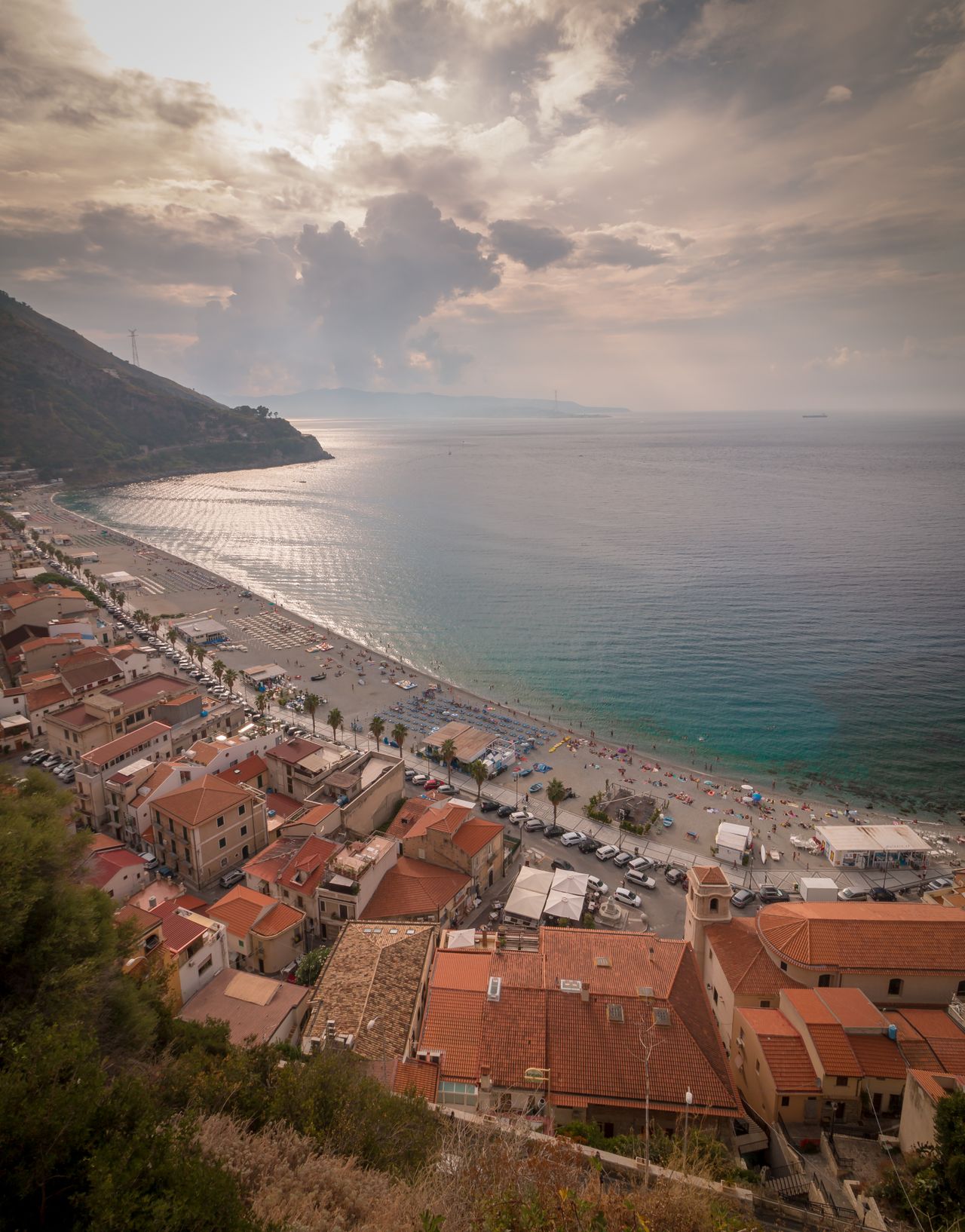
Scilla is 25km north of Reggio Calabria, built on a dramatic rock promontory that divides the beach in two. The castle occupies the tip of the rock; below it, the Chianalea district has houses built directly over the sea on wooden stilts or with their ground floors converted to boat garages flooded at high water. The combination of the castle silhouette against the Strait, the fishing boats pulled up on the beach, and the narrow lanes of Chianalea makes Scilla one of the most photographed and atmospheric fishing villages in southern Italy.
A guided half-day trip from Reggio covers the drive north along the coast (itself a scenic reward), a walk through Chianalea with explanation of the district’s history as a swordfish-fishing community, a climb to the castle viewpoint, and usually a return stop at one of the seafront restaurants for swordfish in some form. The castle (Castello Ruffo) is occasionally open for tours; a guide can confirm access in advance and often has relationships with the local staff that allow entry on days when it is technically closed to the public.
Aspromonte National Park Hiking Tour
Duration: 6 hours | From: approximately €45 per person
Aspromonte rises directly behind Reggio Calabria to a maximum elevation of 1,956m at Monte Botte Donato. The park covers approximately 64,000 hectares of beech and pine forest, river gorges, and rocky ridgelines. For visitors arriving from the coast, the transition from palm-tree seafront to beech forest in under an hour is disorienting in the best way.
Guided hiking tours from Reggio Calabria typically target the Gambarie area (road access to the summit ridge), the Pietra Cappa granite monolith (the largest monolith in Europe, at approximately 500m height), or the river gorges of the Amendolea valley. Autumn (September–October) is the best season for the forest colours; spring (April–May) for wildflowers including several endemic orchid species. The park also contains Byzantine-Greek Orthodox churches in hilltop villages that preserve the Grecanico dialect, a direct descendant of ancient Greek still spoken by small communities in the Bovesia area.
Book the Aspromonte hiking tour
Pentedattilo Ghost Village Day Trip
Duration: 5 hours | From: approximately €40 per person
Pentedattilo is 35km south of Reggio Calabria, perched on a five-fingered rock outcrop that gives the village its name (from the Greek for “five fingers”). The old village was largely abandoned in the mid-20th century following a series of landslides, and the remaining ruins — a castle, a church, and the skeletal stone houses clinging to the rock face — have since become one of the most dramatic abandoned-village photographs in Italy.
Guided tours combine the drive through the Reggio hinterland (past citrus and olive groves and bergamot plantations — Reggio Calabria produces approximately 90% of the world’s bergamot essential oil) with a walk through the ghost village and an explanation of the 1686 Alberti Massacre, a feudal vendetta that killed the entire Alberti family in their castle on the eve of a wedding and contributed to the village’s reputation for tragedy. Some tours include a bergamot farm visit on the return leg.
Book the Pentedattilo day trip
Practical Information
Getting to Reggio Calabria: Reggio Calabria Centrale is served by direct trains from Naples (approximately 3–4 hours) and Rome (approximately 5 hours). The Strait of Messina crossing to Sicily takes approximately 20 minutes by hydrofoil from the port adjacent to the central station.
When to visit: May to June and September to October are optimal — the heat is manageable, the Strait is calm enough for boat tours, and the museum has shorter queues. July and August bring extreme heat (35–40°C) and high humidity.
Museum hours: The Museo Nazionale della Magna Grecia is open Tuesday to Sunday, 9:00–20:00. Closed Mondays. Entry approximately €8 as of 2026. The Bronzi di Riace gallery may require a timed entry slot in summer; book in advance via the museum website.
Currency and practicalities: Most tour operators accept card payment; cash is advisable for smaller food and market experiences included in food tours.