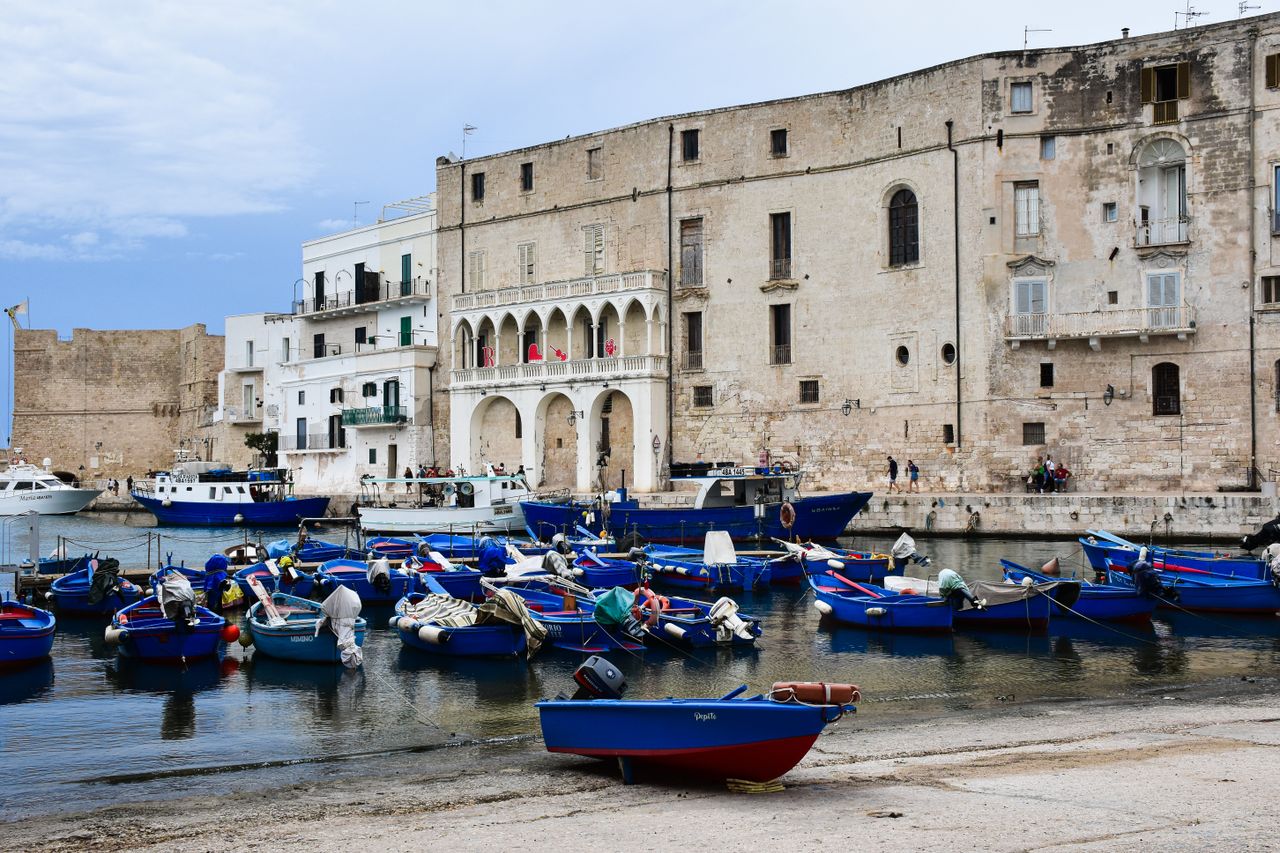
Monopoli sits on the Adriatic coast of Puglia, 45km southeast of Bari, at the point where the flat olive-grove country of the Murge plateau meets the sea. The town has grown considerably in recent years as a travel destination, largely because it combines what visitors come to Puglia for — a well-preserved historic core, a working fishing harbour, and easy access to both Adriatic beaches and the trulli country of the Itria Valley — without the congestion that now affects Polignano a Mare on the coast or Alberobello inland.
The old town is built on a promontory that extends slightly into the sea. The main approach from the harbour side runs below the walls of Castello Carlo V, a Spanish coastal fortress completed in 1552 under the reign of Charles V of Spain as part of a coordinated defensive network built along the Adriatic coast in response to Ottoman naval raids. The castle towers are visible from the water and from the main harbour. Below the castle, Cala Porta Vecchia — a small swimming cove accessible directly from the old town walls — is one of the most-photographed spots in the entire town.
The Cathedral of Maria Santissima della Madia has an origin story unusual even by Italian standards. The first church on the site dates from 1107, rebuilt in its current form in the 18th century. According to the local tradition, a Byzantine icon of the Madonna — the Madia — arrived on the sea one night in 1117, floating on a wooden raft, and was brought ashore by fishermen. The icon is still venerated in the cathedral, and the Festa della Madia each December (the 16th) sees a procession re-enacting the arrival by sea.
The coastline north and south of Monopoli is rocky limestone with a series of grotte (sea caves) and small coves accessible only by boat or kayak. The beaches within 15km — Torre Capitano, Cozze near Torre Egnazia, Cala Fontanina — add to the range of options. The surrounding countryside is olive grove territory: Puglia produces approximately 40 percent of Italy’s olive oil, and masserie (fortified farmhouses) offering cookery classes, farm visits, and estate meals are a significant part of what the region offers visitors willing to venture a few kilometres from the coast.
Quick Comparison: Top Monopoli Tours at a Glance
| Tour | Duration | From | Best For |
|---|---|---|---|
| Monopoli old town walking tour | 2 hours | €15 | First-time visitors |
| Sea cave and snorkelling boat tour | 3 hours | €25 | Adriatic coastline |
| Sunset cruise from Monopoli harbour | 2 hours | €20 | Evening on the water |
| Alberobello and trulli day trip | Full day | €65 | Iconic trulli architecture |
| Masseria cooking class | 4 hours | €80 | Puglian farm cuisine |
| Kayak tour of the coastline | 3 hours | €35 | Active exploration |
| Monopoli harbour food tasting tour | 2.5 hours | €45 | Seafood and local produce |
Monopoli Old Town Walking Tour
Duration: 2 hours | From: approximately €15 per person
The old town is compact — a 20-minute walk covers it end to end — but the guide’s value is in the details rather than navigation. A walking tour typically begins at the main harbour, crosses to the old harbour below the castle walls, and works through the streets of the historic centre to the cathedral, the castle exterior, and Cala Porta Vecchia. The guide explains the Spanish period fortifications (the castle was part of a much larger defensive programme involving similar structures at Otranto, Gallipoli, and a dozen smaller points along the coast), the arrival legend of the Madia icon, and the urban development that expanded the town beyond its original island core in the 19th and early 20th centuries.
The streets immediately around the cathedral are lined with small Baroque palazzi, and the alleyways between them have the characteristic whitewashed look of the Valle d’Itria villages brought to a coastal setting. Morning tours avoid the afternoon heat in summer and give better light for photography at Cala Porta Vecchia, where the sea colour is most vivid in the earlier part of the day. The walking route covers approximately 3km on mostly flat ground.
Book the Monopoli Walking Tour
Sea Cave and Snorkelling Boat Tour
Duration: 3 hours | From: approximately €25 per person
The Adriatic coast between Monopoli and Torre Egnazia, 15km north, and south towards Savelletri and Fasano carries a series of sea caves carved into the limestone at water level. Some open wide enough to motor through; others are best explored by snorkelling in the approach. The water clarity in this stretch is good — the Adriatic here is sheltered enough that summer conditions are generally calm by mid-morning, though afternoons can bring a breeze.
Boat tours depart from the main harbour or the old harbour below the castle and follow the coast, stopping at cave entrances and designated swimming spots. The skipper identifies which caves are passable on any given day based on sea state. Snorkelling equipment is included with most tours. The posidonia seagrass meadows visible underwater provide habitat for sea bream, sea urchins, and octopus. The guide or skipper can usually identify key species. Three hours allows for 2 to 3 cave stops and a sustained swimming interval at a sandy cove. This is the most popular boat tour format available from Monopoli and the one that books most quickly in July and August.
Alberobello and Trulli Day Trip
Duration: Full day | From: approximately €65 per person
Alberobello, 37km west of Monopoli, contains the largest concentration of trulli — the conical dry-stone huts that are the architectural signature of the Itria Valley — and has been a UNESCO World Heritage Site since 1996. The two main districts of Rione Monti (1,000+ trulli on a hillside) and Aia Piccola are the most visited, but a guide makes a real difference in explaining the building technique, the disputed theory about the removable roof caps and tax avoidance, and the organic way the settlement developed over several centuries.
Tours from Monopoli typically combine Alberobello with a stop in either Locorotondo or Martina Franca — both whitewashed hilltop towns with well-preserved historic centres and good restaurants. Some operators include lunch at a masseria in the Itria Valley, which adds an element of the agricultural landscape to the tour and gives an opportunity to try the local cuisine (orecchiette with cime di rapa, fave e cicoria, burrata made fresh that morning). Transport is by minivan. Group sizes are usually 6 to 12 people.
Masseria Cooking Class
Duration: 4 hours | From: approximately €80 per person
The masserie of the Monopoli hinterland — many of them within 10 to 15km of the coast — are Puglia’s most distinctive agritourism offer. These fortified farmhouses, built from the 16th century onwards as both agricultural production centres and defensive refuges against banditry, now host cooking classes, farm tours, and estate dinners in settings of considerable beauty: thick stone walls, ancient olive trees, and working gardens.
A typical cooking class begins with a tour of the estate and an explanation of olive cultivation and oil production. The cooking session that follows focuses on Puglian staples: making orecchiette pasta by hand (which requires practice — the technique of rolling a small piece of dough backward against the work surface to form the characteristic ear shape is harder than it looks), preparing burrata or fior di latte, and one or two seasonal vegetable dishes based on whatever the garden is producing. The meal is eaten at the masseria table. Some programmes include wine tasting from local Primitivo or Negroamaro producers. Transport from Monopoli is included in most packages.
Book the Masseria Cooking Class
Monopoli Harbour Food Tasting Tour
Duration: 2.5 hours | From: approximately €45 per person
Monopoli’s working fishing harbour is one of the most active in the central Adriatic coastline, and the food tasting tour is built around the produce it brings in: ricci di mare (sea urchins), eaten raw with a squeeze of lemon from a cut shell; raw mussels from local beds; grilled octopus at a harbour-side restaurant; and fritto misto. The tour typically begins at the fish market (best visited in the morning when the overnight catch is being sold) and moves through a sequence of tasting stops at the harbour-side bars, fishmongers, and small restaurants.
The guide explains the seasonal rhythms of the fishing calendar, the different species landed here, and the Puglian cooking traditions around seafood — many of which involve minimal intervention to preserve the freshness of the product. The tour includes all tastings at each stop. This is a good option for food-focused visitors arriving in Monopoli from elsewhere in Puglia who want a concentrated introduction to the local coastal diet rather than an overview of the historic centre.
Practical Information
Getting there: Monopoli is on the main Bari-Taranto railway line. From Bari, trains run frequently and take approximately 35 to 45 minutes. From Brindisi, approximately 1 hour. The station is about 10 minutes’ walk from the old town. By car from Bari, take the SS16 Adriatica south — approximately 40 minutes.
Getting around: The old town is compact and walkable in 20 to 30 minutes at a stroll. Beaches to the north and south require a car, taxi, or hire bike — there is no useful local bus network to the coastal sites outside the main season. Bike hire is available in the town centre.
When to go: June and September are the best months — warm enough to swim, considerably quieter than July and August. The Adriatic water temperature peaks in August at approximately 25 to 27°C. October is good for coastal walking and sightseeing but boat tour availability reduces.
Nearby: Polignano a Mare (20km north, 15 min by train) for the clifftop village. Alberobello (37km west, 45 min by car) for trulli. Torre Egnazia (15km north) for Roman ruins and a luxury masseria strip. Ostuni (45km south) for the white city on the hill.
See our Monopoli city guide and Monopoli hotels guide for more on planning your stay.