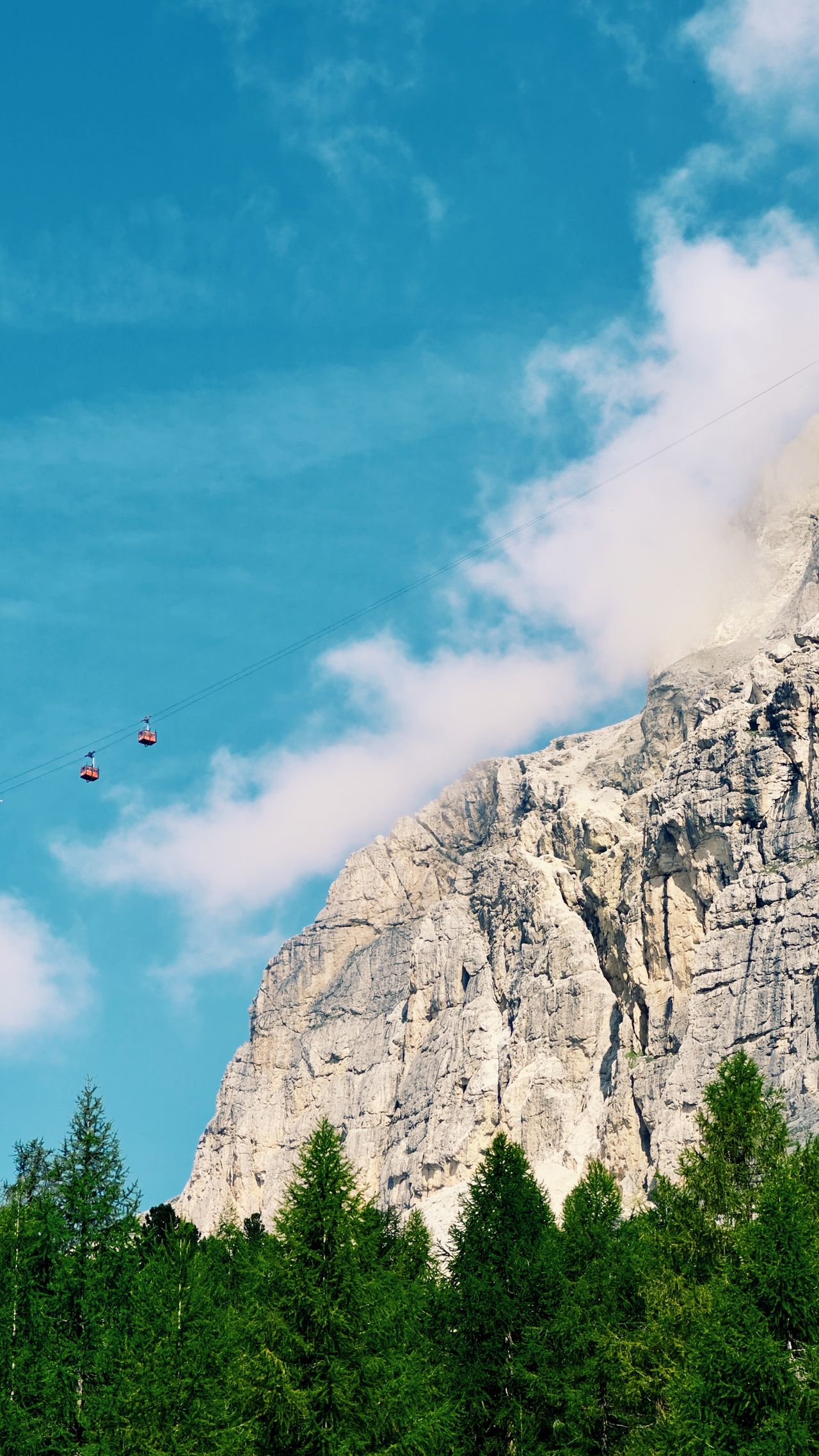
Cortina d’Ampezzo is Italy’s most famous Alpine resort, sitting at 1,224 metres in the Ampezzo basin — a broad, flat valley floor ringed by some of the most dramatic Dolomite formations in the Alps. The Tofane massif (3,244m) closes the western horizon; the Cristallo group (3,221m) rises to the northeast; the smaller but photogenic Cinque Torri (Five Towers) sit on a plateau to the south. The valley floor contains the resort itself: a town of around 5,500 permanent residents that swells to many times that number in peak winter and summer seasons.
Cortina’s fame rests on three periods. The 1956 Winter Olympics brought it to international attention and left the infrastructure — the Olimpia bobsled run, the ice stadium, the expanded road network — that defined the modern resort. The following two decades established its identity as the preferred Italian mountain destination for Milan and Venice society, with a glamour that distinguished it from the more functional ski resorts of the French and Swiss Alps. More recently, the 2026 Winter Olympics used Cortina for several alpine ski events, bringing renewed infrastructure investment and international attention.
The UNESCO Dolomites World Heritage designation (2009) covers nine mountain groups across northeastern Italy including the Ampezzo area. The Dolomites were formed from ancient coral reefs — the Ladinian and Carnian limestone that makes up the pale towers and walls was deposited on the floor of the Tethys Sea approximately 250 million years ago, pushed up during the Alpine orogeny, and then sculpted by glaciation and weathering into the characteristic vertical faces and isolated towers. This geological story is one of the most remarkable in European landscape history, and it underlies both the distinctive colour of the rock (the famous Enrosadira — the alpenglow that turns the Dolomite walls pink and orange at sunrise and sunset) and the extreme topography that makes the Dolomites what they are.
A second layer of history sits on the mountain landscape: the Dolomites were the front line between Italian and Austro-Hungarian forces from 1915 to 1918, and the tunnels, trenches, supply routes, and fortifications cut into the mountains at altitudes above 2,500 metres remain extraordinarily well preserved.
This guide covers the best-rated tours in Cortina d’Ampezzo, from introductory valley walks to full mountain expeditions.
Quick Comparison: Top Cortina Tours at a Glance
| Tour | Duration | From | Best For |
|---|---|---|---|
| Cortina: Town and Valley Orientation Walk | 2 hrs | €25 | First-timers, arrivals |
| Cortina: Tofana Cable Car and Summit Walk | 4 hrs | €55 | Cable car, panoramic views |
| Cortina: Cinque Torri WW1 Open-Air Museum Tour | 4 hrs | €45 | History lovers |
| Cortina: Tre Cime di Lavaredo Day Hike | 8 hrs | €65 | Serious hikers |
| Cortina: Via Ferrata Introduction Tour | 5 hrs | €85 | Adventure seekers |
| Cortina: Dolomites Photography Walk | 3 hrs | €40 | Photographers |
| Cortina: Faloria Cable Car and Alpine Flora Walk | 3.5 hrs | €35 | Casual hikers, families |
| Cortina: Guided Ski Tour (Winter) | 4 hrs | €90 | Skiers, winter visitors |
For First-Timers
Cortina: Town and Valley Orientation Walk
Duration: 2 hours | From: approximately €25 per person
An introduction to Cortina’s geography, history, and character, walking through the Corso Italia (the pedestrian main street, lined with boutiques and cafes, closed to traffic) and into the residential streets beyond. The guide covers the Ladins — the Rhaeto-Romance speaking indigenous population of the Ampezzo valley, whose language and culture predate the Venetian and Austrian periods — and explains the transition from an agricultural mountain economy to a tourism economy in the 20th century. The town’s architectural character — a mix of traditional Tyrolean wooden buildings, Liberty-period villas built for early 20th-century visitors, and post-war resort buildings — is placed in context.
From several points in the valley floor, all the major surrounding peaks are visible, and the guide identifies each formation and explains its geological character. This walk does not go into the mountains but provides the framework for understanding everything else in the area.
Book the Cortina Town and Valley Orientation Walk
Cortina: Dolomites Photography Walk
Duration: 3 hours | From: approximately €40 per person
A guided walk designed around the best photographic positions for the Dolomites formations around Cortina — the Tofane from the valley meadows at Pocol, the Cinque Torri from the approach path, the Cristallo reflected in the Lago di Pianozes. The guide is a local photographer who covers composition, the specific qualities of alpine light at different times of day, and the practical logistics of working in mountain conditions. The walk covers approximately 6km on good paths with limited elevation gain. Departure times vary by season to capture the best light — morning for the Tofane, late afternoon for the Cristallo.
This tour is aimed at photographers of any level — from smartphones to professional equipment — who want local knowledge about positions and timing rather than a standard walking narrative.
Book the Cortina Dolomites Photography Walk
For History Lovers
Cortina: Cinque Torri WW1 Open-Air Museum Tour
Duration: 4 hours | From: approximately €45 per person
The Cinque Torri — five isolated Dolomite towers on a plateau at about 2,100 metres, 10km south of Cortina — were a contested position on the WW1 Dolomite front. The Italian army occupied the towers and the plateau; the Austro-Hungarian front line was a few hundred metres away. The trenches, dugouts, machine gun posts, supply tunnels, and command positions cut into and around the towers between 1915 and 1918 have been preserved and restored as an open-air museum (Museo all’Aperto).
The guided tour accesses the site by chair lift (approximately €12 return, not included) and then spends 2.5 hours covering the military situation on the Dolomite front — how the armies adapted standard infantry tactics to a high-altitude mountain environment, how supplies were brought up to positions at 2,000–3,000 metres in winter conditions, and what the daily conditions were for soldiers stationed here year-round. The guide walks through the reconstructed Italian positions, enters the tunnel sections, and explains the strategic significance of the plateau. Original artillery pieces, equipment, and signage are in place throughout.
This is one of the most accessible and well-preserved WW1 sites in the entire Dolomite front — comparable to the better-known sites on the Pasubio or Marmolada but with fewer visitors.
Book the Cortina Cinque Torri WW1 Open-Air Museum Tour
For Serious Hikers
Cortina: Tre Cime di Lavaredo Day Hike
Duration: 8 hours | From: approximately €65 per person
The Tre Cime di Lavaredo (Three Peaks of Lavaredo) — three distinctive cylindrical towers rising to 2,999m, 2,857m, and 2,361m — are the most photographed mountains in the Dolomites and among the most recognisable peaks in the Alps. They sit 30km east of Cortina, accessible by a toll road to the Rifugio Auronzo at 2,320m (toll approximately €30 per car) or by guided minibus from Cortina. The circuit around the three peaks is approximately 10km with 400 metres of elevation gain and takes 3–4 hours at a comfortable pace; views of the north faces (where the most dramatic climbing routes are) and the surrounding Sexten Dolomites make this one of the great mountain walks in Italy.
The guided day trip from Cortina takes a minibus to the Rifugio Auronzo, walks the circuit with a certified mountain guide who covers the geology and climbing history of the Tre Cime (the north face of the Cima Grande was first climbed in 1933 by Comici and the Dimai brothers in one of the landmark ascents of the golden age of Dolomite climbing), and returns in the afternoon. The hike requires good footwear and basic fitness; it involves no technical difficulty but does cross some exposed terrain at altitude.
Book the Cortina Tre Cime di Lavaredo Day Hike
Cortina: Via Ferrata Introduction Tour
Duration: 5 hours | From: approximately €85 per person
Via ferrata (iron road) routes — fixed iron ladders, pegs, and cables bolted into the rock face that allow non-climbers to ascend steep mountain terrain safely — are a Dolomites speciality invented during WW1 to move troops across cliff faces. Cortina has several via ferrata routes of varying difficulty. This guided introduction is designed for travellers with no previous climbing experience and uses a route rated D/MD (difficult/moderately difficult) that provides genuine exposure and challenge without requiring technical skill.
The guide, a certified mountain guide (Guida Alpina), provides full instruction on using the harness and lanyard system before departure and accompanies the group throughout. All technical equipment — harness, helmet, and via ferrata lanyard — is included in the price. The route ascends approximately 300 metres of fixed equipment over about 2 hours, with a walk-in and walk-out of approximately 45 minutes each. The minimum age is typically 14; a reasonable level of physical fitness and no fear of heights is required.
Book the Cortina Via Ferrata Introduction Tour
For Scenic Excursions
Cortina: Tofana Cable Car and Summit Walk
Duration: 4 hours | From: approximately €55 per person
The Tofana-Freccia nel Cielo (Arrow in the Sky) cable car system rises in three stages from Cortina to Ra Valles at 3,244m — the highest point accessible by cable car in the entire Dolomite system. The views from the upper station encompass a large portion of northeastern Italy: the Venetian Alps, the Carnic Alps on the Austrian border, the Belluno Dolomites, and on clear days the beginning of the Po plain. The guided excursion takes the cable car to the Ra Valles station, walks the path along the ridge, and descends to the Rifugio Pomedes before taking the cable car back down. Cable car tickets (approximately €28 return) are included.
The guide covers the geology of the Tofana formation — the massive is made of Dolomia Principale, the most common Dolomite rock type, laid down in the Triassic period — and the mountaineering history of the Tofane, which were first climbed in the 1860s and 1870s by Austrian and English climbers during the opening-up of the Dolomites to alpinism.
Book the Cortina Tofana Cable Car and Summit Walk
Practical Information
Getting to Cortina: The closest mainline railway station is Calalzo di Cadore, 35km south on the Venezia–Calalzo line. From Calalzo, ATVO coaches connect to Cortina in approximately 1 hour. By car from Venice: approximately 160km, 2.5 hours via the A27 and SS51. From Bolzano: approximately 90km east on the SS51, about 1.5 hours. Cortina itself has no railway.
When to visit: Two distinct seasons. Winter (December–March): skiing on the Dolomiti Superski circuit (1,200km of linked pistes), snowshoeing, and winter sports. Summer (late June–September): hiking, via ferrata, mountain biking, and the best conditions for the Tre Cime circuit and long-distance trails. Shoulder seasons (April–May, October–November) see many facilities closed. The access roads to high-altitude sites including the Tre Cime toll road close in October.
Terrain and altitude: Most tours involve significant elevation change and mountain conditions. Mountain weather can change rapidly even in summer. The town centre at 1,224m is comfortable for most people; sites above 2,500m can cause mild altitude effects in visitors coming from low elevations.
Driving access fees: The Tre Cime di Lavaredo toll road charges approximately €30 per car; guided tours include transport so the toll does not apply separately.